









Sophie Sanders thought she was just experimenting with the latest ‘looksmaxxing’ trend for fun, until a chatbot’s brutally specific suggestions about her face sent her spiralling into insecurity. She explores the dark side of the so-called ‘Stacey face’ phenomenon, and why true contentment can never be found through filters, fillers, or flawless skin.
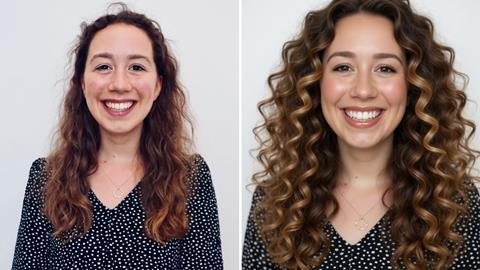
Every time I make an appointment at the hairdressers, they think I’m called Stacey. So much so, it’s become a family joke. As a result, when I was scrolling through the news, the rise of the ‘Stacey face’ grabbed my attention. For those who aren’t au fait with the latest looksmaxxing ‘an online trend focused on improving physical attractiveness through grooming, fitness, beauty treatments, or cosmetic procedures to appear more conventionally attractive’ trend, here’s a whistlestop tour to get you up to speed.
The ‘Stacey face’ is a highly curated look, increasingly seen to be the pinnacle of aesthetic perfection – think slightly parted lips, strong contouring, and supernaturally smooth skin. Its origin can be traced back to online manosphere communities – a deeply worrying fact; it distorts perceptions of beauty and leads to an exponential interest in cosmetic surgery. And it all starts with asking AI to enhance your own face to ‘be more Stacey’. Last week, I gave it a go…
READ MORE: What does the first AI actress mean for Godly creativity?
Within seconds, seven to be precise, I was transformed into an airbrushed version of my actual self feat. glowing skin, lifted eyelashes, high-shine lip gloss, luscious caramel highlights, and pristinely curled hair.
Within seconds, seven to be precise, I was transformed into an airbrushed version of my actual self feat. glowing skin, lifted eyelashes, high-shine lip gloss, luscious caramel highlights, and pristinely curled hair. And the best part, Grok AI said that I have a ‘warm, approachable, and attractive face with expressive eyes and a lovely smile’. Honestly, this was the best compliment I’ve ever received on my appearance – by a long way, and in over a decade of dating. No wonder my ventral medial prefrontal cortex kicked in and gave me a healthy hit of dopamine.
But just moments later, I realised this was a million miles away from being a genuine compliment. The chatbot recommended some tweaks to enhance my beauty, namely a modest 0.5–1.0ml of hyaluronic acid lip filler which it said would give me a perfect pout, a small rhinoplasty to narrow the bridge of my nose, and a light blepharoplasty to make my eyelids a bit heavy. Brutally, the last two played into existing insecurities I have about my facial composition; I’ve long envied girls with perfectly petite noses and eyes without heavy hoods.
READ MORE: Woman ‘marries’ AI persona created on ChatGPT: seeking Christlike love in a tech-driven world
And that’s where this trend gets oh-so-dark.
And that’s where this trend gets oh-so-dark. It’s worlds away from the tame FaceTime filters – think grumpy old man, zany dinosaur, and unicorn sparkles – that my sister and I mess around with on our weekly catch ups. You see, as I sat home alone that evening, these comments got under my skin and into my psyche. I lost an hour of my life scrolling through different blushers and resisting yet another square of dark chocolate – hours I’ll never get back. And at the end of it, I felt pretty rubbish about myself. The stats say I’m not alone. A recent study in the Netherlands showed that 94 percent of young women sometimes feel insecure about the way they look, and 49% say that social media contributes to their body insecurities.
And so, Grok AI is playing a dangerous game. The unfiltered, controversial comments generated by this chatbot have the potential to spark unhealthy spending on skincare, glamorise starvation, and encourage unnecessary cosmetic surgery. Put simply, these chatbots crush the confidence and collar the contentment of young women like my good self.
As a single woman, it would be easy to think these cosmetic tweaks would be the solution to finding a husband – to try every trick in the book to become ‘more Stacey’ and ‘less Becky’. But the truth is that a thinner nose and fuller lips wouldn’t make me feel more beautiful; instead, they would fuel a cycle of discontentment. The Lord stopped my spiralling, and deeply destructive, thoughts about body image in a surprising way – through the words of a seventeenth-century preacher. Way back in 1648, Jeremiah Burroughs wisely said that, ‘contentment is not by addition but by subtraction: seeking to add a thing will not bring contentment. Instead, subtracting from your desires until you are satisfied only with Christ brings contentment.’ He couldn’t have his finger more on the pulse.
A week on, and having reflected at length, my prayer is that the Lord would strip away everything that is distracting me from himself – bodily insecurities, a deep-set desire to be the star in my own romantic comedy, envy at the beauty of friends that far surpasses my own, falling for persuasive adverts for face creams, to name just a few examples. When all is said and done, I pray that I’d be satisfied in him and reflect his beauty to those around me. Lastly, if God has written a husband into a future chapter of my story, he would say that I am ‘altogether beautiful’ both outside and in. And fellow Stacey-face seekers, that’s my prayer for you, too.























1 Reader's comment