






Could archaeologists finally be uncovering evidence of Noah’s Ark in eastern Türkiye? Becky Hunter Kelm, who lives in Turkey with her family, explores the latest scientific investigations, what local Christians and Muslims believe, and why her faith doesn’t depend on what researchers discover.
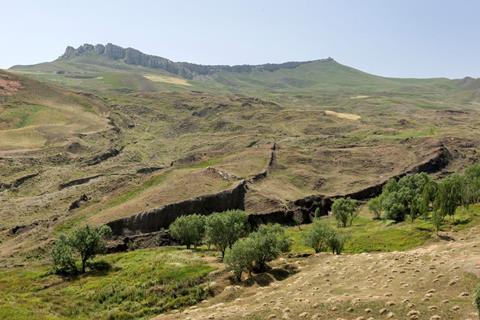
My boys and I have been really excited by the latest reports suggesting that the massive ship-shaped geological formation in eastern Türkiye, in Ağrı’s Doğubayazıt district, could really be the remains of Noah’s Ark.
An army captain and mapping engineer, İlhan Durupınar, first found the formation in 1959 while surveying the plains of East Anatolia for the Turkish Armed Forces. Over the years, this led several researchers, both from Türkiye and abroad, to study the area and see whether it could be physical evidence of the great creation narrative of the three Abrahamic faiths.
This year, for the first time, the Turkish government has granted permission to drill beneath the structure’s surface, a really exciting step towards collecting scientific evidence.
READ MORE: Christians in Armenia are still being kidnapped, here is why I think you need to know about it
Turkish archaeology professor Dr Cenker Atila, from Sivas Cumhuriyet University, began the latest research earlier this year with about 20 other scientists from around the world. With the giant ship-like structure stretching between two villages, Üzengili and Telçeker, researchers have been studying it carefully for almost 90 days.
Andrew Jones, an American researcher and a Christian, has reported that, along with core drilling for around 1,000 soil samples, radar scans have detected interesting anomalies beneath the earth.
Is the boat-shaped formation human-made or a natural occurrence?
Teams continue to work in labs to determine what these soil samples reveal, and the big question we’re all waiting with bated breath to have answered is: Is the boat-shaped formation human-made or a natural occurrence? We won’t know the laboratory results until April or May 2027.
READ MORE: 10 things Christians say all the time that aren’t actually in the Bible
‘Some people had suggested that this was a natural formation, a solid rock mass that had eroded over millions of years and taken the shape of a ship,’ Jones said. ‘But the biggest finding from our drilling was that the structure is entirely soil. There are some large rock blocks in the area, but the core drilling machine continuously brought up soil samples.’
‘This could be a natural formation, or it could be a man-made structure. What we are doing now is investigating it using scientific methods.’ Jones wants to make it very clear that it has not yet been proven that the Durupınar site (named after its discoverer) is the real Noah’s ark. These discoveries don’t bring us to a definite answer yet, and we should be wary of anyone on the internet claiming otherwise (including the Daily Mail, which published the incorrect and misleading headline: Noah’s Ark resting place ‘100% confirmed’ after 4,300 years as astonishing ‘man-made’ structure is detected buried deep underground.)
I loved listening to Andrew Jones’ interview on The Confessionals Podcast, in which he stated that the location of the formation and its size (515 feet in length) do line up with the biblical account of Noah’s ark, plus lots of other really fascinating details, like a nearby town whose ancient name means ‘the black bird won’t land’. Jones also expressed appreciation for his friend, Dr Cenker Atila, who got the government permits to do the drilling.
READ MORE: ‘I found a Bible beneath the rubble’: Finding hope after Venezuela’s devastating earthquake
‘In the past we had so many people claiming they can do something for us and scamming us out of tens of thousands of dollars, but this guy, without any of our money, went ahead in over a month period, got the permit. So it’s like, this is the right time. God has arranged the right person to be in charge.’
If the Durupınar site is proven to be Noah’s ark, it could be the missing piece for many people (Christian and otherwise) who have struggled to believe Scripture.
If the Durupınar site is proven to be Noah’s ark, it could be the missing piece for many people (Christian and otherwise) who have struggled to believe Scripture. But for Christians who do believe it is true, our faith doesn’t depend on the evidence coming back affirmative. If it does, however, it can be a wonderful affirmation of what we already know in our hearts. Although Türkiye has a predominantly Muslim population, it’s officially a secular state, so Turks’ opinions on the Noah’s ark excavation vary across a spectrum.
Most of my friends, secular or religious, believe the story because Noah is a prophet in Islam, and the Qur’an includes an account of Noah’s ark. In the Arabic Qur’an, however, the account says the ark landed on Mount Al-Judi, whereas the biblical account says the ark landed on the ‘mountains of Ararat’. What’s interesting, though, is that the name Al-Judi has been associated with a mountainous region.
So the Turkish Muslims I’ve chatted to have no problem accepting that this could mean the region of mountains where the excavation site is (Durupınar). My Christian Turkish friends are all sure it really is Noah’s ark. They have a joyful expectancy because, after all, Paul and the apostles John and Peter, Barnabas and Philip (and others!) walked the land of Türkiye, so why not the forefather of the faith, Noah, too?!
With all the excitement of Bear Grylls coming over, and knowing researchers are studying evidence in the labs every day, my family and I will be waiting with bated breath for news next spring. How amazing it will be if we really do live on the same soil Noah and his family walked on!


‘I was 33 and furious with God’: Kova International’s Emma Trueick on singleness, faith and finding her dream job with The Chosen

Generation Wed – are the new Gen Z influencers nailing it in terms of God’s design for women?

When does respect become complicity? What the Eiffel Tower’s ‘Invisible Women’ row can teach Christians



















No comments yet