







Jemimah Wright explores the extraordinary life of Barbara Cartland, whose new biography reveals a woman fascinated by God, romance and morality – but also by psychic phenomena and mystical ideas.
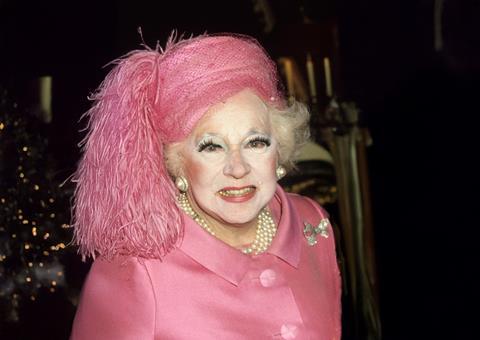
Novelist Barbara Cartland aged 87 in 1988 Contributor: ColourNews
I recently heard author Matthew Sweet being interviewed about his new biography of Barbara Cartland, The Great Dictator: A Life of Barbara Cartland, and I was fascinated by what I learned about the woman behind the pink chiffon and enormous eyelashes (for example, she used boot polish for them rather than mascara, apparently!).
Barbara Cartland was born in Edgbaston, Birmingham, in 1901. She lived through two world wars, the 1960s sexual revolution and the collapse of many of the social conventions of her youth. She died in 2000, aged 98, having spent almost the entire twentieth century in the public eye.
In her life she wrote 723 books, a fact I can’t quite get my head around, considering it took me 10 years to write my first novel. She sold hundreds of millions of copies around the world, and she did it without sitting at a typewriter. She would recline on her sofa, often with her Pekinese on her lap, and dictate her novels to a secretary (another interesting, if not wierd, fact - they were not allowed to give her eye contact while they listened to her!)
READ MORE: Romantasy is the new porn, but no one wants to admit it
Apparently, at one point she was producing around 7,000 words a day. She told Gloria Hunniford during a TV interview in 1984 that she wrote like a journalist – there were no superfluous words.
Barbara Cartland married Captain Alexander George McCorquodale in 1927, but their marriage ended in divorce in 1933. In a plot twist worthy of one of her own novels, she subsequently married his cousin, Hugh McCorquodale, in 1936. They had two sons, while her daughter from her first marriage, Raine, later became Countess Spencer – making Barbara the step-grandmother of Diana, Princess of Wales.
At a time when romance novels were becoming increasingly explicit, Cartland insisted that her own books should remain chaste.
At a time when romance novels were becoming increasingly explicit, Cartland insisted that her own books should remain chaste. Her heroines were usually virgins and sexual relationships were not treated as casual entertainment. She was deeply uncomfortable with the growing sexualisation of popular culture and believed that what people read could influence how they thought and behaved.
READ MORE: The faith, grit and generosity behind Dolly Parton’s rhinestone life
That conviction was demonstrated when Cartland appeared on Wogan in 1987 alongside fellow novelist Jackie Collins. Collins’s books were considerably more sexually explicit, and Cartland was not shy about expressing her disapproval. She regarded the sexual behaviour portrayed in such books as morally dangerous and was particularly concerned about its influence on readers. Barbara Cartland once explained that when she needed an idea for a novel, she would pray: “Please God, get me a plot.” Her faith seems to have been woven into her understanding of life and creativity rather than something she merely mentioned for effect.
Her moral convictions also make more sense in the context of the Christian values that shaped much of twentieth-century Britain. She believed that sex belonged within marriage, that love should involve commitment and that stories about relationships carried moral consequences. However, her spiritual world was not Christian. Sweet’s new biography reveals her involvement with psychic séances, while Cartland’s own writing shows a striking openness to mystical and supernatural ideas.
READ MORE: The Christian message of redemption runs through the books of late bestselling author Barbara Taylor Bradford
In one of her books, Look with Love, Cartland wrote approvingly about the supposedly extraordinary intuitive powers of people in India and Africa.
In one of her books, Look with Love, Cartland wrote approvingly about the supposedly extraordinary intuitive powers of people in India and Africa. She referred to the idea of the “Third Eye”, suggesting that modern Western society had lost something by relying exclusively on physical evidence and rational documentation. She also wrote about people who supposedly knew of distant events through instinct or psychic perception. In The Eyes of Love, for example, an Indian fakir’s curse is central to the plot; elsewhere mysterious Indian figures possess seemingly supernatural abilities.
Perhaps her greatest legacy is not the 723 novels or even the pink dresses. It is the question she leaves behind about what romance is actually for. In an age when romance increasingly means explicitness, perhaps Barbara Cartland leaves us with an unexpected question: what if romance doesn’t need more sex to be compelling – but more commitment and hope?





















No comments yet