


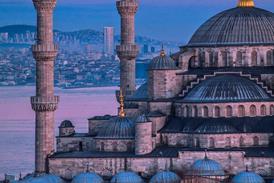


Former Woman Alive editor, Tola-Doll Fisher, was given the opportunity to visit Israel last year and she reflects on the experience in the Holy Land.

I’ve always wanted to visit Israel, that is, in an abstract, maybe someday, consideration. In childhood my family was temporarily part of a ‘Jews for Jesus’ congregation near home in north-west London and most of my fellow students at my secondary school were of Jewish descent. Added to that, my mother’s tribe in Nigeria (Igbo) follow similar traditions to Orthodox Jews and my favourite author growing up was a Jewish woman writing about Jews from Eastern Europe moving to England around the early 20th century. All that to say, there was a lot of anticipation when I was offered the chance to travel to Israel for Woman Alive and this was to be my very first pilgrimage as a Christian.
The question underlining this much contested land is, who belongs here? And who does this land belong to? People of Christian, Jewish, Islamic faith – along with the many denominational offshoots – claim the land as theirs and share stories tracing their roots back to this soil. It is sacred and divided, holy and militarised, worshipped and weaponised. Soldiers are present in the streets and stand outside holy sites because here, faith is inseparable from power.
READ MORE: The baptised Jew: A life of faith shaped by Israel, war and surrender
Since returning home, many people have asked me about the atmosphere in Israel. Was there a sense of fear? Or danger? The truth is, this is a place where people carry its history the way some of us carry grief – a sort of resigned and practised endurance. There’s a general sense of uncertainty as normalcy and a day-to-day living that to my eyes, as a UK-dweller, belies the ever-present rumble of political unrest.
Travelling with other media representatives and church leaders, on our first day, someone said: “It all started here.” It’s a cosy and comforting truth for many of us as Christians. Yes, Christianity started here because of Jesus. But Jesus was a Jew and yet we often behave as though we inherited the land without the people.
From the moment we stepped onto the plane heavy with Orthodox Jewish travellers I was conscious of Hebrew spoken not as a biblical echo, but as a living language. Jesus was a Jew who lived among Jews and spoke primarily to a Jewish audience. The disciples were Jewish. The scriptures Jesus quoted were from Jewish text. And yet, over centuries, we Christians have often behaved as though Christianity emerged independently, detached from the particularity of land and people, as though faith could float free from its roots without association or consequence.
READ MORE: The current conflict in Israel is every Christian’s business
How easily we forget that our faith is grafted into an older story! Paul’s metaphor in Romans 11, of branches grafted into an olive tree, stopped feeling poetic and started feeling corrective. A grafted branch does not replace the tree; it depends on it. It draws life from roots it did not plant. Perhaps part of our struggle as Christians in thinking about Israel is that we have not always embraced the posture of grafted branches. We have sometimes spoken as though the story was handed to us outright, rather than entrusted to us with reverence.
At the same time, it would be dishonest to pretend that Christians are simply observers here. In Nazareth, the city where Jesus grew up (with resident make up now thought to be 75% Muslim and 25% Christian), believers describe themselves as “living stones”. Many of them are Arabic-speaking, although they prefer to identify as Israeli Christians rather than Arab Christians; a reminder of how layered and sensitive identity can be in this region. Hearing of their stories of navigating social pressure, political complexity and, at times, discrimination, I was struck by how easy it is for Christians outside Israel to romanticise the land while overlooking the people who are quietly practising their faith within it. The holy sites draw crowds; the living Church often remains unseen.
I also became aware of the temptation for Christians to over-spiritualise Israel or over-politicise it, sometimes in the same breath. In certain circles, Israel is spoken of almost exclusively in terms of prophecy and end-times timelines, as though its primary significance is symbolic. In others, it is reduced to a geopolitical issue to be debated and resolved from afar. Neither approach felt adequate once I was there.
It made me wonder what it would look like for Christians to approach Israel not as claimants or commentators, but as people willing to listen carefully, to honour Jewish history, to acknowledge Palestinian pain, and to resist the urge to simplify what is inherently complex.
One afternoon, near the West Bank, our bus was stopped by soldiers. There was tension in the air, but it dissipated quickly when one of our Israeli guides spoke and was recognised as someone who belonged. The exchange was brief, almost routine, yet it revealed something about shared identity and mutual trust that I could not easily dismiss. It made me wonder what it would look like for Christians to approach Israel not as claimants or commentators, but as people willing to listen carefully, to honour Jewish history, to acknowledge Palestinian pain, and to resist the urge to simplify what is inherently complex.
Christians are not at the centre of the story of Israel, and not on the sidelines either. We fit as those who remember that our faith is rooted in Jewish soil, who recognise that living Christian communities still carry the gospel here, and who are willing to inhabit the tension between reverence and realism. Perhaps our role is less about staking a claim and more about cultivating humility – learning to speak with care, to pray with understanding and to engage with this land in a way that reflects the heart of the One who first walked its dusty roads.
I didn’t expect the holy sites to feel so…human.

Before going to Israel, I imagined I would be overwhelmed by a sense of reverence at every turn, as though the ground itself would hum with certainty. Instead, what I experienced was something quieter and more layered. The holiness wasn’t loud. It didn’t perform. In fact, some of the places that moved me most were the ones that felt almost ordinary.
Take the Garden Tomb. It is not grand or ornate like the Church of the Holy Sepulchre, which is shared by six different Christian denominations and carries centuries of incense, tension and tradition in its walls. The Garden Tomb is simply a small garden with a rock-cut tomb. It’s the place that references the death of our Lord Jesus, but I remember standing there and feeling an unexpected lift in my spirit, a kind of gentle joy that felt somehow at odds with the silent reverence of a final resting place. Maybe because I knew it wasn’t a final resting place at all, I was over-awed with the significance of that, of Christ overcoming death, and found myself with the strong desire to sing!
READ MORE: God has a heart for the people of Israel and Palestine… so we should too
At the Church of the Holy Sepulchre by contrast, I was struck by the complexity of it all. Greek Orthodox, Armenian, Catholic, Syriac, Coptic and Ethiopian Christians all share the space, each with their own traditions and designated areas. The keys, we were told, are kept by two Muslim families to maintain neutrality. It is both beautiful and slightly bewildering, a physical picture of how fragmented and yet intertwined the global Church can be. I found myself less focused on proving which stone might be the exact spot of crucifixion and more aware of how deeply people long to anchor their faith in something tangible.
Magdala was confronting. Located on the shores of the Sea of Galilee, it is known as the crossroads of Jewish and Christian history and the hometown of Mary Magdalene. To stand in a first-century synagogue where Jesus may have taught, and to see the mikveh baths (immersion pools) with their uniformed seven steps down and seven steps up, was to sense how embodied worship was in that culture – with cleansing being both physical and spiritual. It made me wonder about our own practices, and how easily we can separate what the Bible holds together. Other than Communion, have we thrown out rituals – viewing them as only pertinent to those in the Old Testament? We might hold sacred practices more at certain times of the year, but many of us reject rituals in modern Christianity as somehow outside the framework of our faith. I am now trying to hold this in balance, because there is a reason and place for repetition, and sacred practices such as liturgies can actually help us to develop deeper faith lives.
The Mount of Olives, with its sweeping view of Jerusalem, gave me more than geographical perspective. From that height, you see how tightly everything sits together: sacred sites, residential buildings, checkpoints, markets. Holiness coexists with ordinary life and that excited me. Maybe you’re familiar with organisations like Street Pastors and Ski Angels? Both offer prayer to strangers and normalise speaking about faith in public spaces but, for the most part, public spirituality from Christians in the West mostly presents as church evangelism (to specific churches) and political protests. I personally feel panicked at the idea and resulting responsibility of evangelising to someone in the traditional sense – trying to lead them to Christ – but how about just a conversation about faith with a neighbour or barista?
We didn’t get to The Western Wall or Wailing Wall for this trip because we were short of time. But I heard from one of the church leaders who has been several times before, that it feels like a ‘thin place’ and the reverence she felt there previously had made her want to return with her specific prayers to talk to and hear from God; to press her written prayers into the cracks of ancient stone, as so many have done before.
Spiritual tourism can, potentially, sound offensive. It sounds like a single-minded determination to pull from a country in the name of something good (and God) and lofty, while leaving out the part that makes it holy in the first place. You can’t – and shouldn’t – do this with Israel. There is a lot to learn and unpack when you are literally standing in the places we have heard and read so much of in the Bible. Myself and my fellow tourists agreed that we will read the word differently upon returning.
Yet Christianity is not meant to be a museum faith and, as I write this, I’m conscious there are many Christians who will never get the opportunity to visit Israel; it doesn’t make one any less of a believer.
What stayed with me most were not the sites, but the conversations. The laughter on the bus, the shared prayers, the way someone would say something simple and it would remain lodged in my spirit for days. I’ve heard it said that a miracle is not an unusual thing happening, but an ordinary thing happening at exactly the right time. Most of these sites were ordinary, until Jesus came and made them hosts to miraculous events – and that is exactly what this journey felt like to me.






















No comments yet