




Born into an agnostic family, Mavis Crispin was determined to explore faith for herself – a journey that would eventually take her from North London to Peru, where she was ordained in her 50s. Now 80, the former teacher and Church of England priest reflects on a lifetime of following God, from being hit over the head with a Bible as a child to discovering that “the Lord never leaves a place without His light”.
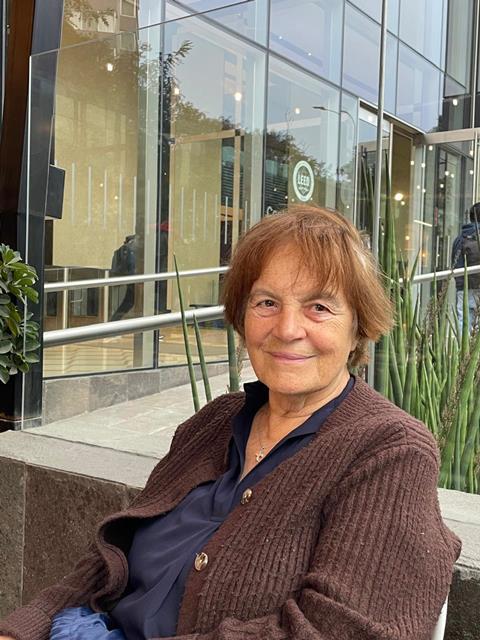
I was born in 1946, just after the Second World War. We’re known as “victory babies”. I grew up in North London, where I have lived most of my life. My childhood was reminiscent of the war. There were bomb shelters and bomb sites – in fact, places where we played. But it also generated a sense of camaraderie: we had overcome, and we would overcome.
Resources were scarce and school classes were huge, but we were all in it together. There was also a lot of freedom. You’d just go out and play and come back at mealtime. I was born into a sort of agnostic, atheistic family. I had good parents and a good home. They were determined to give their children more than they had, but also wanted to make life better for all families. When I started school, I was withdrawn from the Christian assemblies. They were all Christian in those days. The only other children who were withdrawn were Jewish children, so I used to sit in a room with them. It generated a kind of persecution, particularly from the staff: “You’re not Jewish. Why are you sitting there?”
It made me bold because I would say, “I haven’t made up my mind yet.” That was quite hard to say to teachers in the 1950s. My parents didn’t want me to engage in Christian worship because, “You’re not a Christian.” But they said, “In order to decide what you are, you need to have knowledge.”
So, bizarrely, they sent me to Sunday school. The reason was that I needed to learn about Christianity in order to choose. But they also said, “This country has been founded on Christian heritage, identity and principles. Therefore, you should know about it.” My first memory of Sunday school is of the teacher asking, “What did Jesus do? What was he? Was he a plumber? Was he a builder? Was he a carpenter?”
So I put my hand up – I was only about seven – and said, “I think he must have been a builder because he built all these churches. I can see lots of churches.” I got a bang on the head with a Bible. “Wrong.”
At secondary school, I consciously decided, “I’m not going to be a Christian just because I live in a Christian country. I’m going to find out about everything.”
It’s not wrong when you think about it. Jesus has built, and is still building, his Church, thank God. Another teacher later said to me as I was putting chairs away one day, “One day, you will teach these things.” It was sort of a prophecy, really, because I’m now an ordained minister in the Church of England. At secondary school, I consciously decided, “I’m not going to be a Christian just because I live in a Christian country. I’m going to find out about everything.”
We had more freedom in those days, so I went to Catholic churches, synagogues and mosques. There weren’t many mosques. I remember going into one when I was about 13. I’d bought a book called The Charm of Islam, and a man told me off because I hadn’t taken my shoes off. I said, “How would I know to do that?”
That was his only concern. I thought, supposing he’d said, “I see you’re interested in Islam. Let me help you.” It was a little bit of a turning point. When I was 14, an RE teacher suggested I go to Westminster Chapel in London, where Dr Martyn Lloyd-Jones preached. In one way, it was the worst possible service for a teenager: long sermons, old-fashioned language and hymns, with no concessions at all. But I heard, “If anyone is in Christ, they’re a new person. The old has gone; the new has come.”
And I thought, “That is for me. I know this is for me.” The youth group was also incredible. There were about 50 or 60 teenagers, with wonderful activities and Bible study. We went to Italy to look at paintings, Switzerland to see the mountains and Yugoslavia to see communism. I always wanted to be a teacher. In my heart, I knew it would fit me. But I was discouraged at school because, as a girl and a working-class girl, I shouldn’t have those aspirations. One careers adviser said, “Oh, my dear, have you thought about working in a shop? Or perhaps you could be a hairdresser?”
I said, “No, I’m going to be a teacher.”
I became a dental nurse for a while, then completed my O and A levels, mostly on my own. I ended up at Stranmillis College in Northern Ireland, doing a three-year course to become a primary school teacher. It was a very different culture, particularly because of the tensions between Catholic and Protestant communities. My first teaching practice was on the Shankill Road, and the Falls Road was fairly nearby. I had never encountered that sort of tension before. By then, I was also thinking about marriage. When I was 17, I prayed, “I would love to marry a scientist. I’m interested in science. I would love to have someone really left of centre, but a committed Christian. And by the way, Lord, I like Welsh accents.”
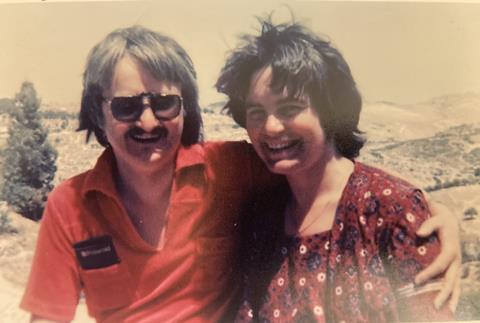
Not long afterwards, I went on a hike with friends and met a man doing a PhD in physics. Alan was a committed Christian, a scientist, spoke with a Welsh accent and had a Guardian newspaper under his arm. Our relationship began after a rather extraordinary mix-up. After a climbing weekend, I accidentally took home his maroon holdall, as I had the same one. When I unzipped it, it was his bag. So we had to be in contact. We married in 1969. I started teaching, and he continued with his physics, lecturing and research. We had three boys, two years apart: Darren, Gareth and Owen.
They all have Welsh names and, it turns out, they all mean exactly what they are. Darren means “strong rock”, and he is. Gareth means “gentle one”, and he is. Owen means “noble one” or “noble warrior”, and he is.
My husband was sick for about ten years. He had bladder cancer and underwent different kinds of treatment, but he always kept working. He was a deacon in a Baptist church and led a Bible study. As his illness became more serious, we recognised that he might not be healed. We knew many Christians who had died – holy people, serving the Lord. I wondered why.
The Church was short of men, and it was short of scientists and men who knew the Bible and could speak it in the workplace and academic environments. He was all of those things. I said to the Lord, “Why? It’s better if you take me!”
I remember thinking that the Church needed men like Alan. Eventually, we nursed him at home. Our sons were young adults by then and were incredibly supportive, as were our friends and family. My husband said things that nearly-widows don’t want to hear: “The Lord’s got a great work for you to do.” I didn’t want that. I said, “I want a great work for us to do.”
I was recovering in hospital when I had what I would describe as an angelic encounter.
He died when I was in my early 50s. I loved my job and had a very good community around me, lovely sons and a supportive wider family. I’d also had quite serious surgery myself. I was recovering in hospital when I had what I would describe as an angelic encounter. I woke up after an afternoon sleep with my mind full of Isaiah 40: “You will rise up on wings like eagles. You will run and not grow weary. You will walk and not faint.”
The other patients said, “Mavis, you’ve missed all the fun.” While I was asleep, they said, someone in a white robe had come in, put their hand on my shoulder and said something to me.
“We don’t know exactly, but it sounded good. It sounded nice.” The nurses called security, but by the time they arrived, the person had disappeared. I felt like getting up and going home. I felt that much better. Those words from Isaiah have stayed with me ever since. After my husband died, I stayed in my job for about three years. I was a deputy head by then, but I was also praying, “What next, Lord?”
That eventually led me to Pakistan, where I visited Afghan refugee camps. Among my luggage were Bibles, Land Rover parts for a medical mission, paperwork and clothes. Just as my suitcase was going through security, the man watching turned away to take a phone call. My luggage passed through customs without inspection. But later, on a bus travelling towards Peshawar, my suitcase caught fire. Smoke was pouring out of my bag. The other passengers – Muslim men with chickens under their arms – rushed to help. I sat on the case and said, “Stop!”
The fire went out. My clothes and suitcase were damaged, but the Bibles, paperwork and Land Rover parts were all intact. I returned home in a shalwar kameez, gave in my notice and, aged 54, began studying theology and counselling at London School of Theology. I later travelled to Ethiopia and eventually met the Bishop of Peru. He showed me a job on his computer that seemed to have my name all over it: diocesan education coordinator, with a brief to raise educational standards. So off I went to Peru with the South American Mission Society for two years. There, I experienced some very interesting words from God through natural metaphors.
One came through fireflies in the jungle. I was in a hut, and I’ve never been in such darkness. It’s the same with your eyes open as when they’re closed. It’s incredible. But through the mosquito nets, fireflies suddenly appeared. They were all in a group, whirling around the ceiling. What I noticed was that when one firefly’s light goes out, another one comes on. There is always light. I interpreted that as the Lord saying, “If you come and work here, Mavis, you’re going to be a very small light. There have been lights before you, and when your light goes off, there’ll be other lights after you.”
In other words, don’t be tempted to think, “I’m going to change all this. I’m going to sort all this out.”
I did change quite a lot, but the message was that the Lord never leaves a place without His light. The light is there before you. Even if you go into a place that seems pagan or atheistic, the Lord has some light there already. You might add to it. I was eventually ordained in a cathedral in Peru by the Bishop of Peru. I came home after two years because I hadn’t promised to stay forever. By then, my son Gareth had also had a call and had gone to seminary. He had a baby, and I thought it would be wonderful to support him and my daughter-in-law while she attended some of the courses.
I later became a priest in the Church of England. I’m very interested in children and teenagers and in passing the faith on to the third and fourth generation, as the Bible tells us. I’ve written books for my grandchildren, including books about my own life and my husband’s life, as well as an apologetics book for children, Better Than Gold: Living Wisely in the Age of the Anthropocene.
I’m still teaching courses on the environment and biblical studies worldwide, and I’ve developed workshops for children, which I trialled in Rwanda and Lima. They use a lot of activity, games, storytelling and local resources. The teachers and leaders watch and participate rather than simply talking at the children. In Rwanda, we saw an African fish eagle flying, so I thought, “We’ll do some art.”
We painted it as a whole class using different shades of coffee. They don’t have the resources, so you’ve got to use what’s there. I thought it needed some texture, and after a night of rain I found naturally discarded ant wings on the lintel of the door where I was staying. I gathered the wings, took them to school and we stuck them on the eagle.
I wrote the Isaiah verse on it and sent a photograph to Compassion International. They wanted to use it, so I asked them to acknowledge the children. For me, faith is about trusting God while also taking responsibility for what is in front of us. I would say: trust God and keep your powder dry. It’s a Cromwellian saying, and “powder” in that context was gunpowder. You can’t expect your guns to work if you’ve let the powder get wet. It’s the same in life. If your baby is crawling towards the fire, you don’t hold a prayer meeting. You lift the baby up. You put the fireguard up.
Trust God and keep your powder dry. There’s another saying from the South American theologian Rubem Alves that I love: “Hope is hearing the melody of the future. Faith is to dance to it.” “Dance” means live, doesn’t it? So what you know God is going to do in the future – what’s coming, what’s promised – live as if that is already a reality.


















No comments yet