







Hope Bonarcher dives into Sophie Barthes’ unsettling sci-fi satire The Pod Generation, a film that asks whether modern technology is liberating women — or quietly erasing what makes us human. With sharp cultural insight and theological reflection, Bonarcher explores why this futuristic comedy suddenly feels less like fiction and more like prophecy.
“No woman is completely free until she has control over her own reproductive system… For the first time in history, we aren’t victims of our biology.” Alice
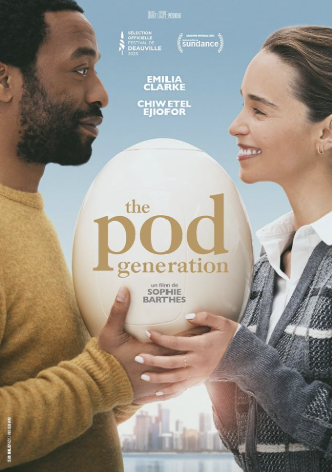
This is just one golden nugget from French director and screenwriter Sophie Barthes’ brilliant sci-fi satire, The Pod Generation. Starring the delightfully cast Emilia Clarke and Chiwetel Ejiofor, whose superpowers of relatability give viewers immediate access to the plight of main characters Rachel and Alvy, the film explores the question of carrying the baby they both desire, and could naturally conceive, in an artificial womb.
READ MORE: I had a baby at 49!
It seems like a no-brainer. Everyone at Rachel’s competitive tech workplace is doing it. Her boss encourages it as an incentive tied to a coveted promotion, securing Rachel a spot at the top of the impossible-to-enter waitlist for The Womb Center (just call 1-800-WOMB for an appointment), so she can maintain peak productivity at work. It’s the future, progress is assumed to be inherently good, and the option seems obvious. So why is her husband, naturalist botanist Alvy, so firmly against it?
What makes the movie work particularly well is the elastic countenance of Emilia Clarke’s Rachel (made all the more compelling by the actress’s public rejection of fillers and Botox, no judgment, but hallelujah). Rachel moves through the film as if in a dream, fittingly, since the movie itself is rife with dream sequences, carrying an unsettling “can’t quite put your finger on it” suspicion that something is amiss.
READ MORE: K-pop Demon Hunters and the power of redemption
Barthes developed the plot after experiencing strange dreams during her own pregnancy.
Barthes developed the plot after experiencing strange dreams during her own pregnancy. When the movie debuted a decade later, during the same week as the launch of ChatGPT, she realized she had birthed the film into a reality where, in the foreseeable future, its premise could actually happen. Barthes further explained the film’s wider questions: “What does it mean for a society that is pretending to be feminist and help women, while at the same time giving them the message that it’s not a good idea to have children if you want to remain a competitive worker?” She pointed to real-life examples from Silicon Valley, where female employees are tempted with $10,000 incentives to freeze their eggs.
READ MORE: DAVID: A movie 30 years in the making
The Pod Generation explores themes of evolution versus technology; a benevolent, all-knowing Creator is never mentioned.
The Pod Generation explores themes of evolution versus technology; a benevolent, all-knowing Creator is never mentioned. Creation, nature itself, becomes the ghoulish boogeyman this satirical society of technological exceptionalism robotically kicks against. There is no notion of nature, or of man for that matter, as creation; only humans contending with AI in an “Original Created Thing vs. Created Thing 2.0” death match.
Near the end of the movie, after revealing that the AI development company has created a nursery where children in art class don’t create art but instead critique the art their computers generate, the Womb Center director boasts, “Artificial Intelligence is much more creative than us!” There may come a time when this proves true, but scripture reminds us that we will never out-create the Creator:
You placed the world on its foundation so it would never be moved. You clothed the earth with floods of water, water that covered even the mountains. At your command, the water fled; at the sound of your thunder, it hurried away.
Mountains rose and valleys sank to the levels you decreed. Then you set a firm boundary for the seas, so they would never again cover the earth. You make springs pour water into the ravines, so streams gush down from the mountains.
They provide water for all the animals, and the wild donkeys quench their thirst. The birds nest beside the streams and sing among the branches of the trees. You send rain on the mountains from your heavenly home, and you fill the earth with the fruit of your labor. Psalm 104:5–13
In the film, Alvy poignantly notes, “We should be humbled that we don’t know that much and we can’t control that much.” This is the central dilemma of The Pod Generation, and what makes it worth watching: it poses questions worth answering. If it becomes possible to do otherwise, will women submit to the ultimate quandary still inherent in pregnancy, the innate lack of control it requires? Or will we continue the fool’s game of remaking ourselves in men’s image?























No comments yet