








Sophie Dianne reflects on the much-anticipated Netflix reboot of Little House on the Prairie and asks whether something important has been lost in the retelling. As a lifelong fan of the beloved series, she explores what happened to the Christian faith that once lay at the heart of the Ingalls family’s story.
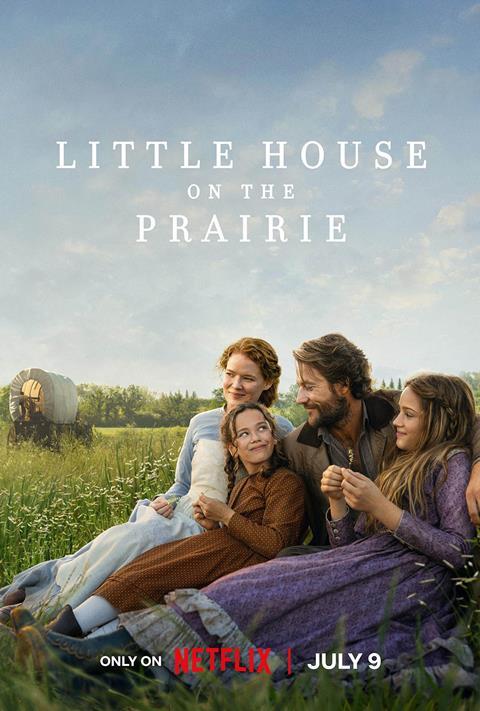
On 9 July, the Little House on the Prairie reboot was released on Netflix, and true to form, I binged all eight episodes. As a period drama, it is lovely, so I wasn’t surprised to see it had made number three in the streaming platform’s Top 10.
The original 1970s show displayed an idealistic but challenging life, and that translated into the latest adaptation. But it was interesting to see whether the 2026 series had lost its deep Christian roots.
For those of you unfamiliar with the classic, let me give you a summary: Little House on the Prairie follows the Ingalls family as they leave the snowy forests of Wisconsin in the late 1800s in an attempt to settle a new farm and build a community on the American frontier.
READ MORE: ‘What Little House on the Prairie taught me about a godly attitude to sex and marriage’
Before making it to the small screen, a series of nine books was published, written by Laura Ingalls Wilder, the show’s main protagonist.
Before making it to the small screen, a series of nine books was published, written by Laura Ingalls Wilder, the show’s main protagonist. Each story was based on her childhood experiences, but it wasn’t until 1932, at the age of 65, that her first novel was released, entitled Little House in the Big Woods. There was, however, some controversy due to her daughter, Rose Wilder Lane, who was a secret ghost writer.
Lane was a radical liberal who faced accusations from many who felt she had manipulated her mother’s memoir to promote her personal political agenda and suppress historical facts. Ingalls Wilder, on the other hand, viewed her Christian faith as the fundamental backdrop to her books. She didn’t, however, want it to be the central focus; instead, she carefully wove her Protestant worldview into the narrative. This belief system stood strong in the 1970s series but seems to have migrated out of the reboot.
In the Netflix adaptation, showrunner Rebecca Sonnenshine chose not to eliminate faith entirely, but intentionally shifted its role, preferring Christianity no longer to be the Ingalls family’s primary anchor or solution to crises.
READ MORE: Two women at the heart of Christian publishing
Michael Landon was a filmmaker famous for his role in Bonanza and for portraying Charles Ingalls in the 1974 adaptation. For millions, Landon became an icon of wholesome Christian entertainment. His interpretation of the patriarch in Little House on the Prairie was deeply influenced by his own spiritual beliefs. Scenes frequently depicted prayer time, Bible study and the whole family worshipping through hymns.
The Netflix writers wanted to steer closer to Laura Ingalls Wilder’s original manuscripts, as they felt she had purposefully avoided a preachy tone.
The Netflix writers wanted to steer closer to Laura Ingalls Wilder’s original manuscripts, as they felt she had purposefully avoided a preachy tone. Although I would argue that this decision was born from compromise rather than sensitivity.
READ MORE: What bestselling novel Yesteryear reveals about faith, fame and following Jesus
In an interview with The Christian Science Monitor, showrunner Sonnenshine justified her reasons for redirecting the story. She explained that she is a lifelong fan of the source material, viewing the books as foundational American literature driven by the human need for community and less about divine intervention. For Sonnenshine, the Netflix adaptation was also a chance to reclaim the true female perspective she believed had been lost in the 1974 show.
These decisions resulted in conformity. The unpacking of Bibles, the building of a church and the singing of hymns that made no mention of Jesus merely ticked the Christianity box, with little substantial effort. Meanwhile, the spiritual beliefs of the Osage people were explored, and respect was shown to those who were forced into the Osage Manual Labour Schools set up by Father John Schoenmakers.
There was no doubt that the Church was represented negatively in this adaptation. Avoiding a preachy tone does not justify the absence of God.
Grounding the show as a historical drama rather than an explicitly faith-based series framed the 2026 adaptation as a more universal story that was nuanced but flawed. Its themes were designed to resonate with a broad global audience regardless of faith. But to my mum, a child of the 1970s, Little House on the Prairie was a tangible introduction to Christianity. Her generation had the opportunity to explore faith in an accessible way. It’s a shame to see those roots trampled on and such an opportunity wasted the second time around.






















1 Reader's comment