








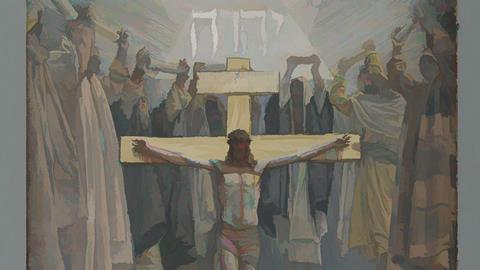

Elaine Storkey looks at what Jesus said to the wailing women in Luke 23, and what his words might mean for us today
Study passages: Luke 23:27-31
When a popular celebrity dies, it’s not at all unusual to find people who never knew them personally weeping publicly in the street. Someone who has made a great impact on others often draws mourners together in open demonstrations of grief. Luke gives us a picture of this towards the end of his Gospel. He describes a large crowd of women and men walking down the road and weeping over Jesus. Except Jesus was not yet dead. He was on his way to be executed.
Those who were weeping were women. Some commentators suggest they might have been ‘professional mourners’ – women who followed a funeral procession, wailing and lamenting the departed. Some of them probably were, but when Luke describes them as “grief-stricken women” (v27, NLT) it is more likely that the majority were crying genuine tears of sorrow. They knew Jesus was an innocent man, about to die, and many would be overwhelmed by the knowledge that there was nothing they could do to stop it. Whatever the level of anguish, their loud weeping drew the attention of Jesus. Despite his own pain and suffering, and the horrendous weight of the cross he carried with the help of Simon of Cyrene, he focused concern on the women. As he paused to speak to them, his words must have taken them by surprise: “Daughters of Jerusalem, do not weep for me; weep for yourselves and for your children. For the time will come when you will say, ‘Blessed are the childless women, the wombs that never bore and the breasts that never nursed!’” (vv28–29).
I wonder what they made of this. His statement was utterly counter-cultural. Whyever would anyone be grateful for barrenness in a woman? In so many biblical instances childlessness was treated as a shame and disgrace. The stories of Rachel and Leah (Genesis 29) and Hannah and Peninnah (1 Samuel 1) ran through Hebrew history. They illustrated the sheer pain of being childless, especially if a rival wife was fertile. Some of the women in the crowd may well have been unable to conceive themselves and were carrying the humiliation of that in their own culture.
Jesus saw beyond the moment
Jesus was showing his own deep compassion for the women who were weeping; he was moved by their tears. But he also knew what future they would be facing. And, in this, he was not only speaking to the women. In addressing them as “daughters of Jerusalem” he was repeating the language used in the Hebrew scriptures to refer to the entire nation. For example, when in happier times, God had forgiven Israel’s sins and turned away their enemies, the prophet Zephaniah proclaimed: “Shout aloud, O Israel! Be glad and rejoice with all your heart, Daughter Jerusalem!’ (Zephaniah 3:14). Jesus’ reference here, however, is closer to the deep cry in Lamentations when Israel faced the painful consequences of evil-doing: “Who has ever seen such sorrow? O daughter of Jerusalem, to what can I compare your anguish?” (Lamentations 2:13, NLT). Clearly, Jesus saw something that the weeping women did not see, and it was cataclysmic.
Jesus saw with prophetic clarity and insight what the weeping did not see
Jesus’ words made clear that those who will suffer most in this terrible future are those who love, for love brings greater vulnerability to us all. In this future crisis, there will be no joy in motherhood, only heartache. Mothers, who face the horrific ordeal of seeing their children starving, mutilated or killed, will envy the childless. The pain of helplessness against the atrocities that brutalise and devastate their children will be overwhelming. Some might even face horrendous choices for survival.
Jesus saw this future as worse than any fears people could imagine. For example, in those days the fear of being buried alive (taphephobia) was common, probably because there was no medical way of deciding definitively whether someone was dead or in a coma. But Jesus prophesied that people would be pleading to be buried alive. He quoted from Hosea: “Then they will say to the mountains, ‘Cover us!’ and to the hills, ‘Fall on us!’”(Hosea 10:8). Staying alive would be far worse than being entombed but breathing. His few words to the women ended with a final bleak warning: “If people do these things when the tree is green, what will happen when it is dry?” (Luke 23:31). This alarming question reminded them that the killing of Jesus was taking place in relatively peaceful times. Even then, manipulation and collusion between evil powerful forces could result in unjust execution. But what level of atrocity could be ushered in during times of widespread lawlessness and conflict?
The reality Jesus was prophesying
What truths lay behind Jesus’ remarks in this encounter with the daughters of Jerusalem? I think he was making them aware that he knew what he had to go through and had come to terms with it. Jesus was about to die for the sins of the world, as his act of loving self-sacrifice. But they did not know what the future held for them and they had not come to terms with it. So the world would continue in its sin, and judgment would come in the most destructive form, affecting every one of them.
The horrible picture of the future that Jesus prophesied was only three decades away. From AD 60 onwards, the persecution of Israel by the Roman Empire slowly becomes systematic. By AD 66 it had become widespread, as evidenced by the first Jewish-Roman war. The dreadful siege of Jerusalem in AD 70 resulted in the massacre of a large part of the Hebrew population. Survivors were displaced and enslaved. The Jewish historian Josephus, writing in AD 94/95, documented the horror of life for the Jews. He recounted the dead bodies clogging the streets, with so much blood flowing everywhere that it put out the fires in the burning houses. He also painted a horrifying picture of starvation and suffering, where “refuse which even animals would reject was collected and turned into food. In the end they were eating belts and shoes.” His account of Mary of Bethezuba is a terrifying sequel to what Jesus had prophesied to the weeping women. Driven by “fury and want”, she finally lost all sense of motherly love and responsibility. Seizing her infant child at her breast, she cried: “My poor baby, why should I keep you alive in this world of war and famine?” She then killed her son, roasted the body and ate half of it. (Flavius Josephus, The Jewish War, Book 6 – the only eyewitness account that exists of the end of the Second Temple period.)
Jesus saw with prophetic clarity and insight what the weeping did not see. His injunction to them to weep for themselves and their children was vindicated by the events that would follow. Judgment would come on Israel for the people’s rejection of his love; even Josephus saw the period of AD 64-70 as God’s judgment on the sins of Israel. The pain and ordeal would be overwhelming, and Jewish people would become a diaspora and scatter across the world for the next two millennia.
How can we understand this passage today?
Most biblical commentators see the significance of this passage to be a warning to us all: that God is both loving and just; that there will be judgment for sin at the end of time; and it could be a terrifying experience. This is a justifiable interpretation of Jesus’ words. But it is important to acknowledge, too, that Jesus’ prophetic warning was also historical and it was fulfilled in real human time.
We must not, however, take the wrong message away from this passage. The fact that Jesus prophesied that Jewish people would suffer does not mean that those who caused the suffering were justified in their actions. The sins of the Roman rulers were multiple and deep. Persecution is always wrong, and, whether this happened centuries ago or today, those who commit atrocities against others will be held accountable. We are to ensure that we ourselves live in a society which does not scapegoat minorities. We are to seek peace and reconciliation among its citizens.
We also need to see the evil and wrongdoing in high places alongside the love and compassion of Jesus, especially while enduring unbelievable pain. In his concern for the weeping women, Jesus shows us how much he understands the cost of love. In his warnings for the future, he urges us to be prepared to face hardship and persecution. And in his desire to let us glimpse the terrible consequences of sin, he reveals the very depths of love in the heart of God. Judgment on sin and evil is wrapped into events throughout history; judgment will also mark the end days of our world. Yet our God is the one who shows patience towards sinful human beings; he does not want anyone to perish, but for everyone to come to repentance (2 Peter 3:9). Let’s share that truth in this new year.



















No comments yet