







Elaine Storkey considers 1 Chronicles 7:21-24 to unpack who Sheerah was, and her significance for us today, urging us not to waste what we have been given
Occasionally I come across verses in the Bible that I find both intriguing and frustrating. Intriguing, because they mention people I’ve never heard of before, and frustrating, because I never hear of them again! Most of the time, it doesn’t really matter; after all, the Bible mentions thousands of people by name and we can’t expect to read the life history of them all. But sometimes we come across someone who must have been very significant, yet all we find is a one-line summary of what they did. When the name in question is of a woman, it is even more tantalising. It whets our appetite but leaves us hungry for more: we want to know what kind of person she was, and what motivated her to accomplish what she did.
A woman of skill and great accomplishment
One of these women is mentioned in 1 Chronicles 7:24. We have a brief backstory and family line – she was a descendant of Joseph – specifically, either the daughter or granddaughter of his son Ephraim. Ephraim and his brother Manasseh, sons of Joseph and his Egyptian wife, Asenath, had been born in Egypt (Genesis 46:20) but by the time this story opens, Ephraim’s family had been living in Canaan. They’d gone through a difficult period where their sons had been killed in a racial assault in Gath (famous for its association with David and Goliath – see 1 Samuel 17:4). These deaths presented a huge loss to the generational line of the family, so the couple went back to the task of procreation and a new son Beriah (aptly named ‘misfortune’) was born. The text then goes on to mention the birth of a girl, Sheerah, but leaves us to work out whether she was the daughter of Ephraim or Beriah.
The fact that the text names this girl child at all is surprising. Hebrew genealogies usually focus on the males, and eight men have already been identified as Ephraim’s descendants. If other daughters or granddaughters also existed, they are lost in the mist of time. But this one is preserved and immediately we find out why. It was because of the powerful physical mark she left on Jewish history: “His daughter was Sheerah, who built Lower and Upper Beth Horon as well as Uzzen Sheerah” (v24).
Sheerah was a woman who built cities! In fact, she is the only woman described as a city builder in the Old Testament. A dozen questions come immediately to mind. How did she do this? Who gave her that role and who helped her? Where did she get her knowledge of construction? Was it hard for her to marshal an army of workers and give orders? Did anyone challenge her authority? What were her motivations? Was she married or single? Unfortunately, neither in the Bible nor in Jewish Midrash or Talmud is any light thrown on these questions.
She is the only woman described as a city builder in the Old Testament
We do know, however, that, even then, to build a city required a vision, a plan, teamwork and leadership. For a woman to undertake the creation of three of them was a very remarkable accomplishment in the patriarchal context in which she lived. These were undoubtedly male roles, and she must have held an unusually prominent position in the community and culture. Two researchers – Jewish professor Ehud Ben Zvi and Antje Labahn – point out that Sheerah’s actions can be seen as a “reflection of a divine blessing” since, in 1 Chronicles, building activities indicated divine blessing. And certainly, the cities Sheerah built were to play a key part in God’s provision of safety for future generations of Israel.
What were her cities like?
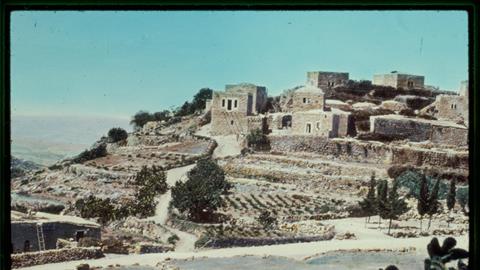
The cities Sheerah built were fortified, and in very strategic locations. Upper and Lower Beth Horon were twin cities roughly two miles apart and located about 15 kilometres northwest of where Jerusalem would be sited. They were built in strategic hillside locations near the border of Judah and the northern tribal districts. Alongside them was a major mountain pass. Their position alone gave them considerable prominence. Whoever controlled the routes around them, controlled Canaan.
We know little of the third town, which bore her own name, Uzzen Sheerah (‘a portion of Sheerah’), but the Beth Horon cities feature elsewhere in the Bible and throughout history. Many generations later, they were where Joshua chased and attacked his enemies: a formidable coalition of southern kings (Joshua 10:10). As armies fled down the road from Beth Horon, God came to Joshua’s rescue, and large hailstones rained down on the enemy, causing more deaths than in the battle (v11). Later, Beth Horon, along with pastures for livestock, was given to the landless Levi tribe, in the reallocation of tribal locations, so they could live in security (Joshua 21:21-22). Centuries later still, King Solomon fortified both the cities with walls, gates and bars because of their huge significance on vital caravan routes (2 Chronicles 8:5).
Outside the scriptures, the Beth Horon towns were the site for three battles between 167 and 160 BC during the Jewish Maccabean revolt against the Seleucid Empire. They were incorporated into the Ottoman Empire with the rest of the Middle East in 1517 until the First World War. By then they were small Arab towns, and suffered war damage, but their importance as key defensive points remained. Today, thousands of years after Sheerah built them, these ancient biblical Beth Horon sites still exist. They are now Beit Ur al-Tahta and Beit Ur al-Fauqa – Palestinian villages in the West Bank, near Ramallah (and, sadly, key disputed locations in the ongoing Israeli–Palestinian conflict). Who would have guessed that what was created by this little-known woman in the Hebrew scriptures would remain so strategic and significant right down through the millennia?
What can we learn from Sheerah’s story today?
We don’t know what barriers Sheerah faced, but we do know she must have had determination and persistence to achieve what she did. Although we know nothing about her strategies or personality, we can be encouraged that a woman in ancient history left such a legacy. And the fact she could do it in a male-dominant culture with restrictive roles for women should spur us on to greater confidence in our own calling. When God blesses us with gifts, he means us to use them.
We might not be called today to undertake tasks of Sheerah’s size, but Christian women exhibit enormous talents entrusted to them by God, in so many initiatives and organisations. People’s lives are changed and restored as their gifts are put to work in diverse ways – safeguarding, community care, food distribution, debt advice. Sheerah’s story is a challenge to all of us not to let our own vision and abilities be wasted or negated. It’s a prompt for us to pray that the Holy Spirit will open up more opportunities for our own gifts to be developed and used.
The story raises another issue for our lives: the importance of building. Every generation lays a foundation for the ones to follow, so what kind of foundations are we building on while we are here on earth? Do we build on faith and trust in God, so we encourage children to know God’s love for them, and adults to be slow to judge and quick to forgive? These qualities are crucial for every generation.
Are we building on the forgiving, redemptive love of God through Jesus and his offer of new life? Truth about Jesus has to be presented afresh to every generation and embodied in fellowships that exude warmth and welcome.
Are we building on God’s heart for children and vulnerable people, so our homes are places of peace and understanding, where children grow in safety and the lonely or bereaved can find hospitality and comfort? The dangers in our world of grooming, cyber-bullying and loneliness are acute and we need to come in prayer against them.
Are we building on God’s endowment of human dignity, so that we can create a culture of respect where those we disagree with are not disparaged or belittled but treated with civility? The level of abuse and name-calling on social media and elsewhere has now reached epidemic proportions.
Sheerah’s cities were built from the materials around her for the security and peace of Israel. But we are called to build both materially and spiritually for the benefit of the whole world. In the New Testament, Paul tells us that we build “on the foundation of the apostles and prophets with Christ Jesus himself as the chief cornerstone” (Ephesians 2:20). Future generations of Christians continue the work that earlier ones have started. We also build for eternity, for this world does not last for ever. We look to St John’s vision of the heavenly city where there will be no sorrow or anguish, crying or pain, and we will dwell in eternal love and joy with God (Revelation 21).



















No comments yet