








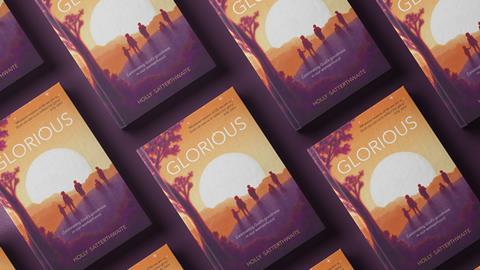

Based on an extract from her latest book, Glorious: Celebrating God’s goodness in our womanhood, Holly Satterthwaite has a message on God’s love, based on story of the bleeding woman
The narrative of the bleeding woman (Mark 5:21–42) doesn’t just speak about the glory of God’s power over sin; it also speaks of the compassion and gentle care of Jesus. The King of the universe also cares about human physical wellbeing in [her] temporary body on this temporary earth (2 Corinthians) – he heals her medical condition. He [then] raises Jairus’ daughter from death and instructs the parents to make her a meal (Mark 5:43). He cares about our physicality as only a God who has walked the earth alongside us can. Jesus was tempted and experienced physical weakness in his earthly body in the same way we do. He didn’t just sympathise with the bleeding woman; he knew what pain felt like, and what it was like to be socially excluded and despised. In time, his experience of pain would far eclipse this woman’s experience, as he was nailed to the cross.
For this reason – love – when the woman touched his robe, Jesus allowed the event to interrupt his journey to Jairus’ dying daughter. He didn’t react with distaste or annoyance. This woman was not an inconvenience to him; instead, he “immediately turned about” (Mark 5:30, ESV) responding with time and grace. The woman and her need were not distasteful to him. It’s likely, given the nature of the woman’s bleeding, that it would have been evident from her leak-stained clothing. We might have been embarrassed or disgusted by the whole affair, but Jesus cared about her physical and social suffering. He didn’t treat her differently from any other person, because her ceremonial uncleanliness was no more grotesque to him than the moral uncleanliness that every person in that crowd carried in their hearts. In his humanity, Jesus rubbed alongside the sludge of sin constantly; that is why he came to rescue us. We look at his gentle treatment of the woman and see real compassion that went beyond cultural stigmas. The compassion he shows when he reaches out to us is no less. Without him, our sinful hearts are just as ugly – we are just better at hiding them from the crowd around us.
Furthermore, Jesus doesn’t prioritise people and his time according to the worldly importance of the person in front of him. Reading 1 Corinthians 1:27 (ESV) – “But God chose what is foolish in the world to shame the wise; God chose what is weak in the world to shame the strong” – it seems very in line with God’s character that a woman of such little means and social standing would interrupt Jairus’ request, a more prominent and probably wealthier person (Mark 5:22). This woman, like many others in the Gospels, seemed to sense that Jesus was for people of every social class. Jesus didn’t play politics or people-pleasing games; he was led by love – limitless love that transcends time. A delay to Jairus and his daughter was not a concern.
We’re not required to strive to be unlimited but to trust in the one who already is
In our western culture of possibilities and self-belief, it can be helpful to remember that we are created beings and ‘human-sized’. By this, I mean that, unlike God, we are limited. Our bodies are fragile, and our emotional resources can run out; we are the created, not the Creator. We’re not required to strive to be unlimited but to trust in the one who already is. The bleeding woman knew this very well; it fuelled her desperate, risky decision to join the crowds that day and touch Jesus’ robe. Like the man let down on a mat through the broken roof (Luke 5:17–26), she knew if she could only get to Jesus, it would be OK. I want to live with that faith and longing, and I don’t want to have to wait until I’m seriously ill to find it. Some of you may be battling ill health now and are well aware of the limited nature of being human. We get a taste of it each month, when our emotions can change, and our bodies feel tired and sore. We experience it when the menopause arrives and reminds us that our days are numbered, and that endings and limits are an intrinsic part of this earthly life. God, however, is not limited, and his emotional resources never run out. His compassion is endless, and no suffering is beyond his power to alleviate. The bleeding woman found healing in Jesus, but she also found an experiential confirmation of her faith that this God–human was gloriously unlimited in power and compassion.
Jesus encourages us in our faith
The narrative of the bleeding woman encourages us that God will respond to our faith, even when it’s rather imperfect. The woman appears to have placed her faith for healing in an object (his garment) rather than in his person. It reminds me of visiting Venice on holiday and viewing the supposed thorns from Jesus’ crown on the cross, a frayed corner of his burial cloths and a vial of his mother’s milk – all superstitiously and reverently adored by the Catholic churches we visited.
Jesus doesn’t wait for her faith to be thoroughly theologically sound. Instead, he encourages and praises her for the faith she does have. This is remarkable because even this sapling faith is evidence of the compassion of God, because he is the source of it. And yet Jesus makes no mention of this when he addresses her. He doesn’t demand adoration for the miraculous power that he has displayed, which is the root cause of her healing. Instead, his good glory comes to her gently, in love, as he commends her for the faith that she couldn’t have had nor exercised without him. As we hold out our dented, oddly shaped mustard seeds of faith, he won’t toss them away but, instead, offers us the help we need for them to grow into the mighty oaks he longs for us to shelter under. Perhaps by stipulating that “your faith has made you well” (Mark 5:34, ESV, italics mine), Jesus was gently growing and shaping the woman’s faith to see that it was his personal response to her personal faith that cured her, rather than the clothes having any special powers.
She knew if she could only get to Jesus, it would be OK
This side of eternity, I’m not sure any of us can offer up perfect faith, whether we are beset with doubts, misread a sense of ease as an indication of God’s direction, or dilute our faith with a parallel reliance on self, money or comfort. When I came to faith as a young teenager, I went on long walks in the fields near my home to pray and study the Bible. There was a huge old tree in the middle of a sheep field that I used to look at and sometimes sit under. This tree became an image of the unchanging refuge that God was to me.
One day, after moving away for university, I discovered the tree had been cut down and, in all honesty, it threw me a little. For a moment, I stood in the field and thought: “How do I know you are with me now, God? It’s changed!” God may have used the tree as a channel to communicate some truths I was thirsty for, but he was never a tree. As it happens, maybe God was in the cutting down of the tree because the severing of my emotional connection to that image helped me find God’s unchanging character all around me, even when tossed to and fro by the wild waves of life. I learned that life didn’t need to be constant for God to stay present.
Jesus doesn’t wait for her faith to be thoroughly theologically sound
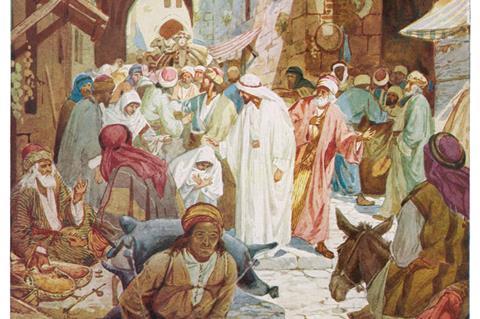
I wonder how often people spoke to the bleeding woman during her twelve years of exclusion from society. It would have been hard for her to have had much conversation with those ceremonially clean (remembering this was before the advent of phones and email!). Upon Jesus searching for the one who touched him (Mark 5:32), she “came in fear and trembling” (Mark 5:33), perhaps expecting… She “fell down before him” (Mark 5:33, ESV) in awe. How does Jesus respond? The first word said to her following twelve years of suffering and unbearable exclusion is one of intense joyful inclusion – Jesus called her “Daughter” (Mark 5:34).
Without Jesus, we are like the bleeding woman – continually unworthy to have fellowship with God, cut off from him by our own sin. But through Jesus we are called children of God. Welcomed, not just into a community but into the very heart of his family. Though we still stand before him, drenched in scarlet sins like menstrual rags, Jesus stands with us and offers us a covenantal cup of forgiveness – one overflowing with yet more blood. But this blood is his own, which doesn’t stain like ours but rather cleanses and washes us white as snow (Isaiah 1:18; Psalm 51:7). Like the father of the prodigal son, adorning his child with the best robe upon his repentant return (Luke 15:22), when we trust in the blood of Jesus, the cross and resurrection, our stained rags are transformed into “garments of salvation” and the “robe of righteousness” (Isaiah 61:10, ESV).
Jesus goes on from this event to raise Jairus’ daughter from the dead. He lovingly calls her ‘little girl’ (Mark 5:41). This girl was twelve years old – a sweet, beloved child with a family that would do anything to help her. She had crowds weeping in distress at her passing. It’s easy to understand why Jesus made time for her. I would too. The bleeding woman came to Jesus, surrounded by crowds indifferent to her distress. She wasn’t a cute child; she had a shameful and distasteful condition, and she had no one to speak on her behalf. Yet Jesus, just as lovingly, called her Daughter. As we grow, we never outgrow the need for a saviour or a father, and our God is the perfect Father. Whoever you are, he calls you Daughter.
This book extract is from Glorious: Celebrating God’s goodness in our womanhood, (Authentic Media).




















No comments yet