







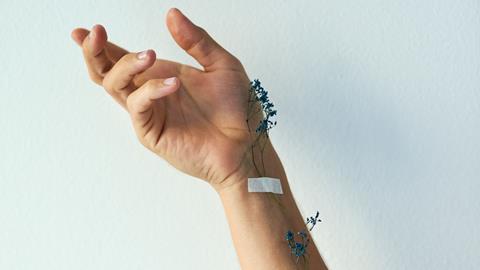

A high percentage of young women in our churches, families and social circles are struggling with harming themselves, and they need support, not judgement, says high school teacher-librarian Rachel Allcock
Many readers will skip past this piece, quietly thanking God that they are not directly affected by self-harm. “I don’t know anyone who cuts themselves,” they’ll say. “My body is a temple, and I would never do anything to harm it.” In fact, I’m probably just quoting the thoughts I’ve had, particularly before I went back into high-school education and received training on self-harm. This training helps teachers feel better equipped to have sensitive conversations and guide students to expert help, but it does not make us specialists.
My intention in this article is to bring a hidden suffering into the light. I pray that my words reflect God’s grace and truth and do not cause anyone to stumble or struggle in their private battles with self-harm. The Bible teaches that every person is inherently loved and made in the image of God (Genesis 1:27). Nothing can separate us from the love of God that is revealed in Christ Jesus our Lord (Romans 8:38–39). Not even our darkest private battles are hidden, and God cares about them all.
The magnitude of the issue
Self-harm is a mental health challenge requiring care and support, not judgement. It’s likely you’ve heard self-harm described as ‘attention-seeking’, but a key feature of most self-harming behaviour is the need to remain hidden, not the desire to be noticed. After an initial feeling of release or control comes a deep sense of guilt and shame.
If you know three or more young adult women (16–24-year-olds), one of them could be self-harming. That’s usually at least one in every tiny youth group, circle of friends or extended family. Women of this age are twice as likely to self-harm as men, and although the figures drop with increasing age, about one in nine adults admits to self-harming at some point in their lives.
Responses and perceptions
I asked some older teenagers what they thought about those statistics. The boys were in denial and didn’t believe one in four 16–24-year-olds have self-harmed at some point in their lives. After a bit of (reluctant) discussion, they admitted it’s common for boys to become obsessed with exercise and restrictive diets, but they didn’t immediately connect this behaviour with self-harm.
Not even our darkest private battles are hidden, and God cares about them all
The girls were given the higher, gender-specific figure: 31.7 per cent of women aged 16–24 admitted to self-harming now, or in the past. They weren’t surprised by the statistics. Used to seeing evidence of cutting and eating disorders, they instinctively know “never to mention it”. They have friends who have been sectioned (compulsorily detained in a hospital for assessment or treatment).
What is self-harm?
The mental health charity Mind’s website (mind.org.uk) explains that self-harm is when you “hurt yourself as a way of dealing with very difficult feelings, painful memories or overwhelming situations or experiences”. Some people know why they do it, while others can’t make sense of their behaviour and don’t know a reason behind it.
The perplexing nature of our struggle with desire and action is not new. Paul documents it when he grieves his sinful nature getting the better of him: “I do not understand what I do. For what I want to do I do not do, but what I hate I do” (Romans 7:15). This is a universal experience, and we may never fully understand why we, or others, engage in this type of behaviour. For problem-solvers and control freaks, this is an important reminder that we don’t have the power to save, fix and rescue. Only Jesus can do that.
Mind lists ways people self-harm as:
cutting yourself
poisoning yourself
over-eating or under-eating
exercising excessively
biting yourself
picking or scratching at your skin
burning your skin
inserting objects into your body
hitting yourself or walls
misusing alcohol, prescription or recreational drugs
pulling your hair
having unsafe sex
self-neglect
putting yourself at risk of harm, such as getting
into fights.
Warped views and insensitive comments
While it’s common to conceal some self-harming behaviours, friends and colleagues regularly boast about partaking in other common forms of self-harm – without ever naming it as such. Being hungover, missing sleep, ‘pulling an all-nighter’ to meet a deadline or experimenting with extreme diets are common topics of conversation around the water cooler.
Overeating is still referenced in a jokey way. Maybe we even mention our tendency to ‘binge eat’ cookie dough ice cream when we introduce ourselves. It’s widespread knowledge that binge eating, crash diets and constant calorie counting are damaging to our bodies and minds. Many of us struggle to control ourselves around food, but I’ve only ever had one person admit to me that they have Binge Eating Disorder (BED), despite estimates suggesting it affects one in 25 people. How many of our friends seriously struggle but only ever hear jokes made about the issue?
Overwhelmed by guilt, women turn to self-harm instead of salvation by faith
Just as diagnosed Obsessive Compulsive Disorder (OCD) sufferers know there is much more to the condition than liking our spice racks organised (we need to stop saying we’re “a bit OCD”), those with diagnosed Binge Eating Disorder know there is much more to the condition than the odd moment of overindulgence. Let’s be sensitive and careful in our use of words and labels. For someone trapped in a web of constant destructive thoughts, it’s not helpful to hear a ‘thriving’ person make a flippant reference to the issue.
As with excessive drinking, few of us want to admit that disordered eating is a form of self-harm, but there it is, listed alongside poisoning and self-neglect.
Avoid judgement and create safe spaces
Christian author and journalist Lauren Windle writes and speaks about the judgement she received in a Christian bookshop when she asked for a book on sin and Jesus. As she left, a person in the shop told her: “You know Christians don’t dress like that.” Aged 19, an alcoholic and on the cusp of a drug addition, this caused her to distance herself from church at a time when she couldn’t have needed it more.
It angers me to hear how judgemental that statement was. However, I’m sure there have been times when what I don’t say – and my unconsciously awkward body language – casts judgement on someone desperate for help and understanding. A disapproving glance or shocked expression when glimpsing someone’s scars might be enough to encourage continued hiding and secrecy.
The Protestant work ethic
If you were raised in a Christian family, with high importance placed on the values of self-denial, discipline and hard work, it’s likely you struggle to rest or find value in having fun and ‘doing nothing’. The scriptural basis for the importance of productivity and efficiency is solid – there are many verses to support frugal living, self-denial and discipline (such as Colossians 3:23–24, Proverbs 10:4). But the ‘Protestant work ethic’, which was popularised by Max Weber’s 1905 book, The Protestant Ethic and the Spirit of Capitalism, has impacted generations of churchgoers. Its stance that working hard is a spiritual duty, and spending frugally a vital sign of faith, has resulted in an unhealthy sense that the only thing worth celebrating is success – and it’s OK for that to come at a huge cost. The cost might be an increased risk of diabetes, depression, high blood pressure and heart disease, yet we still prioritise the ‘to-do’ list over taking care of our bodies.
Self-harm as ‘penance’?
When I started at secondary school, I was shocked to see the woodcuts and illuminated manuscripts of flagellants in my year 7 history textbook. The images showed monks and nuns hitting themselves with a whip as a form of religious ritual. The teacher calmly explained that this was called self-flagellation, and it was a fairly common form of penance or an attempt to draw close to God in medieval times.
While the Church no longer recommends self-flagellation and other extreme medieval practices, academic research makes a clear connection between the contradictory messages that come from venerating saints, and devout young women suffering a mental health crisis. Many men and women named as saints used self-harm as a spiritual discipline. A young woman, referenced in a research paper, gave similar accounts of her feelings after cutting herself as the 16th-century nun St Maria Maddalena (St. Mary Magdalen de’ Pazzi), who felt her self-mutilation transformed her into an instrument of God.
I imagine we all remember at least one school friend who used their compass or took pins from the noticeboard to scratch their skin, telling those who questioned them that it was to punish herself. Overwhelmed by guilt, women can turn to self-harm instead of salvation by faith.
A doctor may miss the connections between a young woman’s faith background and her reasoning behind her self-harming behaviour. However, we can be on the lookout for this, ready to offer truth and understanding if people become fixated on ‘role models’ from Church history. You should not be self-harming as a penance for sins. This is not what God wants or commands.
Signposting and safeguarding
As with many other hurts, helping someone work through their self-harming behaviours is a long-term commitment. Signposting is essential – provide a list of organisations, charities and experts to which people can self-refer (see boxes at end). Despite a prayer team’s good intentions, counselling can be dangerous unless done by a trained professional.
As churches continue to improve their welcome and create safe spaces for everyone, it’s worth auditing what we provide and whether it is safe. For a start, paracetamol, knives and other potential trigger items need to be safely stored. Find out whether there is any training available to you and read the safeguarding policy your church should have in place. Don’t promise confidentiality if someone confides in you, as they may disclose something that needs to be shared with the safeguarding team, for instance, in order to keep them safe. Read other articles on the subject to feel better equipped.
There is hope
Shifting outside our comfort zones, changing our language and being honest about self-harm may not feel easy, but Jesus calls us to reach out and provide community. Listen first, resist the urge to rationalise and fix, show compassion and be patient. And if you are struggling, know that freedom is possible – don’t lose hope.
“The light shines in the darkness, and the darkness has not overcome it” (John 1:5).
Helpful resources
All the statistics in this piece are from the NHS Survey of Mental Health and Wellbeing, England (2023/4).
Carrie and David Grant, A Very Modern Family (Piatkus, 2023)
The Grants have four children, all with mental health challenges. As they share their family’s journey in this book, it becomes painfully apparent how difficult it is to access professional help for trauma and neurodivergence, which are both underlying issues that may lead to self-harming behaviour. The book focuses on a need for compassionate communication, validation of feelings and empathy.
Websites that provide information and further articles:
Accessing support
If you’re feeling vulnerable, please seek expert help.
The Samaritans offers confidential emotional support: Call 116 123 for free samaritans.org
Mind provides information, resources and signposting to local services: mind.org.uk
Self Injury Support (SiS) is a peer-led charity that supports girls and women: selfinjurysupport.org.uk


















No comments yet