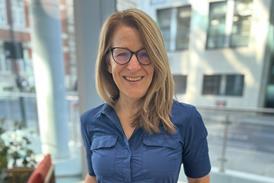
Ciara Dierking faced a sudden and life-threatening illness in December 2024, which resulted in the amputation of all four limbs. She spoke with our deputy editor Jemimah Wright about her journey through suffering, faith and learning to choose gratitude during unimaginable loss

Jemimah Wright (JW): Ciara, could we start your story when your son Colton first became sick? That was about two years ago, wasn’t it?

Ciara Dierking (CD): Yes, it was two years ago, on 26 December that I took my son Colton to the emergency room in Lancaster, Pennsylvania.

JW: What was wrong with Colton?

CD: I believe he had strep, coronavirus and cysts on his neck that were caused by the coronavirus. I didn’t go back into the hospital with him after that initial visit, but that was what we were told.

JW: And up to that point, how were you feeling physically?

CD: I had actually been feeling completely fine, which is kind of crazy. But while I was at the emergency room with Colton, I started to feel unwell. I thought it was just stress, as I’d never had to take one of my kids to the ER before. By the end of that day, though, I really didn’t feel good. My husband, David, stayed at the hospital with Colton, and I went to my in-laws’ house to rest. I was only 33, so I assumed rest would fix it. I rested the next day, but when I woke up on the 28th, I knew I needed to go to the hospital. It was becoming hard to breathe and even hard to walk. My mother-in-law drove me to the same emergency room where I had taken Colton.

JW: Before we go further, can I ask about your faith background? Did you grow up in a Christian home?

CD: Yes, I was raised in a Christian family. My parents took us to church every time the doors were open. But I was a perfectionist, so for much of my life I relied on my good works. I felt like I deserved salvation. 

JW: So would you say your faith had deepened before this medical crisis?

CD: Yes, about a year or two before, my mom gave me A Gospel Primer, which is a very boring-looking book with a brown cover. But when I started reading it, it was life-changing. I realised how undeserving I was of salvation. I had confessed Christ at five, but I don’t really think He was Lord of my whole life, or that I really understood and appreciated my salvation until then.

Sovereignty on its own can feel frightening if it’s not held together with His goodness

JW: So when you were admitted to the hospital, what did doctors discover?

CD: They did scans and breathing tests and quickly realised my lungs had holes in them from pneumonia. They put me on the highest level of oxygen possible, took my blood and prepared to intubate me. I didn’t even know what that meant. From that point on, I was out of it for two to three weeks and remember very little. I had gone in thinking I’d get antibiotics and walk out!

JW: What had caused your body to shut down so severely?

CD: I had pneumonia, strep and the flu all at once. Doctors said my body could have fought any one of those on its own, but together they turned my body septic.

JW: Were people praying for you at that point?

CD: Yes. As soon as things became serious, my husband called my parents in South Carolina, and they immediately started driving while praying the whole way. My in-laws were there with my husband as well, praying constantly.

JW: Meanwhile, how was Colton doing?

CD: He was improving, but he was still in pain. The cysts on his neck hadn’t been diagnosed right away, so they didn’t know why he was hurting. David had his hands full with our son Jackson, who was five, and Colton, who was three, still needed a lot of care while I was critically ill.

pp8_March2026_Profile_1

The day Ciara came home from the hospital was taken on 7th June 2024.

JW: Were you in a coma?

CD: Yes. I was in a full coma for about two weeks, and then it took another week to wake up. I’m very sensitive to medication, so waking took much longer than expected.

JW: Was there a point when doctors thought you might not survive?

CD: Many times. The day I was admitted, the doctor noticed my organs were shutting down and put me on ECMO [extracorporeal membrane oxygenation, a life-support system that acts as an artificial heart and lungs]. That same night, my heart stopped beating for about 20 minutes. Without that machine, I wouldn’t be here. My husband was told four or five times that they weren’t sure I would make it.

I didn’t need answers as much as I needed to trust

JW: How long were you in hospital altogether?

CD: Five and a half months. I was in Lancaster General for six weeks, then flown to Charlotte, North Carolina, because they needed to give me specialised care. I live in Rockville, South Carolina, so Charlotte was closer to home. God provided a surgeon there who had extensive experience with amputees and a rare fungal infection called mucormycosis. My first amputations were while I was still in Pennsylvania. They were due to the medication used to keep my organs alive – it redirected blood flow away from my limbs. Later, because I got a fungal infection, they had to amputate more to ensure it was fully removed.

JW: You’ve shared that coming home from the hospital was both exciting and incredibly hard. Can you describe what that time was like?

CD: In my mind, I was thinking: “This is the end of the journey.” I was finally leaving hospital, and could not wait. The first day I got home, it did feel exciting. All my family was here, and people brought us ice cream, cake and balloons.

Then the next morning, when I woke up all I could see were the areas of my home that I used to take care of. To be honest, my house was a mess, and I could do nothing about it. In the hospital, I had nurses and doctors to take care of me. I love my husband, but I was really scared that he had so little expertise in what needed to be done. I was not very healthy when I came home – I couldn’t even sit up.

I think it just hit me that even though I was home, I was never going to be the same person I was before. And that was really, really difficult.

pp10_March2026_Profile

Wedding photo 6th October 2012

JW: How did you cope emotionally?

CD: Honestly, the second night home, I had plans to end my life. But without limbs, I couldn’t [do anything]. We have the sweetest, amazing people in our church, and someone asked if they could drop off some food. She came into my messy bedroom, sat on my bed and just spoke God’s word to me. She told me this might be the first time I really had to actively choose faith, and that I was going to need to take every thought captive to the obedience of Christ. She said that was my job, minute by minute. My church family and a mentor who visited weekly saved my life.

JW: Can you share how the ‘Always Grateful’ shirts began?

CD: A friend organised a fundraiser while I was in hospital and made shirts with the words ‘Always Grateful’ on them, inspired by the book I had bought a few months earlier, Choosing Gratitude by Nancy Leigh DeMoss, and by 1 Thessalonians 5:18, which says: “Give thanks in all circumstances; for this is God’s will for you in Christ Jesus.” People began sharing our story through the shirts, so we decided to continue making them. Each design has a specific story tied to how God sustained me.

JW: Gratitude clearly became central to your journey.

CD: Yes. David and I realised early on that if we focused on what we’d lost, we’d be overwhelmed. Instead, we wrote down small things we were thankful for each day – even a clean hospital gown or flowers.

This journey has forced me to walk straight into my greatest fears

JW: How has this experience changed you?

CD: I’m a very different person. I wasn’t grateful before, but now I’m deeply thankful for things I once took for granted. Motherhood has changed too. I’m more patient and present. I care less about a perfect house and more about shepherding my boys’ hearts.

JW: How have your sons adjusted?

CD: They were young, which helped. They accepted it quickly and adapted. Life is different, but they’re resilient.

JW: What would you say to someone struggling to choose gratitude?

CD: Pray and ask God for help. Ask the Holy Spirit to help your unbelief. Pray for others who are suffering, as it lifts your eyes off yourself. And find a mentor who will speak truth into your life.

JW: How did you manage to make peace with the question: “Why me?”

CD: It took over a year. I asked that question honestly and often, sometimes daily. I wrestled not only with why this happened, but with very specific questions, such as: “Why are my limbs so short?”; “Why have I lost my elbows and knees when others with sepsis haven’t?” Those details matter so much in everyday life, and I grieved them deeply. At first, I clung to the truth that God is sovereign, but sovereignty on its own can feel frightening if it’s not held together with His goodness. Over time, as I studied scripture and reflected on God’s character – His mercy, His compassion, His faithfulness – I began to trust Him more deeply. I realised that my mind is finite, and I will never fully understand His ways. Strangely, that acceptance brought peace. I didn’t need answers as much as I needed to trust that He is a good Shepherd who cares for His sheep – even when the path is incomprehensible.

pp9_March2026_Profile

Ciara with her husband and their two sons before getting sick.

JW: You’ve also said that God is bigger than our fears. Can you tell us more about that?

CD: One of the most surprising things for me is that this journey has forced me to walk straight into my greatest fears. Long before I ever got sick, I was terrified of an extended hospital stay and of being completely dependent on other people. I valued independence so highly, and the thought of losing it made me anxious. Then suddenly, I was in the hospital for five and a half months, unable to move, speak or even roll over. And yet, God met me there. He didn’t give me strength for the whole journey all at once; He gave it hour by hour, sometimes minute by minute, and it was enough.

I also used to dread public speaking. It made me physically sick with anxiety. Now, I stand in front of people and share my story, and, while I still have to pray and rely on the Holy Spirit, the fear no longer controls me. What this experience has taught me is that when God calls us to walk through something terrifying, He also provides the grace to endure it. Our fears often feel overwhelming because we imagine facing them alone, but we never do. God is far bigger than anything we fear, and He is faithful to supply exactly what we need when we need it.

Follow Ciara @alwaysgratefulthreads