









As the Bayeux Tapestry prepares to return to Britain for the first time in almost 1,000 years, Jenny Sanders looks beyond the famous battle scenes to uncover the little-known stories of the three women stitched into history. Her reflection asks an even bigger question: if your life were woven into a tapestry, who would appear—and would you feature in someone else’s?
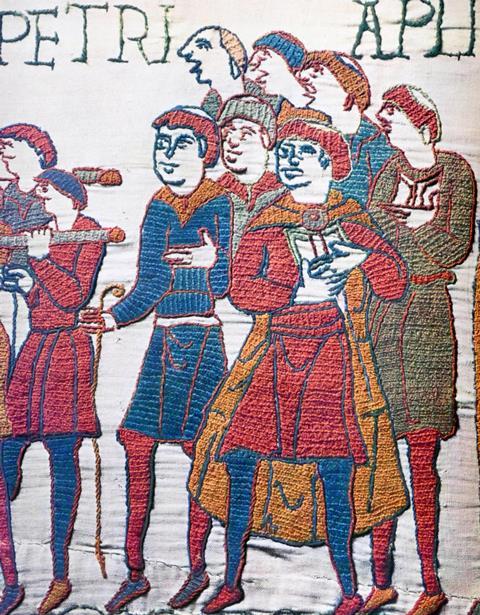
The Bayeux Tapestry, depicting the famous Battle of Hastings in 1066, recently arrived in London for an exhibition later this year. It’s the one date from history most of us remember.
The eleventh century relied largely on oral traditions for recording and communicating history, so the visual narrative of how Harold II, brother-in-law to Edward the Confessor, claimed the throne (there being no direct heir), despite not having royal blood, and was defeated by William the Conqueror, was powerful and effective. It was commissioned by the victor’s half-brother, Bishop Odo, around 1077 to decorate his new cathedral.
READ MORE: ‘God used my stitching to show people his goodness’
The stitching of dyed wool was probably worked by seamstresses in or around Canterbury. The completed tapestry – which technically is a work of embroidery on a linen backing – was then sent across ‘the narrow sea’ to Normandy. It’s extraordinary that it’s survived for over 900 years and, almost as extraordinary, that France has allowed it out of the country. There’s been a huge amount of controversy about loaning it because of its age and fragility. The recently deceased artist David Hockney was one of many art lovers concerned for its delicacy. He said it was ‘madness’ to even attempt to move it. The Treasury have insured it for a whopping £800 million while its climate-controlled home in Normandy is being renovated.
The first wave of tickets has sold out in readiness for the exhibition at the British Museum, scheduled from September through to July next year.
The first wave of tickets has sold out in readiness for the exhibition at the British Museum, scheduled from September through to July next year. If you fancy viewing it between January and March next year, get set for ticket sales in October. Visitors will be moved along its length in a similar way to viewers of the Crown Jewels at the Tower of London.
READ MORE: ‘I went to the Museum of the Book and this is how it helped me become more confident in my faith’
Unsurprisingly, perhaps, Bishop Odo features prominently in the tapestry, which is 70 metres long and 50cm wide. It consists of 58 scenes, 190 horses, 37 ships and 35 dogs but, surprisingly, of the 626 characters pictured, only three are women.
One of these is Edward the Confessor’s wife, Edith of Wessex, crowned Queen and the last of the Saxon queens, who is pictured at his deathbed.
One of these is Edward the Confessor’s wife, Edith of Wessex, crowned Queen and the last of the Saxon queens, who is pictured at his deathbed. He had been ill for some time, possibly sustaining a series of strokes. A wealthy and educated woman, thanks to an upbringing at Wilton Abbey, Edith spoke five languages and was included as one of the king’s advisors. Three of her brothers, including the unfortunate Harold, died at the Battle of Hastings.
READ MORE: This Racial Justice Sunday I want to urge Christians to support the petition to decolonise the British Museum
The second woman is unnamed; historians speculate that she’s a representative figure. She is shown holding the hand of a child, fleeing from a manor house as invaders set it alight and begin their trail of destruction. Other historians suggest that she might be Harold’s wife, Edith Swanneck, or even his mother.
The third woman has the name Ӕlfgyva stitched above her head in a scene which seems unrelated to those either side of it. She’s shown in a doorway with a priest who is touching her cheek. Is he blessing her, comforting her, admonishing her or involved in an inappropriate relationship with her? The image in the lower margin suggests the latter, but no one knows for sure. This uncertainty is all grist to the mill for medieval historians who argue over whether she’s Emma of Normandy (the King of Norway’s first wife), Ælfgifu of Northampton, or a disgraced noblewoman or nun. There’s equal uncertainty over whether the man with the arrow in his eye is actually Harold, which is what most of us were taught in school. Contemporary sources believe that he was hacked to death with a sword and, since the stitching indicates that the arrow is a later addition replacing a spear, he’s more likely to be one of the other figures.
Whatever the true identity of any of the figures in the tapestry, it’s a historic masterpiece that makes me wonder what a tapestry of our own lives would look like. Which women would appear in ours? I’m sure we could name them easily: quality women who’ve mentored, discipled, invested in us and inspired us. Might we also appear on someone else’s tapestry?
The great certainty is that, on God’s tapestry of history, each of us would, without question, be known by name.
























No comments yet