







Could NASA’s calculations help pinpoint the exact date of Jesus’ crucifixion? Jemimah Wright explores why mathematician and broadcaster Hannah Fry has sparked fresh interest in one of Christianity’s most significant events after sharing some extraordinary astronomical evidence on Instagram.
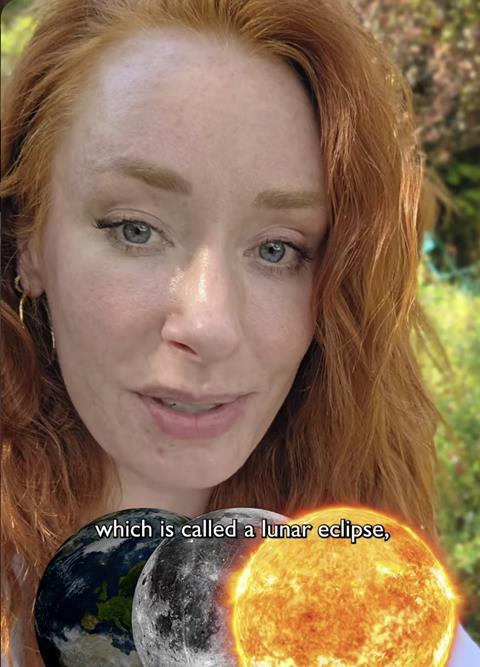
It was back in August when the UK experienced a deep partial solar eclipse, which was the most significant solar eclipse visible from the British Isles since the total eclipse of August 11, 1999. Professor Hannah Fry posted a video on Instagram suggesting that NASA’s calculations could help establish the date of Jesus’ crucifixion.
Apologies if you have seen it already, but somehow, the video only appeared on my feed last night, and I found it so interesting! In the video, Hannah begins by explaining the difference between solar and lunar eclipses.
READ MORE: ‘God keeps me young!’: Katie Piper’s faith and the science of staying younger
If you haven’t come across Hannah Fry before, she’s a British mathematician, bestselling author and television presenter, known for making complicated scientific ideas entertaining and accessible.
Currently Professor of the Public Understanding of Mathematics at the University of Cambridge, Hannah has presented BBC programmes including The Secret Genius of Modern Life and co-hosted the popular Radio 4 series The Curious Cases of Rutherford & Fry. She’s also written books exploring everything from artificial intelligence to the mathematics of love.
Raised Catholic, which she mentions in her reel caption, Hannah has a talent for showing how mathematics can help us understand the world around us. And in her Instagram video, she explores an extraordinary connection between astronomy and the Bible.
‘There have been all these amazing videos going round from the solar eclipse, which is what happens when the moon gets in the way of the sun and the Earth,’ she explains. A lunar eclipse, on the other hand, happens when the Earth passes between the sun and the moon.’
She then shares some historical examples of how people have responded to eclipses over the centuries.
READ MORE: Science catching up with the Bible
In ancient China, around 2000 BC, people believed a dragon was eating the sun
In ancient China, around 2000 BC, people believed a dragon was eating the sun. According to the story Hannah recounts, they would beat drums and shoot arrows into the sky to frighten it away. One emperor was reportedly so furious with his astronomers for failing to predict an eclipse that he had them beheaded.
Then there’s the story of the Medes and Lydians, who had been at war for years in the sixth century BC. During one battle, the sky suddenly darkened in the middle of the day. Both sides were so terrified that they stopped fighting and signed a peace treaty!
But Hannah says as her favourite example, the ‘absolute best’, is from the Bible. She explains that around 50 days after Jesus was crucified, the apostle Peter stood up to address a crowd and quoted the prophet Joel: ‘The sun will be turned to darkness and the moon to blood before the coming of the great and glorious day of the Lord’ (Acts 2:20, NIV).
READ MORE: Scientists have made an astonishing discovery about the human brain – but does it point to God?
It turns out that astronomical calculations show a partial lunar eclipse occurred on 3 April AD 33 – a date some researchers believe could have been the very day Jesus was crucified
It turns out that astronomical calculations show a partial lunar eclipse occurred on 3 April AD 33 – a date some researchers believe could have been the very day Jesus was crucified. In 2009, NASA published extensive eclipse calculations covering 5,000 years, from 2000 BC to AD 3000. The work was produced by astronomers Fred Espenak, affectionately known as ‘Mr Eclipse’, and Jean Meeus.
These calculations allow scientists to work out when eclipses occurred, even thousands of years ago. They show that a partial lunar eclipse took place on Friday 3 April AD 33, potentially visible from Jerusalem as the moon rose that evening. The Gospel of Matthew records that darkness fell over the land during Jesus’ crucifixion, from noon until three in the afternoon (Matthew 27:45). Then, in Acts 2:20, Peter quotes the prophet Joel, referring to the moon turning to blood. During a lunar eclipse, the moon can take on a reddish appearance, which makes the connection particularly intriguing.
Interestingly, this theory isn’t new. Back in 1983, researchers Colin Humphreys and W G Waddington published a paper in the scientific journal Nature, entitled Dating the Crucifixion. By examining the Jewish calendar, biblical accounts and astronomical calculations, they proposed Friday 3 April AD 33 as the most likely date of Jesus’ death. Of course, NASA hasn’t officially confirmed the date Jesus died. Its calculations establish that an eclipse occurred, while researchers have proposed a possible connection to the crucifixion. Other scholars have suggested different dates, so the question remains open.
The significance of Good Friday has never depended on knowing the precise date. As Christians, we believe Jesus died for our sins and rose again, offering forgiveness and eternal life. Hannah Fry’s video might not prove when Jesus died, but it invites people who might never open a Bible to consider the historical events at the heart of Christianity. And if a mathematician’s Instagram video encourages thousands of people to investigate the story of Jesus, that’s surely something worth celebrating.
























No comments yet