







In the dark comedy Wicker, Olivia Colman marries a man made entirely of wicker, who turns out to be a surprisingly good husband. Alex Noel explores what this bizarre love story reveals about marriage, gender roles and why women shouldn’t have to settle for less.
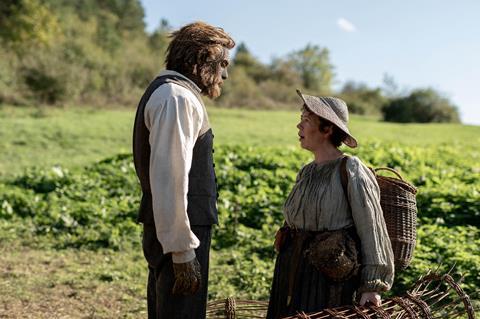
Wicker, a dark comedy starring Olivia Colman and Alexander Skarsgård, opened in cinemas on 30 October. The next day – on Halloween – I went to see it, keen to discover whether this fable about a fisherwoman’s wicker husband would serve up the husband material we’ve all been yearning for or prove to be a dreadful horror show.
While Wicker has gained notoriety for being a sexy, fetishised romp with a basket (inspiring numerous snigger-worthy memes on social media, as well as some very well-timed marketing from homeware companies like IKEA), it’s not the film you might think it is.
READ MORE: Olivia Colman has gone grey – what does our fear of ageing say about our faith?
In the small village where the fisherwoman sells her fish every day, the men are known by their trades, and the women are known by their men: Baker, Baker’s Wife, Tailor and Tailor’s Wife (who was formerly Doctor’s Daughter) – you get the picture. It is a community that thrives on making transactions and adhering to strict roles. When it comes to marriage, a man “collars” his wife – quite literally – and at the altar the newlywed couple are pronounced “Man and his Wife”. A woman seemingly belongs to her husband, in the same sense, we guess, as his owning a dog.
To the village folk, the fisherwoman is a figure of fun and derision. She walks with a limp, smells of fish, is unmarried (which is no surprise to the villagers) and lives life on her own. She might play up to this and give as good as she gets, but little about her qualifies her to fit in or be valued.
READ MORE: Can I belong in Church as a single person?
One day, at a village wedding, she “catches the bouquet” (which in this case is a ritual involving shaking woven eggs that explode with colourful powder).
One day, at a village wedding, she “catches the bouquet” (which in this case is a ritual involving shaking woven eggs that explode with colourful powder). The thought that she would be next to marry is as ridiculous to her as it is impossible to everyone gathered there. But this time, instead of laughing along and agreeing with their verdict, she decides to do something else. An idea occurs to her: the same basket maker who made the woven eggs seems to have a magic touch; perhaps he could help? So she commissions him to make her a husband. His response is simply: “Be at the chapel in a month.” And so it is that a month later, a man woven entirely from wicker waits at the altar, ready to marry the fisherwoman.
At their wedding, there is no collaring, no saying “Man and his Wife”, just a solemn promise made to each other in front of the priest. And so their relationship begins and starts to blossom as they get on with loving each other in an unconventionally equal partnership. She fishes, he fixes the house, they make love. Nothing about their marriage fits the traditional paradigm here – least of all the fact that it is so important to the wicker husband that his wife is happy; something that he prioritises at every turn. Because then, as he explains one day to the other men, he is happy too.
READ MORE: Want to find a husband? What Finland’s pink baskets can teach Christian single women
Quite apart from being made from wicker, this out-of-the-box relationship disturbs them.
But this is all too much for the villagers. Quite apart from being made from wicker, this out-of-the-box relationship disturbs them. It shines a light on their own inadequacies and highlights their unmet needs and longings, whether that’s to have a more fulfilling relationship or to be free from the diktats of a system that stifles them – women especially. But in the end, none of the villagers can move beyond their transactionalism or the self-orientation that drives it. The film is a clever comment on the overarching ideas that shape societies down to their smallest units and the most intimate of relationships, and which determine how men and women are to be respectively valued.
It shines a light, too, on what we expect from marriage. As an unmarried woman, I’ve asked myself – as people have asked me – am I too fussy? Too idealistic? Am I asking too much of marriage? But I would counter: is it too much to want a loving, equal partnership? And for marriage not to be another extension of wider societal ills?
Ephesians 5 lays out a vision for marriage characterised by loving mutuality and reciprocity between husband and wife, though for many Christians the jury’s still out on what this looks like in practice. Nonetheless, instead of vilifying those who seem to reject marriage in favour of singleness, we should ask what harmful ideas our understanding of marriage has imbibed that mean it’s undesirable for them. Perhaps then we might find our way to it being a context – along with the rest of society, too – where men and women flourish equally.























No comments yet