









Author, Ruth Leigh explores why we can form surprisingly deep attachments to fictional characters and people we’ve never met – and what these ‘parasocial’ relationships reveal about our longing to be known. Could our love of books ultimately point us towards the one relationship that can never be one-sided?
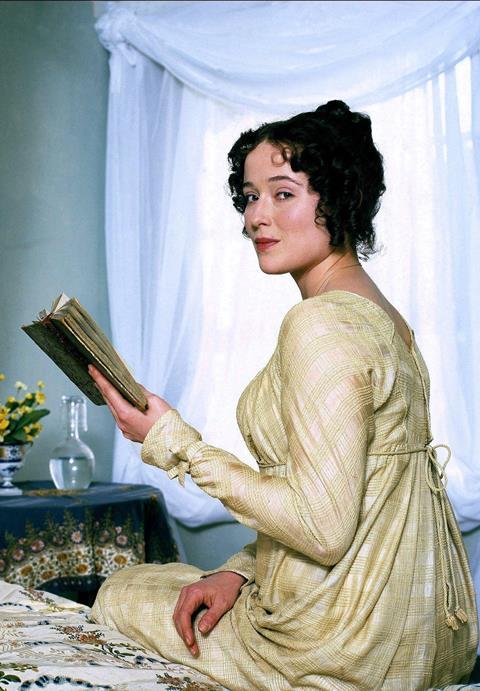
Jennifer Ehle: Pride And Prejudice Characters: Elizabeth Bennet Uk 1995 Contributor: Cinematic
Getting lost in a book has been my favourite thing to do since the age of five. By the time I got to grammar school, my eager young mind was populated by strong heroines. Anne (of Green Gables), plucky red-haired orphan brought up in a Canadian farmhouse. Sara (A Little Princess) catapulted from a life of wealth and ease to one of unrelenting drudgery and hardship. Molly Hughes (I got her trilogy of nineteenth-century memoirs for Christmas the year I was ten), born into a London stockbroker’s family in 1866 with four older brothers, chronicling a life of joy, disappointment, loss and hope. Even now, huge chunks of those beloved books dwell at the back of my mind. Anne, Sara and Molly are old friends, albeit ones I’ve never met.
Which leads us neatly on to the Cambridge Dictionary Word of the Year 2025, which is parasocial. It’s a slightly uncomfortable word. Unlike 2019’s “upcycling” or 2021’s “perseverance”, it reflects the way our society relies increasingly on chatbots and AI. What, then, is a parasocial friendship, something also referenced by the Cambridge Dictionary?
READ MORE: What bestselling novel Yesteryear reveals about faith, fame and following Jesus
It’s defined as, “a one-sided psychological connection where a person feels a deep sense of friendship, intimacy, or bond with someone they do not personally know—such as a celebrity, influencer, fictional character, or artificial intelligence.” It was first identified in the nineteen-fifties as television became more common. With a vast crowd of new people beamed into the living room (both real and imaginary), the first parasocial relationships began to form.
What is it about inaccessible famous people and inspirational characters in books which we find so attractive?
What is it about inaccessible famous people and inspirational characters in books which we find so attractive? Do they meet a need in us that nothing else can? Fill a void of some kind? Novelist Meg Mason recently published a piece in The Guardian about her parasocial relationship with novelist Nancy Mitford. As a lonely teenager, she read, “The Pursuit of Love” and became slightly obsessed. Thirty years on, she says, “I still find it hard to believe she [Mitford] isn’t actually my friend.”
I reread this novel and its companion, “Love in a Cold Climate”, at least once a year. I’ve also read lots of Mitford biographies and would absolutely hate to be friends with Nancy Mitford. Undeniably a talented writer and humourist, she was also waspish, unkind and cutting, bullying her youngest sister (the future 11th Duchess of Devonshire) and launching elaborate “teases” on friends and family. However, that has never stopped me enjoying her writing and yearning for more of it.
READ MORE: I gave up on writing my novel, until God gave my friend a prophetic word that changed everything
As a lonely, isolated teenager myself, I turned to books for comfort.
As a lonely, isolated teenager myself, I turned to books for comfort. I’d left the church at fourteen and while I still believed in God, I didn’t have a personal relationship with Him. Books were safe and welcoming. To Anne, Sara and Molly, I added legions more, people I felt I knew, who might understand me if they met me, who would perhaps become friends. Looking back, I can see that they performed a vital function, making me less alone, and rather more seen.
However, the whole point of a parasocial relationship is that it is one-sided. It doesn’t matter how much I love Lizzy Bennet or Don Tillman or Eleanor Oliphant. They can’t love me back. Only God can do that. It’s impossible to have a parasocial relationship with Him. We speak, He answers. We cry out, He comforts us. We ask for inspiration, He sends us words and pictures.
READ MORE: Why I believe women’s fiction is an important tool to share the gospel
I understand why the Cambridge Dictionary Word of the Year is what it is. But that doesn’t mean I have to like it. I hate the thought of our society moving closer to these kinds of empty exchanges with no real depth or foundation. Let’s write and read books and articles that uplift and inspire, encourage others in their faith, feast on the good things that God has given us.
What’s the opposite of a parasocial relationship? A social, reciprocal one where both parties benefit, grow and become closer. We can do that with God and let Him meet our needs in a way that a fictional character or a celebrity never could.






















No comments yet