








Writer Emma Lindsey reflects on what it means to support England as a Black British Christian. As the Women’s World Cup sparks conversations about identity and belonging, she explains why she’s reclaiming both her faith and her flag.
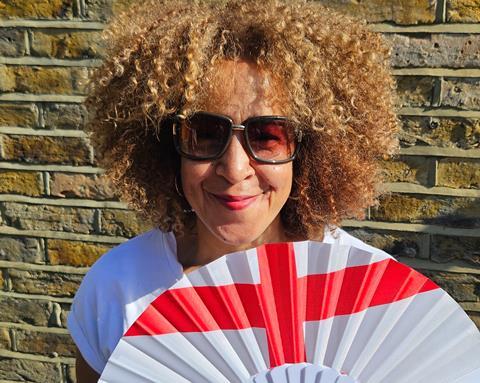
Black-English: a subcategory, or perhaps a related category, of Black British. It means embracing the “bothness”, rather than the “otherness”, of belonging to both identities. Why Blinglish instead of Blenglish? Because it sounds better. And because being Blinglish naturally has a bit of bling about it. No inverted commas needed. We all know what I mean. Definition over.
So how did this Blinglishness come about? And why do I think it matters? Because when it comes to sporting allegiances, national identity comes to the fore, along with the need to pick a side. I was born in England and raised here. While England feels like my home, I wouldn’t call myself English. British, yes, but not English.
And yet, my love of a cuppa, fish and chips and – did someone say Yorkshire pudding? – suggests otherwise. Ask my American sisters and they’ll tell you just how English I am. And yet I have also been made to feel “other”, because I am obviously Black: Black American and Caribbean. I am Blinglish.
READ MORE: In Sarah Taylor’s appointment, England Men’s Cricket have brought welcome encouragement to ordinary women – whatever our field!
Supporting England during this World Cup, I was surprised – and, I have to confess, felt a twinge of betrayal – when my husband, who is Jamaican, let slip that he was supporting the DRC. I had simply assumed he’d be supporting England. When I asked, “Why not England?”
He replied, “I’m supporting the Black team.”
He replied, “I’m supporting the Black team.”
When I pointed out that the England squad also has Black players – 15 of the 26, in fact – it didn’t change his mind.
After that match, I kept thinking about our conversation, about my own cries of “Come on, England!” during the tournament, and about the fact that, when push comes to shove, supporting England really matters to me. A few days later, while shopping in Primark, I spotted an England hand fan. I reached for it, then had a visceral reaction and immediately pulled my hand away. It just felt wrong. But why?
Because whenever I see the England flag – the stark white background behind the blood-red cross – I feel excluded. For me, the England flag has become associated with racism. I think I speak for many people of colour when I say that those waving the national flag can sometimes seem to be saying, “You’re not welcome.” And it’s not only the thugs.
READ MORE: ‘I am a missionary to my own country – England’
It’s also the politely racist neighbour who never gives you more than a nod despite living next door to you for years.
It’s also the politely racist neighbour who never gives you more than a nod despite living next door to you for years. It’s the colleagues who don’t comment on your blindingly obvious suntan when you return from holiday. It’s the feeling of never being truly seen, alongside the countless other microaggressions that Black and Brown people encounter, endure and, for the sake of their sanity, often have to shrug off every day.
But every little thing counts, and it all adds up. That’s why the England flag doesn’t feel like mine. It doesn’t feel like something I can fully get behind because I fear that, if I did, it might simply turn around and kick me in the gut. Then I thought about England’s Black players – Jude Bellingham, Marc Guéhi, Noni Madueke and Bukayo Saka – wearing the England shirt and giving everything for this country.
And I made a decision. I’m not giving in to the racists who have claimed the England flag for themselves. I’m not going to let them win. So I decided to buy not only the England hand fan but also the T-shirt.
READ MORE: I Googled all the whole England women’s football squad to find out if they were Christians and here’s what I learned
During England’s campaign to bring the World Cup home for the first time in 60 years, I’ve been wearing and waving my England flag with pride. Yes, I’ve received some curious looks too, but I’m happy to have the conversation.
I’m cheering for an England victory largely for the sake of unity. It’s time to close that circle. A win would bring the nation together, rising above our cultural differences. Galatians 3:28 reminds us of the equality we share in Christ: “There is neither Jew nor Gentile, neither slave nor free, nor is there male and female, for you are all one in Christ Jesus.”
But once the tournament is over and the merchandise has been packed away, I know where I truly belong. Above race. Above culture. There is one place where I am fully known and fully accepted. No hyphenated identities or linguistic gymnastics are needed to explain it. As Jesus said in John 18:36: “My kingdom is not of this world.”
I believe that World Cup victory for the team would be not just a win for football but a reminder that England is a Christian nation.




















No comments yet