


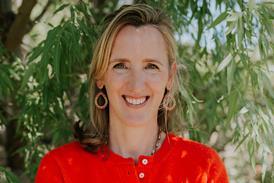





Jennifer Tucker, award-winning author and mental health advocate, told Claire Musters how learning embodied prayer helped her anxiety, and why she believes incorporating it into our daily lives would benefit us all
Jennifer was raised in a Christian family and learned from a young age that she could talk to God. However, she came to realise that she viewed prayer “more as an obligation than an invitation”. She understands now that her prayers “were largely disconnected from my bodily experiences”, explaining: “I tended to separate my spiritual life from my physical life, never really understanding or appreciating the deep connection between my mind, body and soul.”
Facing the truth
Jennifer spent 40 years not recognising the symptoms of anxiety and depression she was experiencing. She thought that having any mental health struggles meant: “I didn’t have enough faith or the right kind of faith, or I didn’t pray enough or the right way, or I just didn’t trust God enough.”
She ignored her physical symptoms and pushed down difficult emotions, all the while hiding behind perfectionism, overworking and people-pleasing. But “the stress and anxiety would build over time until I was on the floor of the bathroom, sobbing uncontrollably. Or the sadness and despair would press in until I shut down and became numb inside.”
It was only when her daughter began to have panic attacks at the age of 13, and was diagnosed with Generalised Anxiety Disorder, that Jennifer realised she had to be honest about her own mental health. With her daughter’s daily ongoing battle, Jennifer felt out of control, but still she focused her attention on helping her daughter. Prayer seemed harder: “like my words were just hitting the ceiling and going nowhere…I began to doubt if God even heard my prayers at all.”
Jennifer’s own anxiety and depression felt crushing and, sat in a hospital room next to her sick daughter, she couldn’t catch her breath and finally realised she needed God in a physical, bodily sense. “I had no more words left, no more desire to perform or perfect or even pray…I was simply desperate for God’s presence. I needed to know in my bones that He was still with me.”
Learning to pray differently
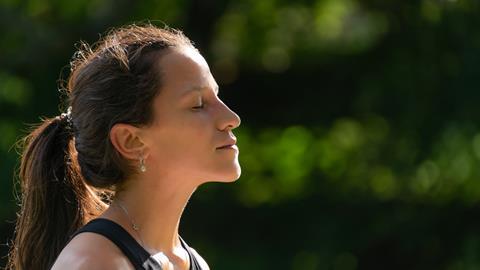
Jennifer started praying breath prayers, inhaling and exhaling while repeating a short biblical phrase. “I prayed these when my daughter was hospitalised – I walked the halls and just breathed and prayed. The deep breaths physically calmed my body while the simple prayer tethered me to God’s love.”
As the challenges continued, Jennifer then began meditating on scripture, learning how to “listen with the ears of my heart as I meditated on God’s word. These meditative prayers became an anchor for my soul.”
The stress continued to build up in Jennifer’s body, so she realised that, as well as slowing down and being still, she also needed to move. “Movement can be extremely helpful in calming the physical symptoms of stress. When we move, our body sends sensory messages to the brain that communicate safety, which in turn slows the release of stress hormones and allows the brain to move into a state of calm. Not only that, any time you contract your muscles (which is any time you move), your muscles release proteins called myokines which travel through your bloodstream and affect every system in your body. One of the first scientific papers about myokines called them ‘hope molecules’, because of the power they have to improve mood and promote emotional wellbeing.”
Jennifer found that moving her body as she drew closer to God helped to calm her soul, and she began regularly using embodied prayers (prayers connected to some kind of body movement). The impact has been profound: “I no longer see my physical experiences or mental health struggles as roadblocks to my faith, but as gentle invitations to draw closer to Christ in prayer. These practices are not some New Age concept, but centuries-old practices that are deeply tied to scripture. The goal is not to empty the mind, but to focus on God’s presence and the truths in His word.”
Jennifer has found the embodied prayer practices have helped her to walk through continuing difficulties. While the journey is still hard, and has included a combination of medication, therapy, prayer, meditation and movement, she can say that the prayer practices “have helped shift the orientation of my heart, and allowed me to more effectively walk through difficult emotions and challenging circumstances with my whole self and with a deeper abiding peace, knowing that God is with me through it all”.
Everyday rhythms of prayer
Jennifer believes that God can be found in each moment: “We rarely slow down long enough to pay attention to the moment right in front of us, let alone notice God’s presence with us in every moment.”
Becoming intentionally aware of God means that we can pray continually whatever we are doing – it is not something extra we need to try and squeeze into our busy days. She suggests: “Start by choosing a routine task or movement you do every day and make that a time to pray. You can pray for your children as you wash the dishes, or pray for your spouse as you fold laundry. Pray for your neighbours as you feed your pets, or pray for your friends as you prepare dinner. You can reach out to God as you brush your teeth, you can talk to Him while you walk the dog, you can share your worries with Him as you make your bed.”
Jennifer recognises that “there is no perfect answer to the struggles and stress of life”. Jesus warned us that we would experience hardship and difficulties (see John 16:33). However, Jennifer truly believes that “no matter your current circumstances, you can experience the inner strength and abiding peace you long for, even in the midst of deep darkness and difficulty. There is hope. And that hope just might begin in a place you may not expect – the place where you carry the stories of your suffering: your body.”
Building a ‘prayer tool kit’
In her latest book, Prayer in Motion, Jennifer shares a selection of simple techniques, along with embodied prayers, that can help reduce stress and increase feelings of safety and peace. The idea is that people can try them out, keep the most helpful ones for their personal ‘prayer tool kit’, and choose to pair the different practices with simple prayers.
Grounding techniques These engage your senses and bring your attention to the present moment, helping to soothe and settle your body by shifting your focus away from distressing thoughts. A breath prayer can be utilised with some techniques to shift thoughts on to God’s word. (See Butterfly Breathing as an example.)
Movement activities Whether a slow walk, gentle stretches or even dancing, movement helps regulate your nervous system and eases the symptoms of stress. Ordinary movements paired with embodied prayer can help calm your body while deepening your connection to God. (See Legs Up as an example.)
Movement can be extremely helpful in calming the physical symptoms of stress
Connection practices There is safety, healing, strength and peace in connection – to ourselves, to others and to God. Connections can help regulate our nervous system and give us a sense of belonging. Some simple ways to connect include taking a walk with someone, playing a game together, worshipping in a group.
Example techniques
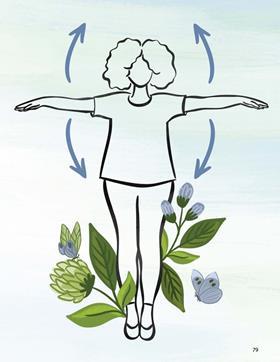
Butterfly breathing
Simply raise and lower your arms (like a butterfly) as you slowly inhale and exhale to help calm big emotions and promote feelings of safety in your body.
Start: Stand or sit with your arms at your sides.
Inhale: As you take a deep breath in through your nose, slowly raise your arms out to your sides and above your head.
Exhale: As you breathe out slowly through your mouth, lower your arms back to your sides.
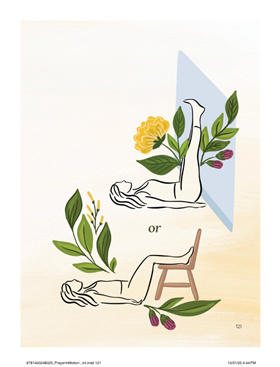
Legs up
This gentle resting pose can help alleviate lower back pain and improve circulation. It is best performed in a quiet spot at home, away from distractions.
Sit on the floor, with your side against a wall, your knees bent and your feet drawn in toward your hips.
Carefully swing your legs up against the wall, as you turn to lie flat on your back. Use your arms to support you, if necessary.
Your bottom should be as close to the wall as possible (or slightly away from the wall) as you extend your legs up the wall, allowing your feet to rest against it.
An alternative option would be to use a chair instead of a wall: Lie on the floor with your knees bent and your calves and feet resting up on the seat of a chair.
Adapted content taken from Prayer in Motion by Jennifer Tucker. Copyright © 2026 by Jennifer Tucker. Used by permission of Thomas Nelson.
Jennifer Tucker is an artist and bestselling author whose transformative prayer series include Breath as Prayer, Present in Prayer and, her latest, Prayer in Motion (Thomas Nelson). Jennifer is a wife, mother and grandmother, as well as an advocate for mental health.





















No comments yet