









Hosted by Claire Musters
This month I’m reading…
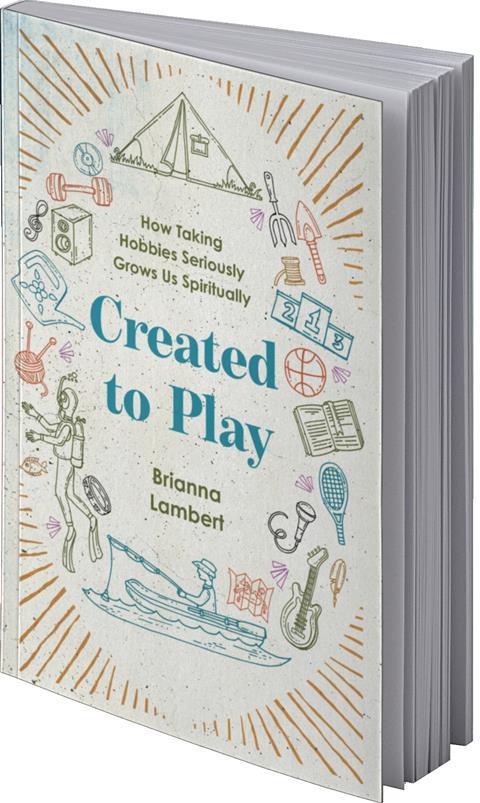
Created to Play: How taking hobbies seriously grows us spiritually by Brianna Lambert (IVP, 978-1514011508)
Too many of us juggle work, church, family, relationships, etc and feel guilty if we ‘indulge’ in hobby/pleasure time outside of the few weeks of holiday that we take. Brianna introduces an entirely new concept: what if our hobbies have far greater purposes than we give them credit for? What if God created us to “delight in play not in order to prove our worth but to humbly look upon His”?
When we engage with our hobbies, Brianna reminds us that we are stepping out of the “work-oriented mindset” and actually posturing ourselves towards worship. I started reading this book soon after discussing some jewellery-making I had done a few weeks previously. Having commented on my lack of talent, I was challenged by the question: why couldn’t I just enjoy the process? As Brianna says: “play isn’t about what we accomplish; it’s about who we become in the process”.
The book is broken down into eleven chapters – one introducing the idea of ‘rediscovering play’, and then the other ten focusing on different types of hobbyists, such as the makers, the heralds, the nourishers, the restorers, the historians and the beholders, etc. In each chapter Brianna starts by listing the types of hobbyists that fall under that category (for example, under the makers she lists – among others – artists, crocheters, soap makers, model builders, poets, costume designers etc); the joy that is attached to that type of play; and the key temptation such hobbyists might face, which is fascinating and eye-opening. At the end of each chapter is a ‘start playing’ section, where Brianna provides practical pointers to help readers engage with play for themselves.
I found this to be both a refreshing and challenging read – and a great reminder to take time to enjoy my hobbies without feeling pressurised to produce something to a certain standard or guilty because I’m taking time out to do something that refreshes me.
We often work too hard and then crash afterwards, numbing ourselves through either simply sleeping or engaging with mindless activities. But you assert that engaging in play can bring us deep refreshment. Could you explain how?
Yes, I think we’re all guilty of slipping into that numbing kind of rest, myself included. Most of our play will involve an element of labour. It takes effort to get out to the garden and plant or go for a run. Yet we need to remember this work can be rejuvenating. Our bodies give us a great example of how rest and work can walk hand-in-hand together. When we sleep, our bodies are actually quite busy – reorganising and stabilising our neural pathways. Interestingly enough, some reports show that the same area of the brain that initiates sleep also initiates play. These realities might help us think about how, even beyond the emotional benefits of doing something we enjoy, we can also benefit physically through the labour of our play.
What has been your own journey of discovering the purpose of play?
Early on in my life, I remember feeling a great amount of guilt about the activities I loved doing. I had drawn lines between activities that felt religious and everything else that felt secular. However, the more I began to grow in my understanding of who God is and how He works in the world, the more I realised that God holds no such lines. Every bit of joy and delight I feel – whether that’s on a hiking trail or with a good novel – comes from His hand as a gift, and, what’s more, it could point me to the beauty found in Him. This was very freeing for me to realise. I no longer had to feel like I was lazy for wanting to read or that I was squandering my time by choosing to bake a complicated pastry. I approached my favourite hobbies with greater joy because I knew they were good gifts from the Lord, and I started to look for what He might be teaching me through that activity.
You say that we live in a time when it’s never been easier to play, as the internet introduces us to so many different (and sometimes forgotten) hobbies. So why do so many of us still struggle to engage with play?
There’s such a paradox in that we have so much opportunity to play – access to instruction and easy access to the materials for so many hobbies – yet at the same time the play isn’t real play at all. This counterfeit play tells us to pick up a hobby primarily because of how useful it will be for us. We live and breathe the idea of utility as the highest good – seen in the apps that help make us more efficient, or the life hacks that can shave two minutes of effort off our day. This mentality causes us to turn to our hobbies looking primarily for results, money or the esteem it will give us. In the process, we miss the beauty of play for its own sake. We forget that play isn’t necessarily about the end result, but about how the Lord shapes and forms us along the way.
In what ways can our hobbies actually form and grow us spiritually?
One of the greatest ways hobbies can form us is by bringing us into humility. Our striving for utility happens because we enjoy feeling as if we are in control. We love doing, but enjoying play as God created it requires us to simply receive. This humbling reality brings us to greater worship as we see how small we are compared to our majestic God. He created those colours we paint across a canvas. He formed the intricately detailed flowers that bloom in our garden. Playing in God’s world reminds us we are one humble part of something greater, and we are filled with gratefulness that God should grant us such sweet joys.
As we slow down and step into a posture of receiving, we’ll also find opportunities for the Lord to teach us. Sometimes, He does so by giving us space to meditate or even be silent before Him. Other times, He uses the thread, the mountains or the collection on our shelf to reemphasise a truth we’ve been learning about His character or a promise from His word. The Lord uses all His world to form us, even our play.
In your first chapter you group the various hobbyists to show how they reflect God’s call to humanity in Genesis. Could you introduce that concept briefly here?
The desires we have to play stem from the God who created us with those passions for a purpose. As God’s image bearers we get to fill the world with reflections of the glory of the Lord. We can do that through our disciple-making, through our vocations, yet we can also do so within our play. When we fill the world with paintings, writing, jokes, woodworking, lattes or bread loaves, we are adding one more reflection that points to the God of all beauty.
We don’t only reflect, but God tasked humankind with the job of tending His creation, and we can do so as we strengthen our muscles with weightlifting, cycle on the road, bend down to till up the garden, or feed the fish in our apartment. Sin brought chaos into this world, so sometimes as hobbyists we will feel the pull to recover what’s been lost. The collections we piece together, our puzzles or our furniture flips portray the reality that sometimes beauty must be gathered back and restored. Finally, as God’s image-bearers, we simply receive His gifts. Our trips to the museum, art gallery, mountains or a movie theatre offer a chance to receive the gifts of the Lord and behold His beauty.
How can our hobbies connect us more deeply with others as well as God?
We were not created in isolation, but God created us for connection with other image-bearers. It should make us stop and notice that the very first time God said creation wasn’t good was when man was alone. We need each other, and play is a wonderful opportunity to live out our purpose of fellowship. When we play together, we not only learn skills, but we gain the opportunity to grow closer to the person playing with us. We’re encouraged by them, we’re given space to talk and commune with them, and we might even practise humility by being limited by them. Playing together opens our eyes to even more that God is teaching us, as we realise the ways God made us to fill, tend and receive His gifts – not only in isolation, but together.
Brianna Lambert on: The books that have changed my life
Jane Eyre by Charlotte Bronte
My first time meeting Jane was as a high schooler, and every re-read since has provided a new layer of depth and beauty. The faith and integrity of Jane has always served as an example I’d like to emulate, and Bronte’s critique of legalistic and self-righteous faith set against the beauty of true grace has made this book ever-applicable to me.
The Goldsworthy Trilogy by Graeme Goldsworthy
The first book in this series opened my hungry eyes for the story of scripture as a whole. At the time of my reading, I hadn’t been introduced to biblical theology, and hadn’t yet understood all the connections to Jesus throughout scripture. These books surprised and delighted me with the beauty of the gospel in God’s unfolding narrative and set me on a path to learn more.
Peace Like a River by Leif Enger
This novel kindled a love of modern fiction within me. Before Peace Like a River, I read mostly nonfiction and classic literature, and Enger’s book pulled me in immediately. Enger knows how to place you in a scene his words create, and makes you fall in love with his characters. The themes from this book have stuck with me ever since I read it.




















No comments yet