



Could art help us see ourselves, others and even God in a completely new way? The Revd Dr Ayla Lepine explores how the extraordinary work of women artists, including Frida Kahlo and Barbara Walker, reveals unexpected connections between creativity, suffering and faith.
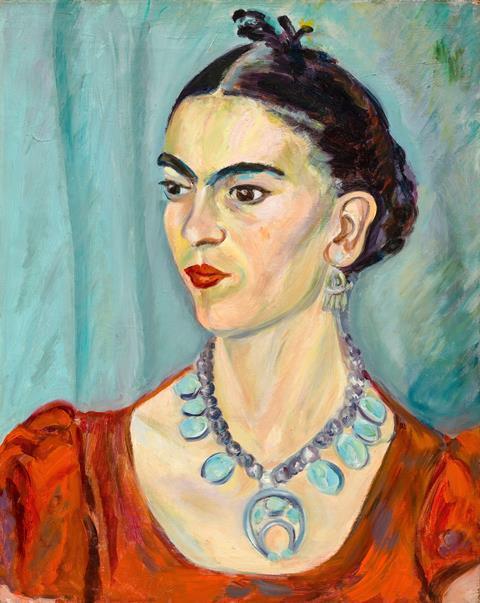
Frida Kahlo (1907-1954), Mexican painter, portrait painting in oil on canvas by Magda Pach, 1933 Contributor: incamerastock
Most of us were taught to look at religious art in a particular way. We stand before a huge altarpiece or a famous painting, we read a label, and we take in and consider what we’ve been told is important. But what if the most important thing in the picture is the person we were never invited to notice? What if holiness is beyond the frame, as well as within it, and how can we recognise it in women’s creativity in particular?
For the past few years, I have been spending time with women artists whose work asks exactly these questions. In my new book, Women, Art, God, a series of conversations with women leaders in the arts and in the Church illuminates how spending time with art by women across centuries, cultures and identities doesn’t simply add new names to an old list. These works of art can change how we see the world, and when our perspective changes, our experiences of God’s presence can be transformed as well.
READ MORE: Can a film or art piece be Christian without mentioning God?
The Birmingham-born artist Barbara Walker has spent years in the galleries of Britain’s major museums, looking at ‘Old Master’ paintings and responding to them. In many of them, she saw and honoured Black figures. Many of them are unnamed in the images and in historical records. These people are often cast as servants, pages, attendants, witnesses, soldiers and archetypes or symbols – they are, first and foremost, people – human beings made in the image of God.
In her Vanishing Point series, begun in 2017, Walker attends to this. She embosses the white figures and their surroundings, pressing their outlines into the paper without ink, so they become ghostly white shapes with lightly raised edges. Then she draws the Black figure in graphite, in careful and tender detail. Brought into focus, reimagined and recentred, the person history may have overlooked is the one who holds your gaze.
READ MORE: At 65, Caroline Quentin is pursuing a long-held dream – and reminding us that with God, it’s never too late
I think of Hagar in the wilderness, who gave God a name: El Roi, the God who sees me.
Walker’s work is now in public collections, including the Government Art Collection, the British Museum and the Fitzwilliam Museum in Cambridge. Spending time researching, teaching with and contemplating these works of art, I think of Hagar in the wilderness, who gave God a name: El Roi, the God who sees me. Walker’s art is a discipline of attention for every viewer. It asks what we would notice if we looked at one another the way God looks at us.
One of my colleagues’ sermons made a deep impression on the congregation recently. He invited us all to look in a mirror, regard our faces with compassion and speak the words ‘God loves me’. Many found this difficult to do, for various reasons. It is a resounding act of acknowledging our own dignity. Self-portraiture can be a way to do this as well, and among the many viewpoints she shared with her audiences – close kin and a global public – Frida Kahlo’s images of herself were a radical autobiographical story in paint. This year, Tate Modern’s exhibition Frida: The Making of an Icon has drawn huge crowds. Kahlo is now so famous that her face appears on tote bags and fridge magnets. It is easy to forget how searingly honest her paintings are.
READ MORE: We launched the first faith-focused art awards because creativity reflects a core part of God’s nature
Kahlo lived with pain for most of her life after a bus accident in her teens
Kahlo lived with pain for most of her life after a bus accident in her teens. She painted herself again and again: pierced, stitched, bleeding, braced. In images including Memory (The Heart) of 1937, on show at Tate, she engages deeply with the embodied symbolism of Mexican Catholic devotion. The Virgin Mary, the Sacred Heart of Christ and ex-votos (simple paintings by people who gave thanks for God’s life-saving interventions) were woven into her work like the braids she interlaced with sparkling jewellery and vivid colours.
Kahlo was no conventional believer, but her art tells a truth that Christians need to hear. Suffering bodies are not shameful, and they are not outside the reach of the sacred. In a culture that hides pain, Kahlo shows it. In doing so, she reminds us of a God who does not stay distant but took on flesh and wounds because of a love stronger than death.
Both of these women artists created work that provides a fresh approach to faith, spirituality and storytelling through images. People across generations, of all faiths and none, and of every background and identity, can experience these works of art as spaces for connection with the core aspects of human life. Making art is always a courageous process, whether it finds its way into homes, churches, galleries or never leaves an artist’s studio. Life and art are both ordinary and extraordinary. And in dialogue with God’s presence among the people, this art resonates with narratives of Jesus noticing and loving people when no one else did. By paying close attention to the edges of life and being astonished by the gift of imagination, spiritual encounter is a genuine possibility in these and many more works of art by women.
Women, Art, God: Spirituality in the Work of Twelve Artists by Ayla Lepine (SCM Press, £30, 5 November) is available from all good bookshops.
















No comments yet