









Stranger dinner parties are becoming the latest Gen Z trend, but the idea of welcoming people into our homes is nothing new. Sophie Sanders explains why opening our doors to strangers is at the heart of the Christian faith – and how a simple meal can change someone’s life.
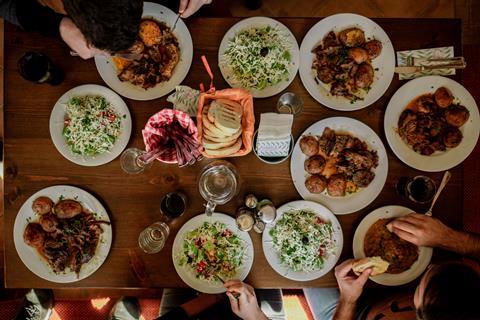
Photo by Stefan Vladimirov on Unsplash
According to a recent Times article by Hannah Bentley, stranger dinner parties have been gaining popularity among my generation. It sounds pretty scary, doesn’t it? Until you realise that a ‘stranger’ could simply be a friend of a friend you’ve not met before, a bestie’s new boyfriend, or simply a next-door neighbour. It’s honestly one of the (very) few trends I’ve seen in recent years that’s made my heart sing, not least because opening up my home to strangers is something I’ve been doing for over a decade and I believe lies at the very heart of what it means to follow Jesus.
READ MORE: Embracing hospitality
My kitchen table is regularly filled with an eclectic mix of people I’ve never met before. Most recently, I cheffed up miso black bean and sticky rice poke bowls with miso-glazed aubergine, followed by mini pavlovas and brownies – if I do say so myself, it was absolutely delicious! Round the table were a fair few regulars plus, on this occasion, my housemate’s friend, whom she’d met a couple of weeks beforehand on her PGCE course. Here was the message that precipitated that invite:
“I met this girl on my course and basically I want to get to know her more, but she’s just landed in Cambridge. I asked her if she had any plans for the weekend, and she said no. And I asked if that was a good thing, and she said that having plans would be nice. So I took a gamble on the fact that you’re generous and hospitable and that she’d be welcome to join us for supper. I hope that’s OK.”
And my reply: “You can, of course, bring a friend. Always, always, always.”
It was a great evening, though I must admit there were points at which I thought she must wonder what she’d signed up for, as a few of us descended into hysterical laughter with tears streaming down our faces… But the best bit? Watching this new friend gain confidence in the group and open up about her story, her interests and her hopes for the future.
Over the years, I’ve bonded with a transplant patient over our shared health struggles; hosted a friend and her teenage sister, who was asking big questions about life and faith and subsequently put her faith in Jesus; provided a rather unconventional liquid meal for a friend of a friend who’d just had a bike accident; and baked a birthday cake for someone I’d only met once who had a severe nut allergy, so I couldn’t simply pop to the shops to buy something to celebrate.
When I have people round, I always cook extra – and my friends know that they’re always welcome to invite someone they know who’s in need of community,
When I have people round, I always cook extra – and my friends know that they’re always welcome to invite someone they know who’s in need of community, care or simply a home-cooked meal. I truly believe there’s an intimacy to inviting people into your home that can’t be replicated by eating out. It’s an open-ended invitation to make yourself at home, to linger a little longer and to enter into community.
Perhaps you’re an introvert or a Pot Noodle fanatic and this radically ordinary hospitality feels outside your wheelhouse. If that’s you, I’d encourage you to just try it. Hospitality doesn’t have to be glamorous, convenient or come with top-tier chat. The simple act of inviting people into your home is always profoundly meaningful, whether you serve up pesto pasta and cookies or something more complex.
READ MORE: I had to learn the balance between hospitality and boundaries - Jesus had it down
It’s far easier to be hospitable to people like us – those who share our interests, beliefs and values
It’s far easier to be hospitable to people like us – those who share our interests, beliefs and values. It’s much harder to open our homes to people whose needs might be complicated, whose conversations might be stilted and whose stories we don’t yet know. But that’s the way of Jesus. He didn’t reserve a place at his table for those who could offer him something in return. He made room for people because they mattered. And he calls us to do the same.
That’s why I think this ostensibly new trend is actually a rediscovery of something ancient – something biblical. It’s something Jesus explicitly calls us to do. In Luke 14, he tells his host not to simply invite his friends, relatives and wealthy neighbours, but instead to make room for those who cannot repay him. In other words, hospitality isn’t meant to be a transaction. It’s meant to be an expression of grace.
READ MORE: What happened when a Korean prayer team came to our church
Gen Z is discovering the beautiful reality that life is richer and communities are stronger when we make space at our tables for strangers, because this is what we were made for. Perhaps, even, they’re discovering something that the Church should never have lost sight of. So, as those who love and follow Jesus, will you make room at your table? Not just for friends, but for strangers. Not just for those who will reciprocate, but for those who have nothing to offer in return except their presence. Not just when it’s easy and convenient, but when it’s costly and frankly inconvenient.
You never know who God might bring along, what conversations might unfold or how God might work through something as ordinary – and extraordinary – as sharing a home-cooked meal.
























No comments yet