








Writer Jenny Sanders celebrates the 40th anniversary of Les Misérables, reflecting on its timeless themes of grace, redemption, and the enduring power of God’s love.
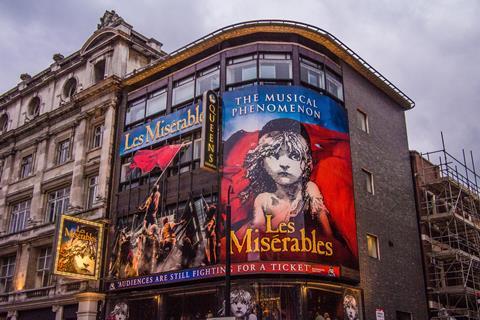
The famous musical created by two Frenchmen, Alain Boubil & Claude-Michel Schönberg is 40 this year. First performed at the Barbican in 1985 and directed by Trevor Nunn of RSC fame, the first reviews weren’t promising but demand for tickets went through the roof as word-of-mouth recommendations circulated. I watched a pre-tour version of it in Belfast last year with Michael Ball and Alfie Bow as protagonists; it was as impactful and mesmerising as ever.
Based on Victor Hugo’s novel, it’s a story of legalism and grace played out in 19th century France, focusing on the grim legalistic policeman, Javert, and the ex-prisoner, Jean Valjean, who finds grace from a priest in a dark hour and uses his life to live it out, taking the newly orphaned Cosette under his paternal wing. Underworld characters provide comic relief in the form of the Thénadiers, while a student revolution gains traction amidst the starving of Paris and is given pathos by young Gavroche, and the unrequited love of Éponine for Marius who has fallen for the now grown up Cosette.
READ MORE: This Lent, you should engage with famous film West Side Story - there are a lot of parallels to Jesus’ story
It’s success is demonstrated by impressive statistics: translated into 22 languages, performed in 53 countries, seen by over 130 million people
It’s success is demonstrated by impressive statistics: translated into 22 languages, performed in 53 countries, seen by over 130 million people and generating approximately £5.6billion at the box office. From the West End to touring productions and school performances, people flock to see it multiple times.
Cameron Mackintosh, who has grown insanely rich as a result of producing what’s affectionately known as ‘Les Mis’ (apart from all the other successful shows he’s masterminded), said: ‘I’m a firm believer in fate. God’s the best producer… And I was destined to do this.’ (The Daily Telegraph, Review: Saturday October 4th).
READ MORE: Heritage and Hope: Celebrating Gospel’s past and present
The themes still resonate with us. When the lights go up at the end of the production there are always tears and a flurry of tissues being passed along the rows. It’s a deeply moving piece of theatre. Grace is still relevant, attractive and captivating. Apparently Caird and his co-writer, James Fenton, tried to expunge the spiritual dimension from their adapted script but realised that in doing so they would lose the heart of the story. Victor Hugo himself was a staunch Roman Catholic in his youth.
One Sunday reviewer recently quoted director John Caird as saying, ‘There is a God-shaped hole in our culture that Les Misérables fills.’ Is he right?
READ MORE: Marilyn Baker: ‘I never thought God could use my voice’
Word on the street about the ‘Quiet Revival’ tells us that unchurched young people in particular are arriving on Sunday mornings asking about faith and who Jesus is.
Word on the street about the ‘Quiet Revival’ tells us that unchurched young people in particular are arriving on Sunday mornings asking about faith and who Jesus is. We could do worse than revisit Les Mis with them to understand the liberating nature of grace and forgiveness played out and so powerfully illustrated on the stage. While policeman Javert vows to hunt the ex-prisoner Valjean down through the years so that justice as he sees it can be served, when Valjean extends grace to him, the law man cannot grasp what is offered to him. Grappling with the contradiction between his own paradigm of right and wrong, he refuses to countenance that of Valjean which is the personification of life and death. When offered that life, tragically, Javert’s world view is shattered and he recoils from life altogether.
Perhaps the most powerful line of the production is one lifted directly from the novel. Before the final chorus, an ageing and ill Valjean is beckoned to heaven by the ghosts of Éponine and Cosette’s mother, Fantine. Together they sing in harmony:
Take my hand and lead me to salvation
Take my love, for love is everlasting
And remember the truth that once was spoken: To love another person is to see the face of God.
That final line is sourced in Jesus’ teaching in the Sermon on the Mount in Matthew 5:8: ‘Blessed are the pure in heart, for they will see God.’
The pure in heart are those who have been made clean before God through forgiveness. Les Mis still has the power to challenge us with biblical truth as well as entertain us. Like David in Psalm 51:10, we are prompted to make the same request: ‘Create in me a pure heart’. Amazingly grace-filled theology from a popular musical. Long may it continue, and grace be better understood and celebrated.




















No comments yet