







The BBC documentary Young, British and Tradwife explores the lives of women who have embraced traditional gender roles, including those who believe their lifestyle is rooted in their Christian faith. Kate Orson reflects on whether the tradwife ideal is truly biblical and questions whether the culture wars surrounding it risk distracting us from the gospel.
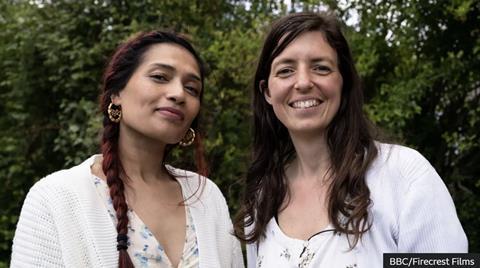
Presenter Poppy Jay (left) and tradwife and mother of seven, Molly Edwards @BBC/Firecrest Films
I sat down to watch the BBC documentary Young, British and Tradwife with some trepidation. I knew that two of the tradwives featured were Christians, and I wasn’t too optimistic about the chances of Christianity being portrayed in a sympathetic light. But I was curious to see what the documentary-maker made of their lifestyle and to explore my own thoughts about whether or not the tradwife ideal really is biblical.
Presenter Poppy Jay had a very personal reason to tell this story. She escaped a forced marriage that was controlling and restrictive. As one might expect from someone with her experience, she has an aversion to the idea of biblical submission. While the documentary clearly points out how the tradwife phenomenon connects to the Christian faith, there’s no mention of the fact that Jay comes from a Muslim family. It might have been more balanced to interview a Muslim tradwife too. Perhaps then it would have seemed less of a dig at the Christian faith.
I’m no tradwife, but I can relate to that desire to return to simpler ways of living: cooking, baking and taking care of the children. I feel like being a homemaker is a luxury that most of us can’t afford, and I actually think there must be a sense of freedom in being released from the pressure to provide financially. When I’m at home doing my housework before rushing off to work, I think about how the idea of women “having it all” is a complete impossibility, and so why not hark back to a time when it was possible for a family to survive on one wage?
In the documentary, Molly Edwards, a Christian and mother of seven children, is portrayed as someone full of authenticity and integrity.
In the documentary, Molly Edwards, a Christian and mother of seven children, is portrayed as someone full of authenticity and integrity. She is the only woman in the documentary who doesn’t make a living through promoting the tradwife lifestyle online. Megan is an online influencer who documents her life for social media. Laura Zachary, who married last year, coaches women in a “Wife Academy”, with courses costing up to £25,000. When we think of Titus 2:3–5 and how Paul exhorts the older women to teach the younger women, I wonder: is this really about biblical education or selling a lifestyle? When Laura talked about her own reliance on her husband, not just for decision-making but for shaping her very identity, I felt uneasy.
With mainstream documentaries, I do sometimes wonder if the subjects are being portrayed accurately or if the scenes are carefully curated to add a sense of drama and extremism. Aaron Edwards is shown working away in his study, writing books, while his wife and daughters do all the housework. Aaron describes his role as leading the family and reminding his wife of the bigger picture when she feels bogged down with domestic tedium. That sounds like he’s got by far the easier task, although he is shown doing some “manly” things like carving meat and chopping wood.
I’ve definitely let go of some of my feminist ways since becoming a Christian, and I feel a lot more appreciative of the unique ways God made men and women different.
I’ve definitely let go of some of my feminist ways since becoming a Christian, and I feel a lot more appreciative of the unique ways God made men and women different. But I think nuance can be lost whenever people take a strong stance, such as “tradwife” versus “feminist”. Women can recognise and embrace the differences between men and women while working outside the home. Men aren’t going to lose their masculinity by helping out with the cooking from time to time. Biblical figures such as Jacob, Lot and Abraham all prepared food.
My husband was completely hopeless at DIY and an amazing cook. Given the choice between writing books in my study and cooking a meal, I’d have to go for the former! God made us all so uniquely that I think we can embrace and love the differences in our gender roles while also allowing for some nuance. In Genesis 25:27, Esau is described as a “skillful hunter, a man of the field”, while Jacob “was a quiet man, dwelling in tents”. There’s no indication that Jacob was any less of a man for enjoying the quiet life.
I decided against mentioning the documentary to some of my non-believing family members because I think sometimes culture wars can be a distraction from what really matters: the gospel. I pray that this documentary will not put people off exploring the truth.
























No comments yet