









Why are shoppers going wild for M&S cookies, and what does this latest social media craze reveal about our deeper need for connection? Coco Huggins explores how our hunger for belonging points to something that only God and genuine community can satisfy.
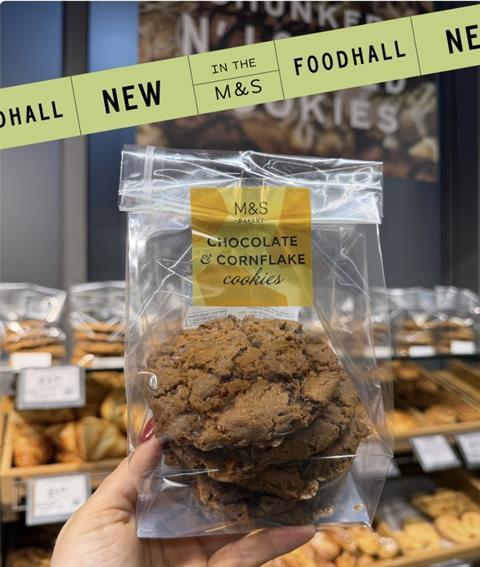
Last week, I was walking through a Marks & Spencer in central London. There is nothing particularly unusual about this. As anyone who knows me well will tell you, my penchant for “picky bits” (and, of course, a Colin the Caterpillar cake) is not quite a core personality trait, but is certainly up there.
What was unusual was the fact that I didn’t buy anything. This was because I had entered the shop, not to source some very aesthetically packaged hummus, but to try to spot an internet craze in action. Cookies.
This might seem strange, particularly if you’re not a big social media person, but Instagram and TikTok have been going crazy over M&S and its range of luxury cookies. So much so that food influencers began sharing videos of queues of shoppers frantically grabbing its latest flavour, chocolate and cornflake, out of the hands of M&S staff before they even reached the shelves.
READ MORE: Many female clergy donned the popular BELIEVE jumper from Marks and Spencer this Christmas, Revd Lucy Brierley explains why
Many might be tempted to scoff at the silliness of it, or even, perhaps, to scorn the poor behaviour of shoppers, but this latest trend reveals something far deeper about our society
Many might be tempted to scoff at the silliness of it, or even, perhaps, to scorn the poor behaviour of shoppers, but this latest trend reveals something far deeper about our society. Back in 2001, Leonard Lauder, chairman of the make-up and skincare brand Estée Lauder, coined the term “lipstick effect” to describe the growth in purchases of small luxury items during times of social and economic instability.
Some, like The Telegraph, have argued that M&S is now a signature example of this phenomenon, with the M&S Food brand being “enthusiastically adopted by young Gen Z and Millennial shoppers” who are replacing dinners or nights out with M&S treats. For Forbes, this is no longer a fleeting or cyclical phenomenon, but a permanent state where small treats replace “big dreams and deferred futures”.
With the usual life milestones feeling increasingly out of reach, it is unsurprising to me that young people are seeking “foodie dopamine hits that make life feel just a little bit less troubling”, as The Telegraph puts it.
READ MORE: ‘Love that for you’ isn’t enough: A Christian case for real encouragement
For me, however, this phenomenon speaks to something far more existential than the economics of affordability.
For me, however, this phenomenon speaks to something far more existential than the economics of affordability. We grab for the cookies, or rush to buy the latest winner of the algorithm war, not just because other goods seem out of reach, but because we want to be seen.
We want to show that we are “in the know”, seeking validation from an audience on the other side of a tiny screen. When we take that photo for social media, we are not just documenting a moment, but trying to be part of something. Seen in this light, the cookie we are reaching for isn’t just a cookie; it gives physical form to our hunger for belonging, community and identity. It was fitting, then, that as I walked to the bakery shelves at the back of M&S, I saw that they were empty, with a “Sorry, I’ll be in soon” sign covering the labels.
Social media trends are fleeting. As soon as one has gone, we need another to take its place, and this ultimately leaves us empty, with the same hunger as before.
READ MORE: Michelle Heritage: ‘If it’s impossible, then God gets the glory’
This hunger is one that no bag of cookies (even M&S ones) will ever be able to fill. It is what Belle Tindall-Riley calls our “sacred ache”: an innate longing for communion with God and, by extension, other human beings made in his image. Things we may take for granted in the ordinary life of churches gain a new significance when viewed in this context. The cup of tea after a service, the baby and toddler group, the warm hub or café are all invitations we extend to enter into relationships with each other across social, economic, ethnic and generational divides.
Social media trends may pass, but God’s invitation does not, and ours shouldn’t either. So while we may scoff at every passing trend, we need to ask ourselves: How are we helping to forge belonging, and what more can we do to tend to our sacred aches?






















No comments yet