






After 30 years serving in Ukraine, missionary Sharyn Borodina has witnessed the devastation of war, the heartbreak of displacement and remarkable stories of faith amid unimaginable suffering. She speaks to Woman Alive’s Jemimah Wright about living under drone attacks, prisoners of war finding Jesus and why she believes the joy of the Lord remains her greatest strength.
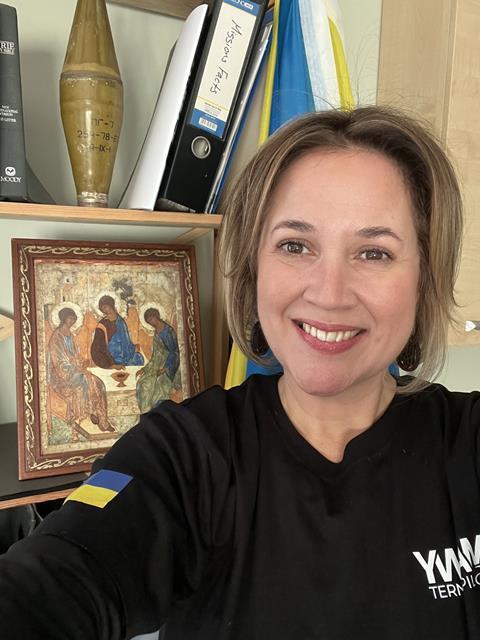
Before we started recording, you told me a bit about where you are and the situation. Can you share where you are, what’s happening and how your night was last night?
I’m in western Ukraine, in the city of Lutsk, and I’m here for a national gathering of Youth With A Mission in Ukraine. So I’m at a conference centre with about 100 full-time YWAM missionaries. And honestly, the last three months have been brutal in terms of drone attacks. But the last week, especially here where I’m at, has seen huge escalations. So I’ve been up in the night listening to the anti-drone defences shooting down drones. Lutsk, just a few days ago, had the largest drone attack since the onset of the full-scale war. There were over 1,000 drones focused on this region.
One thing that really stood out to me yesterday morning was a little girl, about four years old, called Mika. She wanted to go out to play, and she said to her daddy, “Daddy, the drones are gone. Can I go out and play now?”
So, if the drones are there, does that mean you’re in bunkers, or can you still sleep in your beds? What does it mean practically?
But this war has been going on for four and a half years, and people have just normalised this terrible reality. Most people do not go to the shelter. If there’s a really, really bad attack, the windows are shaking and you can hear the blasts close by, then people will go into the shelter, especially if they live in apartment buildings on the upper floors. So it’s enhanced my prayer time quite a bit, especially in the night hours.
Yes, I bet! And can you share what you were speaking on yesterday?
Yes. So I had the privilege of opening up our conference last night, and I’d been asked to share on the topic of gratitude. As I was praying and preparing for that, I really felt like the Lord gave me Nehemiah 8:10, which is the iconic verse, “The joy of the Lord is your strength.”
But I felt, what is the fruit of joy? It’s gratitude. And joy is such a different feeling from happiness. I shared about how our happiness, or the state of feeling happy, has to do with the things that are happening. And right now in Ukraine, the things that are happening are not happy. But joy is something that’s rooted in things that the enemy cannot steal from us. It’s interesting, in the book of Nehemiah, a lot of commentators say that the Hebrew word translated as “strength” could actually be better translated as “fortress” or “stronghold”. So, “The joy of the Lord is my stronghold. The joy of the Lord is my shelter.”
Can we go back to the beginning, how did you get to Ukraine?
Sharyn: I’m originally from the United States, from the state of Idaho. I have no connections at all in my family line to Ukraine, but as a teenager, when I was 18 or 19 years old, I just felt a desire to do a YWAM school that we run called a Discipleship Training School. It’s a three-month Bible school, and then you go on an outreach for two months. The location in the States that I picked had, up until that year, always sent its outreach teams to South America. I’d studied Spanish in high school, and it was a winter school. I thought, how nice would it be to do my thing for Jesus in the warm climate of South America, practise my Spanish and all of that?
And incidentally – although honestly, for me, it wasn’t an accident – it was 100 per cent confirmation of God’s call on my life, because we landed in Ukraine on my 19th birthday. This year marks the 30th anniversary of that day. And on that same day, I met my future husband, who was the interpreter who’d been sent to meet us. So this call on my life and this love for Ukraine that was imparted to me literally on my 19th birthday coincided with falling in love with my husband. He’s Ukrainian, and now we’ve had 30 years of full-time ministry here. It’s nothing I thought up or could have imagined for myself, but I’m so thankful to the Lord for the privilege of being able to serve here among these people.
The full-scale Russian invasion of Ukraine started in 2022, but the earlier conflict was in 2014, I think, with Russia annexing Crimea. Were you far away from all of that, and was fear an issue in the beginning?
Yes, it impacted our lives very much. We’d lived for 11 years on the Crimean Peninsula of Ukraine. And if you remember, and if your listeners remember, the headlines in 2014 were that Russia invaded and occupied Crimea. And so for our family, in a day, our entire life that we’d known for 11 years – our full-time ministry, the team we were working with and just our home – came to a close. Especially because of my American passport, it wasn’t safe for me to stay there. Our family had to leave. We, of course, thought we would get back, but the doors just closed and closed and closed, and so we relocated to western Ukraine.
I just remember feeling like it was something from the movies. And wondering, “Will I see my husband again?
I just remember feeling like it was something from the movies. And wondering, “Will I see my husband again? Is this the last time we’ll ever be here in this place that we’ve called home, where my children were born, where we raised them, where all those first memories of our young family were made?” And what I really recognised, maybe for the first time in my life, was that the only thing I could do was hold on to Jesus and just trust that He would lead us through those very difficult days. And He did.
When there’s bombing and fighting and shooting, death becomes more real. Did you have to come to terms with the thought of death being imminent in some way? How did you deal with that?
I don’t really recall feeling afraid for my life in 2014. But the realities of war since 2022 are very different. I personally have friends who are serving in the Ukrainian army. We have friends who are prisoners of war. We have friends who are missing in action. We have friends who’ve been killed in action. They called me and made me go and sleep in a different place. I didn’t sleep. The second night, the same thing happened. The third night, I wrote to my family and said, “Listen, if there are more than 40 drones coming in my direction, call me. If there are fewer than 40, just pray for me. But I just need to get my sleep!”
You told me two things before we started. One was a story of a prisoner of war. Can you share that story?
I was here in the summer of 2025, and I had the privilege of speaking at our church. Incidentally, it was a different message on joy. I’d felt like the Lord had asked me to remind them about His joy. And at the end of that Sunday service, a young woman came up to me and began to share her story with me. Maybe she was 22 or 23, but she was newly married, and her husband was a twin.
Both he and his twin brother had been serving on the front lines of the Ukrainian army. They were both captured, and they were in captivity at the same time. And for whatever reason, and there’s really probably no logic to it, the Russians couldn’t figure out that even though these two men looked exactly alike because they were identical twins, they were not the same person. She asked if there was anything I might be able to do to help her, which I really didn’t have any way of doing other than to pray. So I prayed for her and just asked for God’s provision and breakthrough.
Well, this past summer, it was all over the news. Her husband had been released. About two or three months into his captivity, he had a dream. This man was not a believer, but he had a dream that God told him he was going to be freed on Easter Sunday 2026. I feel like he was in captivity for about a year, perhaps nine months to a year. So there was a journey to surviving until Easter Sunday. But he began to pray every single day. And sure enough, on Easter Sunday, he was released.
There’s a news video of him, together with the others who were released, in the process of returning home to Ukraine. And the first thing out of his mouth was, “I had this dream, and God told me He was going to release me on Easter Sunday.” Anyway, this man and his wife are now going to our church here in Ternopil, and they’re learning to walk with the Lord.
You were sharing another story about the Latino soldiers. Can you tell us that story?
One of these couples, one of these families, their names are Gabrielle and Carla. They had grandparents who were from Ukraine and who had immigrated at the turn of the century to Argentina. So there was a history and a connection, and they felt a call from God to return to their family home, the family home of their great-grandparents.
Well, I had high-school Spanish years ago, but we had this family and other workers who did speak Spanish. So right away, they formed these chaplain teams and began to minister specifically to these brigades that were being formed of Spanish-speaking Latino soldiers. Every Monday, we get together at our YWAM base, and we have our praise reports. And it seemed like more and more, I was hearing from our Spanish-speaking staff, “Yes, we had a Sunday morning service all in Spanish. We had an altar call, and these guys came to know Jesus.”
Yes. We’re definitely seeing church attendance increase significantly.
As missionaries, have you found that there’s an increased openness among people to hear the gospel, and has it been easier to evangelise?
Yes. We’re definitely seeing church attendance increase significantly. The evangelical church here is about five per cent of the country. The main churches are Catholic and the Ukrainian Orthodox Church. So we’re definitely seeing much bigger church attendance.
What has encouraged me so much is seeing ministries that are being created, mostly through Christian organisations and evangelical churches, that are ministering to widows, bereaved parents, families of soldiers and injured soldiers. And I think it’s in those places that we’re really seeing opportunities for people to come to faith in Jesus. I often talk about how it’s a “for such a time as this” moment for the Church here in Ukraine. I don’t think there’s an answer that can fix that hurt outside of the message of Jesus Christ and what the Bible teaches about forgiveness and roots of bitterness.
What would you say to those in the UK who might be feeling fearful about the possibility of war?
And I guess it goes back to what we were talking about earlier, about how the joy of the Lord is my stronghold. None of us wants to face the horrors of war. None of us wants to face tragedy. None of us wants to face those kinds of difficulties. But come what may, God will be there. Come what may, He will give us what we need to walk through whatever it is. And now, in this moment, I often tell people that if we really could see what happens when we pray, we would be much more motivated to pray all the time.
Listen to this interview here.
For the Love of Ukraine: A Story of Faith, Family, and the Fight for Freedom by Sharyn Borodina is available through online booksellers, including Amazon.


Louis Theroux reunites with Megan Phelps-Roper: She escaped America’s most hated church – and explains why they do what they do

Robert Pattinson, James Bond and faith: How my cousin became the first Bond girl – and left Ian Fleming wrestling with guilt

‘Prayer could reduce inflammation and stress hormones – science is discovering what Christians have known for centuries’


















No comments yet