
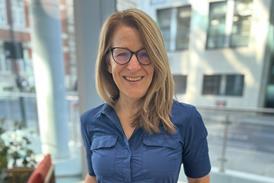







Naomi Partridge has spent more than 15 years developing leaders for some of the world’s biggest food companies. Today, as co-founder of Holos Kombucha, she combines that corporate experience with a passion for helping businesses create genuine social impact.
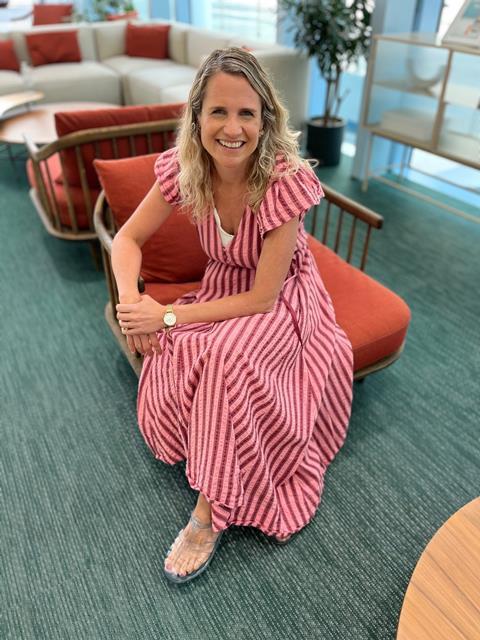
I met Naomi Partridge on a hot July day at Premier’s London studios. She came bearing gifts – bottles of Holos Kombucha, and she has not paid me to say this, but they were possibly the best kombucha I had ever tasted (and I have tasted a lot). Before we got into the Holos story, Naomi spoke a bit about her childhood in High Wycombe.
“I was raised by two parents who loved Jesus and raised us to know him. Going to church, praying together as a family, those things were simply part of our life.”
Her father, who became a leadership coach, also had a profound influence on her future career. “My dad was coaching my brother and me from a really young age, asking, ‘What do you want to do with your life?’ Because of that, I felt I had quite a clear sense early on that I wanted to move into coaching and leadership development.” That calling led her to study psychology before joining Cadbury’s graduate HR programme. Looking back, Naomi believes her Christian faith naturally shaped her understanding of leadership.
“I really see leadership as an expression of faith. There’s so much in the Bible about leadership and about treating people well and with love. Those principles can be directly applied to organisational culture.” Although she loved her work, after around a decade she sensed God inviting her into something different.
“Throughout my twenties I worked really, really hard. I absolutely loved working, I genuinely enjoy work. But I could feel that if I didn’t disrupt myself, I’d probably still be there twenty years later wondering, ‘Was that really God’s call for my life?’ I just had this hunger that there was something more.” Naomi asked her employer if she could take four weeks’ leave to attend a worship programme at Bethel Church in California.
“They said, ‘Actually, we’re sorry, but you can’t have four weeks, you can have two.’” Those two weeks only deepened her conviction. After she shared her desire to spend longer at Bethel, her employer offered her something she still describes as remarkably generous.
“They gave me a whole year off to do the first year of Bethel’s School of Supernatural Ministry and then return to my job afterwards. It was such a generous thing for them to do.” She arrived expecting to deepen her faith. Instead, God began dismantling the identity she had unknowingly built around her career. “I started that year having placed so much of my identity in my work. I’d worked really hard. I was single. I loved what I did. Without even realising it, my job had become such a big part of who I thought I was.”
Then she arrived at Bethel. “No one cared. No one cared what job I’d done or what I could achieve. It stripped everything right back. Then it became this journey of asking, ’Jesus, if I don’t have that identity anymore, then who am I? Where is my identity found? It became this rebuilding process where my identity wasn’t based on what I achieved anymore, but on who I was in Christ.”
Halfway through the year, Naomi sensed God prompting her to spend a week fasting. “I just felt I needed to get on my knees and really press in. The minute the fast ended, I received what I can only describe as a spiritual download. I literally wrote out what I was to do with my life. The strange thing was that I wasn’t even seeking that. I wasn’t praying, ‘God, tell me what to do.’ I was simply saying, ‘I’m here with nothing. Just meet me.’”
She believes God spoke four things with unusual clarity.
“He said: ‘I want you to help fight modern slavery. I want you to work with women. I want you to help women rebuild their lives after slavery. And I want you to speak—to bring awareness of this.’”
“He said: ‘I want you to help fight modern slavery. I want you to work with women. I want you to help women rebuild their lives after slavery. And I want you to speak—to bring awareness of this. What’s so weird is that I hadn’t really been tracking with that form of social injustice at all.” Then an old memory resurfaced.
“I remembered being 14 years old at another youth camp and having an encounter with the Lord where he broke my heart for modern slavery. I’d completely forgotten about it. God knows the whole story, and there’s such reassurance in that. Sometimes he gives you a glimpse and you suddenly realise, ‘Wow, you’ve been planting seeds for years.’”
Although she felt certain about the calling, she had no idea how it would happen. “I knew that’s what I was to do, but I had absolutely no idea how.”
After turning 30, Naomi returned to England. “I came back, moved to London and, to be honest, hit a huge low. I’d left this amazing community. I was working from home before people really worked from home. We were on Skype all day in long meetings, and although I loved where I worked, I was really struggling.” Unsure what to do next, she prayed again.
“I said, ‘Lord, you might be telling me to do something about this calling now, or you might not. I’m going to test it by going back to Bethel for ten days.’”
The answer came on the final day. “On the tenth day I met someone who invited me to join a trip to Cambodia the following March, supporting survivors of exploitation. It was in Cambodia,” she says, “that the Holos story really began.”
In Cambodia, Naomi also met the woman who would become her business partner, Megan. “We actually met at Heathrow Airport,” Naomi smiled. “Megan had only just started dating Joseph, who’s now her husband.”
The two were the only Brits on the trip and quickly bonded over a shared conviction that business could create opportunities for women escaping exploitation. “Even on the flight over we were talking about how business could become a way of creating opportunities for women who’d experienced exploitation.”
While serving in Phnom Penh, they spent an evening on street outreach, where they met two women being exploited.
While serving in Phnom Penh, they spent an evening on street outreach, where they met two women being exploited. “They were really hungry for the Lord, and both of them gave their lives to Jesus during that trip.”
Rather than simply offering immediate support, Naomi and Megan began asking practical questions. ”They both enjoyed doing manicures and pedicures, so we bought them manicure and pedicure kits. We arranged for them to work with our hotel for the next few days, and they earned enough money to buy a phone and begin taking some really practical steps forward.”
The women were also connected with a trusted local charity. For Naomi, it revealed the transformative power of sustainable employment. “Sometimes a small amount of support can completely change the course of someone’s life.”
Although Megan remained in Cambodia for another six months, Naomi returned to England convinced she should use the skills she already possessed. “My first thought was simply, ‘What can I do with the skills I already have?’” Drawing on her HR and coaching background, she began running employability programmes in safe houses for women who had escaped exploitation.
“I found three friends who wanted to help, one of whom was Christine, who later became one of the original Holos co-founders.” The team approached several charities before receiving an unexpected invitation from the Sophie Hayes Foundation. Naomi became CEO, leading the charity for three years while developing employability programmes that have since supported almost 1,000 women.
“All those years in corporate learning and development suddenly made complete sense. Those skills were now helping women rebuild their confidence, identity, belonging and purpose.” About eighteen months later, Naomi and Megan met for coffee in a Starbucks in Angel, north London.
“We started chatting and one of us said, ‘Do you remember that business idea we had in Cambodia? Could we actually do something with it?’”
Then Megan shared something extraordinary. “She said, ‘Last night I had a dream. In the dream we’d started a business and it was called Holos.’”
Then Megan shared something extraordinary. “She said, ‘Last night I had a dream. In the dream we’d started a business and it was called Holos.’” Looking up the name, they discovered that holos means “whole” in Aramaic.
“It was the perfect picture of what we believed God wanted to do.” At that stage, however, they still had no product. “We knew we wanted to start a business, but we didn’t know what we were going to make.”
Instead of beginning with a product, they started with a purpose. “We wanted something that could sit on a supermarket shelf, something we could manufacture ourselves so we could create entry-level jobs, and something that was part of a growing trend.”
In 2016, kombucha stood out. “Megan had discovered kombucha in Cambodia, where she’d been drinking it to help her stomach. I’d tried it at Bethel, although honestly I didn’t like it very much at the time! We looked at the forecasts and thought, ‘Why not give it a go?’”
The following day they bought around £100 worth of home-brewing equipment. “Megan started brewing in her kitchen while I focused on the business side.”
Around the same time, Naomi met her future husband, Tom, at Christ Church Fulham. “It was quite a small church then, and I think we both assumed it probably wasn’t where we’d meet our future spouse. But we loved the church.” When Naomi first introduced Tom to kombucha, he wasn’t convinced. “He tasted another brand and said, ‘That tastes like cheese water!’”
But Tom, a manufacturing engineer, soon became fascinated by the challenge of producing a better-tasting kombucha. “He said, ‘If we’re going to do this, I want to make the best-tasting kombucha people can buy.’” Eventually Tom, Megan’s husband Joseph and their friend Christine joined Naomi and Megan, giving Holos five founders with complementary skills.
“We all came into Holos for different reasons and with different gifts, but we shared exactly the same purpose.” From the outset, social impact was built into the business. “We never set out simply to build a successful drinks company. We wanted to create a business that could help people rebuild their lives.” The founders set aside 25 per cent of the company’s shares for survivors through what is now the Holos Foundation, and committed themselves to creating employment opportunities for women rebuilding their lives after exploitation.
“Our very first paid employees were survivors of exploitation.”
Today, Holos has supported 17 survivors through paid placements, with dedicated trauma-informed workspaces in its factory. The company launched in 2018 and received early support from Resurgo Ventures, helping the founders embed impact into the business from day one. Today, every can of Holos sparkling tea contributes to the Holos Foundation, providing grants that support survivors as they rebuild their lives. Looking back over the twists and turns of her journey, from a childhood spent in church, through a successful corporate career, a life-changing year at Bethel and a pivotal trip to Cambodia, Naomi sees a God who was quietly preparing each chapter long before she could understand it herself.
“I think sometimes we want God to give us the whole plan,” she reflected. “But often he simply asks us to take the next step. When you look back, you realise he was weaving it together all along.”





















No comments yet