






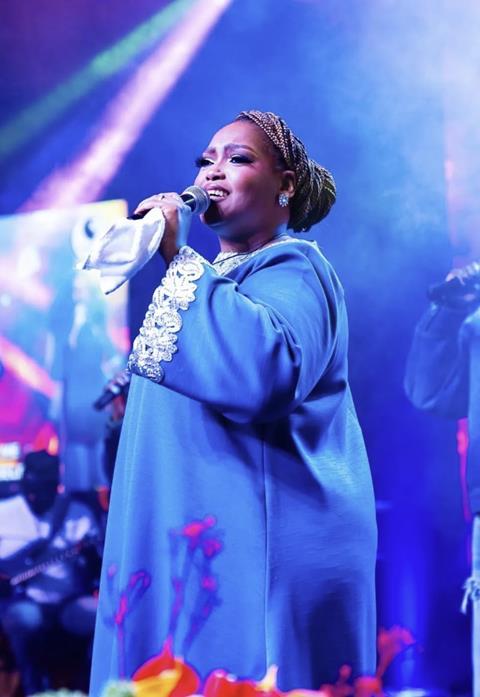
As reports of a ‘quiet revival’ emerge across the UK, award-winning South African gospel singer Ntokozo Mbambo believes God is also moving powerfully in her homeland. Speaking to Jemimah Wright for Woman Alive, she shares her journey of faith, growing up under apartheid and why she believes a new season of spiritual revival is beginning.
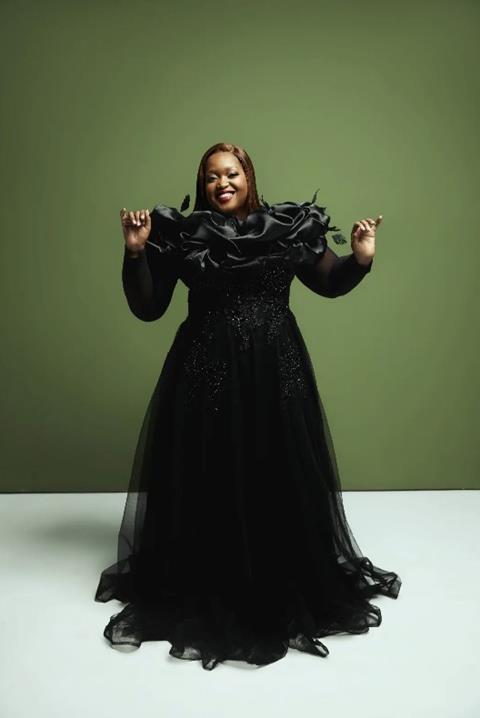
Can you tell us a little about your childhood and how you came to faith?
I grew up in a very strict Christian home. My mother used to be a worship leader in our church, and my father used to do the sound in our church. When I grew up, I actually thought that salvation was passed on from generation to generation. I didn’t think at that point that I had to choose Christ for myself. Until my aunt, my mother’s sister, kept on asking me: “When did you accept Christ? I don’t remember seeing you accepting Christ into your heart.” And I made up some lie! I said: “No, I accepted Him when I was in Sunday school”, trying to create this facade of an experience that I hadn’t had.
I remember we had a crusade in a tent in Umlazi, which is in Durban, South Africa. This pastor spoke such a word that really resonated with my heart, and I felt like God was calling me personally. When he made an altar call that day, I don’t remember standing. I don’t remember walking down the aisle, but I just remember seeing myself literally at the front and crying in His presence.
It felt like an out-of-body experience where God literally made me stand up and carried me to the altar where I could ultimately receive Him. That was the encounter I had when I was 13, and I accepted Christ into my heart.
Did your family notice a change in you after that?
I truly believe that when I accepted Christ, there was a change in the way that I sang because it now came from a place of personal encounter. It came from a place of experience, vulnerability and authenticity. I was no longer living a life of purity because I was scared of my parents, but because I feared God more than anything else.
Do you believe there’s a difference between having musical talent and being anointed by God?
I absolutely do believe there’s a difference. But you know how Scripture says that the gifts of God are without repentance? I believe that God had gifted me and had anointed me. My grandfather spoke a word while my mother was pregnant, and even when I was two years old, my grandfather prophesied over my life. He said that I would travel even to places that he’d never been, preaching the gospel of Jesus Christ.
You were about eight or nine when apartheid ended in South Africa. What do you remember about growing up during that time?
I never felt it because I was so young. As much as there was segregation, my parents worked really hard to make sure that I never felt it. My parents had a way of shielding me and my siblings from the harm of what was going on outside. I definitely know that they experienced it hands-on. I know stories of my father running, trying to get away from the big police van that was trying to arrest them during that time.
I know stories of how my mother had to work extra hard and fight for her position in the hospital where she worked. When she became a nurse, she had to look after her siblings because apartheid had literally locked up black people in such a way that they made sure they never progressed. Progress was very limited in our communities, and my mother had to fight against all of that and break barriers to make sure that I had a better future, and that her siblings could also have a better future.
You sing in both isiZulu and English. What does it mean to worship in your mother tongue?
Oh man, I think it’s such a blessing. It’s so beautiful. I love the Zulu language because it has certain phrases and certain expressions that cannot be explained in mere English. There’s something pure when people worship God in their own tongue because I feel like you’re able to express yourself better. You’re able to find expression and freedom.
You’re one of South Africa’s most celebrated gospel singers. How do you navigate the tension between fame and worshipping God?
I think it really helps to have a very strong relationship with the Father. It helps in the sense that it’s a continuous reminder that it’s not about me, but it’s all about Him. Even when all is said and done, when the awards come through, when people send through their praises, I always find a moment to take all the glory and all the accolades and all the praise and give it back to Him. In a world where people elevate man more than anything, what has kept me sane is remembering that the giver of the gift is the one who deserves all the glory.
In the UK, there’s been talk about a ‘quiet revival’, with young people coming to church and renewed interest in the Bible. Your album is called The Sound of Revival. Are you seeing something similar in South Africa?
Ooh, there’s definitely something similar happening in South Africa. There is definitely a strong move of God. There’s a strong wind that is blowing and brewing. There’s a stirring. I truly believe that at this moment there definitely is a stirring in the spirit. The word itself explains it. When you revive something, you’re bringing it back to life. You’re bringing that which was dead back to life.
I truly believe that we are in the season where God is bringing back to life His people, through the move of the Spirit, through the fire that is burning within us. All around the world, there is this urgency in the spirit to preach the gospel. You’re seeing a lot more people speaking the gospel even on social media, because there really is a stirring going on.
What do you think Christians in the UK can learn from the South African Church?
There are still a lot of hardships going on in our country. It didn’t just end with apartheid. We’re going through a process of learning to live in freedom, and whether we are free indeed. I truly believe that in our country right now, we’re seeing a lot of people coming back to God, coming back to Christ, coming back to the heart of what this life is all about, and it’s all about Jesus. My prayer for the UK is to go back to the One who knows all, to the One who is all, to the One who is able to do exceedingly abundantly above all that we could ever ask or think, according to the power that is at work within us.
That’s all it takes. It takes us literally going back to Him, turning from our wicked ways, seeking His face, and remembering that He is our Maker. No one knows our future. No one is able to help us like He can.
You’re married to fellow musician and producer Nqubeko Mbatha. What encouragement would you give Christian single women waiting for their future husbands?
God is faithful. That much I know. God is faithful. What we have to do is make sure that we hear clearly from Him, because it’s so important who your life partner is. We’re living in a time where people are saying red flags, green flags, but honestly, the flag that matters most is the flag from heaven. If heaven says yes, then that is the correct path.
With your work leading people in worship, how do you protect your relationship with God and avoid becoming spiritually exhausted?
It’s making time to sneak out from the crowd. Now, it has to be daily. It can’t be a once-in-a-while kind of thing because daily people want something out of me. I have to continuously step out and spend time in God’s presence, not because I’m obligated to, but because I love His presence. It’s got nothing to do with me wanting anything from Him. It’s got nothing to do with bringing my requests, but ultimately it’s because I just love Him, and I just love being in His presence.
His presence is renewing. His presence is reviving.
One of the members of my church home group, Setu, is a huge fan of yours. He wanted to ask about your song ‘We Pray for More’. What inspired you to write it?
Wow. Well, hi Setu! The story behind that song is really very interesting. I had been invited to a place here in South Africa called Brits. There was a gathering there, and when we arrived at the venue, there was practically nobody. I believe there had been a murder recently of a schoolteacher who had been kidnapped and murdered on her way home from school. The community had come together to organise this concert to raise funds for that family, but also to pray for their area, to bring God’s presence and intercede for that area.
We did our soundcheck and went to get changed. When we came back in the evening, there were still fewer than 20 people in the audience. There was hopelessness. There was that moment of: why are we even here? What are we even doing? What are we trying to achieve? And in that moment, in that hopelessness, God birthed this song in my spirit.
Even in the midst of the turmoil and the destruction that the enemy is bringing in the community, our cry will always be: “God, we need more. We pray for more of You. We pray for more of Your presence, more of Your power, more of Your glory, so that our communities can be changed.” A performer would probably walk away and say: “No, I refuse to stand up and sing in front of an audience of 20 in a huge community hall.” But because the heart of it all was always about God’s Kingdom and the advancement of His Kingdom, God honoured us by birthing out the song ‘We Pray for More’.

Looking back over your life, what has God taught you about trusting Him? Can you share a time when circumstances looked disastrous, but you had to trust God?
I’ve had to trust God in the worst of situations. You know how Scripture says in Proverbs: “Trust in the Lord with all your heart, and lean not on your own understanding”? I remember in 2015, my husband and I embarked on a faith project. God spoke to me and told me to do a recording, to go all out. An extravagant recording. It was something that had never been done in our country at a venue that hadn’t been explored by gospel artists.
It was hard because it required a lot of money, money that I didn’t have. It made absolutely no sense. I remember we didn’t even have money to feed people at rehearsals. I would wake up at 3am so that I could cook lunch for the day. At that time, I also had two babies. One was about four years old, and I had a two-year-old.
I thank God that we have such a wonderful pastor, Apostle Mzo. One Sunday, he gave us his bank card and said: “Every day, make sure you take out a certain amount, just so that you have money for every day.” Then I remember a week before the recording, we realised that we were sold out. All the tickets had been sold. There wasn’t a seat available.
I was starting to get an anxiety attack because the pressure of everything was just overwhelming.
Yet we did not have money to pay the service providers. We had to pay the production team, lighting, sound and everything. We had absolutely zilch. I remember one day I was in my room, and I felt like I was starting to get an anxiety attack because the pressure of everything was just overwhelming. It felt like an elephant had been placed on my chest, and all of a sudden I couldn’t breathe.
My husband wasn’t home, and my daughters were at preschool. I was alone in my house, and I felt like I was dying because of the pressure. At that point, I remembered something I had heard in a church service. A man of God said that the only way to counteract thoughts of defeat is through speaking the Word of God. I remembered that, and then I remembered the Scripture that said: “Be anxious for nothing.”
I found it in Philippians 4:6–7, and I started saying it. I couldn’t get anything out of my mouth, but I just mumbled it: “Be anxious for nothing, but in all things through prayer and supplication with thanksgiving, make your requests known unto God. And the peace of God, which surpasses all understanding, will guard your heart and mind through Christ Jesus.” I kept saying it over and over and over again until I realised: hey, my voice is coming back. Then I realised I was starting to breathe a lot better.
All of a sudden, I could breathe. All of a sudden, the weight was lifted off my shoulders. All of a sudden, I could feel the warm embrace of God Himself, of His presence, of His Spirit. I felt like at that moment I was not alone, and this was not my battle anymore. The joy of the Lord, which is my strength, started coming back, and I felt alive again because I realised once again that this is not mine.
This project is not mine. This recording is not mine. God told me to do this, so He’s the one who’s going to take care of it. Ultimately, the recording happened. It was a huge success. One of my biggest songs was recorded that night, ‘Jehovah Is Your Name’. It’s got over 36 million views currently. It was through that song that I started travelling internationally. That seed that my husband and I sowed at that time, out of nothing, God used it to propel us and to move us to the ends of the earth, to countries we could never have imagined we’d be able to travel to.
Ntokozo Mbambo’s latest collaborative album, United Altar Sounds: Prayer Room, recorded with her husband Nqubeko Mbatha and fellow gospel singer Ayanda Ntanzi, was released in January 2026. Her latest single, ‘Prayer for the Nation’, is a call for spiritual renewal and national healing, reflecting her belief that God is stirring revival across South Africa.


‘I converted to Islam searching for God – then I encountered Jesus’

I’ve heard bombs exploding over my head, but my faith in God remains unshaken: A missionary’s story from Ukraine

Louis Theroux reunites with Megan Phelps-Roper: She escaped America’s most hated church – and explains why they do what they do



















No comments yet