


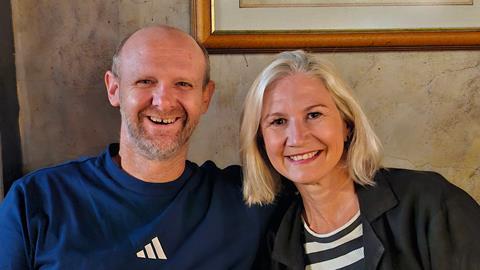

Anne Hartslief on her journey after being diagnosed with cancer
There are seasons in life where, on the surface, everything appears to be working. You are doing the right things, making the right choices, showing up with intention and discipline. From the outside, it looks like progress. But underneath, something begins to shift – quietly at first – until a question forms that you can no longer ignore: Is this actually the life I thought I’d be living?
I didn’t realise how much I had built my life around forward motion until mine came to an abrupt halt.
In 2022, I had confidently declared that it would be my year of ‘next-level health’. I was fully committed, eating well, exercising consistently, attending to long-overdue medical check-ups. I spoke about it often, with the kind of conviction that comes when you believe effort and outcome are directly linked. If I did the right things, I assumed, the result would follow.
Then, at what was meant to be my final routine check-up of the year, I went for a mammogram. Within moments, the narrative I had been living inside shifted completely.
I was diagnosed with cancer.
Living in the ‘before’ and ‘after’
What surprised me most was not immediate fear, although that would come in time. It was the deep and disorientating sense of shame. It felt as though my body, something I had carefully disciplined and managed, had failed me. Despite all the effort, something had been growing inside me anyway, outside of my control.
That moment marked the beginning of a very different kind of journey, one that could not be approached with the same mindset I had used before.
What surprised me most was the deep and disorientating sense of shame
There were surgeries: a double mastectomy, the removal of ovaries and lymph nodes. There were treatments, consultations and long stretches of waiting. Life quickly divided into ‘before’ and ‘after’, and I realised that the structures I had relied on – competence, resilience and the ability to make a plan – were no longer enough to carry me through.
This was not something I could push through or manage my way out of. I had to sit in it. And that was deeply uncomfortable.
I remember standing in church one day, asking a question that felt almost too raw to voice: “How can my body be a temple when it carries disease?” It wasn’t a theological question as much as it was a deeply personal one. The things I had trusted – strength, health, control – no longer felt secure, and I was left navigating a landscape I had never prepared for.
It was in that space that I began to understand something I had read many times in scripture but had never truly experienced: some of the most significant moments in our lives begin in places we would never have chosen.
The Bible often refers to these places as wilderness or exile. And exile, I came to realise, is not only geographical. It is any place of deep disorientation, where life no longer resembles what you expected. It is the diagnosis you didn’t see coming, the relationship that didn’t hold, the opportunity that fell away. It is the moment where your internal map no longer matches the terrain you find yourself in.
How God met me
What struck me most in that season was not how quickly things changed, but how God met me within that change.
He did not meet me with answers or timelines. He did not immediately resolve the situation. Instead, He met me with something far more foundational: identity. Before anything shifted externally, there was this quiet but persistent truth that surfaced again and again: “You are mine”. Not because I was handling it well. Not because I was strong. Not because I had done everything right. Simply because I belonged to Him.
If I am honest, that was not easy to receive. I had built so much of my identity on being capable, on being able to hold things together, to lead, to navigate complexity. And suddenly, I couldn’t. I was confronted with a version of myself that was uncertain, vulnerable and deeply aware of her limitations.
There is a moment that remains particularly vivid. After my first surgery, I walked into the oncologist’s office, expecting closure. I believed the hardest part was behind me. Instead, I was told that the cancer was still present.
In that instant, something in me shifted. Not dramatically, but deeply. I realised that this was not going to be quick or predictable, and that I was not in control of how it would unfold.
That is when the waiting truly began.
The waiting and the unravelling
Waiting has a way of revealing what lies beneath the surface.
Not necessarily things we are consciously hiding, but the patterns we have lived by without questioning. For me, it exposed how much I relied on strength, how quickly I moved into action instead of allowing myself to feel, and how uncomfortable I was with needing others.
It also revealed how much of my identity had been shaped by performance. Just as I was beginning to re-engage with life and work, I became seriously ill again. An infection led to septicemia, and I was rushed into hospital. I remember asking the doctor if I could finish a meeting before going in. This was a small but telling indication of how deeply ingrained my patterns were.
That moment made something unmistakably clear: the way I had been operating was no longer sustainable.
What followed was not a neat transformation, but a gradual unravelling. It was uncomfortable, often messy and at times deeply confronting. Yet within that undoing, something new began to take shape.
The version of me that believed I had to hold everything together began to soften. The belief that I could control outcomes started to loosen. The connection between worth and capability began to weaken.
In its place, a quieter but more grounded sense of identity began to emerge, one rooted not in what I could do, but in who I was.
This shift was held and supported by the people around me. My husband, my children, my friends loved me not for my strength, but for my vulnerability. There is something profoundly transformative about being loved in that way. It does not reinforce performance; it gently dismantles it.
Through that process, I began to understand surrender differently.
Identity is not something we achieve – it is something we receive
Surrender is often misunderstood as passive or defeatist, but what I experienced was something far more honest. It was the recognition that I could not carry everything on my own. It required letting go – not only of outcomes, but of the identities and coping mechanisms I had relied on for so long.
And letting go is rarely comfortable.
We want clarity, certainty and direction. We want to know what lies ahead before we take the next step. But what I experienced instead was a different kind of guidance, less like a detailed map and more like a compass. There was a sense of direction, even when the full picture remained unclear.
Over time, both internally and externally, things began to shift.
Forever changed
Months later, I received the news that the tumour was gone. The relief was immense, but it was accompanied by a deep awareness that I was not the same person who had entered that journey.
Nor was I meant to be.
Something in me had changed. The need for control had softened. The need to perform had loosened. In their place was a deeper humility, a stronger sense of belonging and a clearer understanding that identity is not something we achieve – it is something we receive.
Looking back, I can see that the most significant work did not happen when everything was resolved. It happened in the waiting, in the uncertainty, in the places I would never have chosen.
That is why this story continues to matter, regardless of the season. Because all of us, in different ways, find ourselves living in that space between what has been promised and what has not yet come to pass.
We live between clarity and confusion, strength and vulnerability, joy and sorrow. And perhaps the invitation is not to rush past that tension, but to recognise it as part of the journey itself. To trust that even here, something is being formed. That we are not abandoned in the waiting. That we are not disqualified by the wilderness. That the places we did not choose may hold the very transformation we need.
If there is one thing I have come to know, it is this: God does not wait for us to become whole before He comes towards us. He meets us in the middle of our uncertainty, our questions and our vulnerability.














No comments yet