









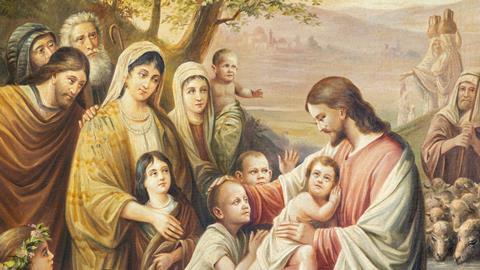

Elaine Storkey unpacks scripture to show us the ‘enormous value’ God places on young people
Study passages: 1 Samuel 3, Psalm 8:2, Matthew 21:14-16, Luke 1:39-45
We often think that the Christian education of a child is a one-way process. We are the ones who believe, so we teach our faith to children to help them to believe too. We read them biblical stories. We tell them they can talk to God and teach them to pray. We teach them worship songs and actions. We instil in them a sense of God’s amazing power and glory reflected in the world God has made. We explain about sin and forgiveness as we share God’s love for them and others. In all this, we’re following the wisdom of the writer of Proverbs when he says: “Start children off on the way they should go, and even when they are old they will not turn from it” (Proverbs 22:6).
Sometimes, however, the biblical authors suggest that the education of young people can also be a two-way process. They present the possibility that children might know God already and develop an authentic faith without it first being instilled by an adult. For God is God, and the spirit of God has access to the heart of a child and so can speak directly to it. Children might even teach us. We discover this in the story of young Samuel, who heard God’s voice calling him three times. Eli the priest was a mature worshipper, but it wasn’t until the third call that he was able to work out whose voice it was (1 Samuel 3:8). And when Samuel made his own obedient and reverent response to God, “speak, for your servant is listening” (v10), God shared with him a disclosure of wisdom and truths which had been hidden from the mature and worldly wise. He became the teacher of Eli, revealing truths which were hard to hear.
In the Psalms, we also find that children can worship God of their own accord. And that worship can release God’s power in places where it is needed. Psalm 8:2 tells us that “through the praise of children and infants” God has “established a stronghold” which defeats enemies and silences the avenger. Jesus draws on this in the New Testament. When He enters the temple at Jerusalem, He sees the corruption and dishonour in what should be a place of worship. An uproar follows as He overturns the money tables and then goes on to perform miracles of healing. His enemies, the chief priests and Pharisees, are outraged at His actions and furious also at the shouts that come from the children. Yet as the children call out “Hosanna to the Son of David” we realise that they see what the Pharisees don’t. They recognise these as miracles and they know who Jesus is. Their shouts are cries of worship. And the religious leaders are indeed silenced when Jesus reminds them of the Old Testament teaching: “From the lips of children and infants you, Lord, have called forth your praise” (Matthew 21:14-16).
The testimony of the unborn child John
We probably all know the most dramatic example of a little one responding to God. He is also the youngest. The context is the meeting of two pregnant cousins, Mary and Elizabeth. Mary had travelled to share news of her pregnancy, but Elizabeth also found out another way. As Mary arrived, Elizabeth exclaimed: “As soon as the sound of your greeting reached my ears, the baby in my womb leaped for joy’ (Luke 1:44). Luke, the doctor and Gospel author, was fascinated enough in the detail to record it not once but twice. He mentioned it in the narrative itself and then in the inspired words that Elizabeth uttered (vv41,44). He knew its medical explanation but wanted us to understand its spiritual significance.
Foetuses of a reasonable size do, of course, move around in the womb. They respond to their own growth in size and organ development. They kick, wriggle and take up the most awkward positions for the mother. They also respond to external stimuli, including the emotions of the ones who carry them. Detailed studies tell us of some of the ways a mother’s trauma or prolonged anxiety can be experienced by the tiny human inside her. So can excitement or joy. Therefore, for a child to leap in the womb when something dramatic is happening is by no means unusual.
Yet what Elizabeth described was more than a natural reaction of a human foetus to an external stimulus. Her baby was relating to the divine presence within Mary’s womb. The Holy Spirit disclosed to this unborn child that the tiny being developing in the womb of Mary was none other than the promised Saviour of the world. The movement of Elizabeth’s baby was a leap of joy and praise. It was an acknowledgment that although his eyes could not yet see, nor his fragile young lungs yet breathe, he could already praise God. And this foetus’ excited leap of exaltation was followed by a lifetime of service, then martyrdom, for his cousin and Lord.
This story is unique yet it also points to the truth that there is no time in the life of a human being when we are too young or too insignificant to praise God, for He has been active in our lives from the beginning. It is a point that the psalmist reflects on when he thinks about his own life. He knows God’s presence and involvement have been there from the earliest moments, even in the very act of creation: “You created my inmost being and knit me together in my mother’s womb,” he confesses. “I praise you because I am fearfully and wonderfully made.” The psalmist knew that he was seen and known by God when he was “made in the secret place…woven together in the depths of the earth” (Psalm 139:13-15).
There is no time in the life of a human being when we are too young or too insignificant to praise God
When we reflect on these passages we begin to grasp the way in which God has access to the lives and hearts of the tiniest infant and how, in ways we cannot understand, children themselves are making their response to God. The Holy Spirit is the greatest educator a child can have. And sometimes we have to allow children to teach us.
What impact should this have on us today?
Seeing children as involved in our own education does not minimise our own calling by God towards them. We are to nurture, teach and educate children in the Christian faith. This is an enormous responsibility, not just for Christian parents but for the Church as a whole. Each generation is called to teach the commandments to love the Lord with all our heart, soul, mind and strength (see Deuteronomy 6:5 AMP). We are told: “Impress them on your children. Talk about them when you sit at home and when you walk along the road, when you lie down and when you get up” (Deuteronomy 6:7). Wherever we look in scripture, God places enormous value on the lives of children; their nurture, protection and education should be close to the top of our priorities as followers of Jesus.
We do also need to acknowledge what children are able to teach us about God. Sometimes they can share that task with adults in straightforward witness to God’s truth. I’m interested to see the new trend on social media, where children communicate the faith in a very public and direct way. In video reels or Facebook shorts children lead praise and worship. We see youngsters, often from a very early age, looking straight to camera and reminding us of a biblical text that we might find helpful today. Their expressive faces convey joy and authenticity and their message is brief. I’ve heard some cynics suggest this is too gimmicky, and complain that adults manipulate children to reach gullible adults by sharing something they cannot themselves understand. I disagree. We watch children doing many things on social media and these offerings are transparent and without guile. The texts they share with us are usually simple but profound, and this easy process of communication allows children to become bolder in sharing what they believe. With a few seconds’ exposure, they can experience the power of sharing scripture that the Holy Spirit gives them.
Children can also educate us in less direct ways. When Jesus called a little one to Him, He used that child as a role model. He told those around Him that unless they were converted and became like little children they would not enter the kingdom of God (Matthew 18:3). It was a strong commendation. Jesus was pointing to childlike qualities that we need to emulate in our maturity. A child’s trust, humility, directness, vulnerability, interdependence, sense of justice, teachability and acceptance of love are vital attributes we should never grow out of.
The body of Christ consists of all who follow Him and share the gifts and love that God has given. Honouring the place of children in that body brings greater wisdom to us all.




















No comments yet