
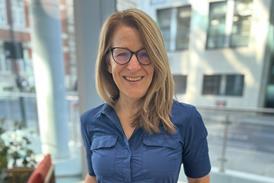








When Alem Derege first heard about Snit Habteab, Eritrea’s first-ever representative at Miss World, she was intrigued by more than the beauty pageant itself. With the Miss World final taking place on Saturday 5 September, Alem reflects on how Snit’s story of faith, family, disability advocacy and discovering her Eritrean identity made her reconsider what a beauty pageant can stand for.
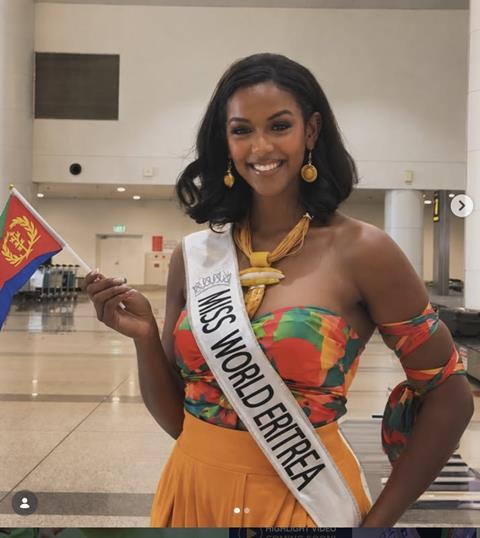
I cannot say that beauty pageants have ever been of much interest to me. I am guilty of assuming them to be purely vanity competitions that lack purpose. That was until a couple of weeks ago when a particular video on Instagram caught my attention. The clip, which has since amassed over 33k likes, shows 27-year-old Snit Habteab being interviewed by Daniel Mejía (winner of Mister World 2024).
Mejía congratulates her on making history by being the first ever woman to represent Eritrea at Miss World. Being Eritrean myself and of a similar age to Snit, I instantly felt both represented by and connected to her. Snit went on to share that she is heavily inspired by her younger sister, Milca, who has Down syndrome. After sadly losing her mother to breast cancer when she was just 20 years old, Snit became a caregiver for Milca. Addressing her sister, she says:
‘A big part of the woman I am and the purpose I carry is because of you. I wish you could see yourself through my eyes and understand how powerful, valuable and capable you are…’
READ MORE: I believe God opened the door to me becoming a beauty queen in my fifties
I was not familiar with Snit prior to watching this interview but was immediately captivated by her sincerity and humbleness, despite the challenges she has faced.
Snit has a degree in Neuroscience from George Mason University in Virginia, and later worked as a Montessori school teacher. She is still relatively new to the world of pageantry but took home the title of Miss Africa USA in 2023 and was also the first ever Eritrean to win this pageant.
But what touched me the most was that when asked, Snit, who is a Christian, credited this win to God.
But what touched me the most was that when asked, Snit, who is a Christian, credited this win to God. She explained that she originally got her start in modelling and had not really considered pageantry until she discovered Miss Africa USA - which she was drawn to because it is a faith-centred organisation that empowers women.
The main objective of Miss World is to raise money for global charities and to promote humanitarian causes, with its motto being ‘beauty with a purpose’, and I believe that Snit embodies this perfectly. Not only is Snit absolutely gorgeous, but she also champions important causes. Snit is a disability rights advocate, and her non-profit initiative ‘Designing for Diversity’ seeks to create learning resources for children of all abilities.
READ MORE: Beauty from ashes
I am half Eritrean, but growing up I never felt connected to my Eritrean heritage.
I am half Eritrean, but growing up I never felt connected to my Eritrean heritage. If anyone asked me where I was from, I would just say Ethiopia, which, while not untrue (my father is from there), it discounts half of me. My mother (who is fully Eritrean) was born and raised in Addis Ababa, Ethiopia and, beyond being able to speak Tigrinya, which is the most commonly spoken language in Eritrea, she did not feel particularly connected to her Eritrean heritage. It was not until around summer 2018 that I became more interested in learning about my Eritrean roots. At the time, I had just finished up my second year of Architecture school and was preparing to head into my third and final year.
I was trying to decide what to write my dissertation about. I vaguely knew that Eritrea had been an Italian colony, but was not aware of how evident this colonial period was up until today through Modernist architecture. In fact, the year prior, in 2017, the entire city of Asmara (Eritrea’s capital) was inscribed onto the UNESCO World Heritage list. I became intrigued and decided that writing my dissertation on this topic would be a great method of self-discovery. I threw myself into the researching and writing process, and loved every moment of it.
Around the time of submitting my dissertation, my dissertation tutor, told me about something called the MSMR Travel Award (although it was an annual award, I had not recalled hearing about it previously). Each year, the London-based Architecture practice MSMR offers £2,000 to a third-year student at the Sheffield School of Architecture. To enter, you have to submit a poster about where you wanted to travel to and why.
READ MORE: Reality Check: America’s Next Top Model and the search for true beauty
‘I think you could have a really good shot at this,’ said my tutor. I had never visited Eritrea before and agreed that this could be an amazing opportunity. Fast forward, by the grace of God, I ended up being awarded the travel scholarship, and in September 2019 I arrived in Eritrea. During this visit, I was able to connect with family and see the beauty of the country for myself - including spending time in the village where my maternal grandparents lived. To this day, that trip has had a profound impact on me - reinforcing my sense of Eritrean identity, and also inspiring my practice as an artist.
Eritrea is the 185th country to join Miss World. In the pageant’s 75-year history, an African nation has only won the Miss World title a total of five times, and only two of those winners were women of colour. The support online for Snit has been huge, and at the time of me writing this, she is currently firmly at the top of the leaderboard in the Africa Round 1 category with over 7 million points. She is a wonderful representative of the Christian faith and the nation of Eritrea. With the 5th September finals fast approaching, I am hopeful for her to take home the Miss World title but, irrespective of the outcome, she is certainly already a winner in my eyes.





















2 Readers' comments