









As writer Bukunmi Awofisayo has observed, fashion communicates whether we intend it to or not. Yet as Christians, we are called to see people the way God does, beyond appearance and first impressions, to the heart, character, and story beneath the surface.
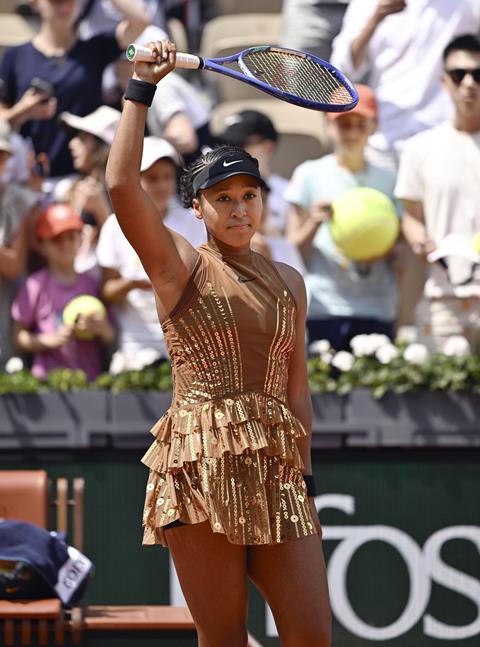
When I saw the headlines around Naomi Osaka’s outfit last week, my first reaction was, “…meh.” Genuinely, isn’t she just trying to play a tennis match? Then I saw it and thought, ooh, I love the sequins. And that was about it. Yet many major UK publications picked up on her outfit, especially following commentary from her opponent. Different headlines, different angles, some critical, some supportive, but still largely framed around appearance.
What initially stood out to me was that coverage of the story became centred around the outfit and the opponent’s comments, in mainstream places that usually lead with sport, results, or analysis.
I spoke to a friend at church who had seen all the headlines and commentary but didn’t know Naomi Osaka had won.
I spoke to a friend at church who had seen all the headlines and commentary but didn’t know Naomi Osaka had won. And that got me quite animated, because her achievement had almost disappeared behind the conversation about appearance. It was buried in the story rather than being the story.
READ MORE: Does Wimbledon star, Aryna Sabalenka believe in God?
And truthfully, I think I had skimmed past the fact that she had won at first too, not because it wasn’t there, but because the framing had already pulled attention elsewhere. It made me realise that something broader is happening in how stories get shaped and what becomes the entry point for our attention.
Some people mentioned that it felt reminiscent of Serena Williams. Her black catsuit at the French Open in 2018 caused major controversy and was later banned from future French Opens. What I only learned later was that it was designed by Nike to support her recovery after a difficult childbirth and improve her blood circulation. How amazing is that?
In interviews, Williams explained that she was simply trying to stay healthy and return to sport as a new mother. Yet much of the conversation centred on the outfit itself rather than the athlete wearing it or the significance behind it.
$100,000 dresses and divine design: What the Met Gala doesn’t tell you about true beauty
This isn’t just true in elite sport; it shows up in everyday life too. I remember speaking with a friend after sharing something one morning at work and asking whether anything I had said felt unclear or off. She told me she honestly couldn’t concentrate because my trench coat was tied too tightly!
We laughed about it afterwards, but my trench coat being tied so tightly reminded her of her mum, and it distracted her from what I was saying. I’ve done the same thing myself. It’s surprisingly human how quickly something visual can take over our attention. Across sport, media, politics, and church life, I keep noticing the same pattern: what we see first can easily become the only thing we talk about.
In church spaces, more than one woman has shared with me that they didn’t always feel fully free to be themselves.
In church spaces, more than one woman has shared with me that they didn’t always feel fully free to be themselves. That no matter what they wore, there was still a sense of being perceived in a certain way. Not necessarily through formal rules, but through subtle assumptions and distractions. How they were seen sometimes felt louder than what they were saying.
The Holy Spirit tells me what to wear
Naturally, humans notice appearance first. We scan a person’s face and what they are wearing, and within seconds we begin to form perceptions about who we think they might be. Clothing can communicate culture, creativity, personality, confidence, and even comfort. There is nothing inherently wrong with noticing what someone wears. The problem comes when appearance becomes the only lens through which we interpret a person, drowning out everything else they are trying to say. Because as believers, the God we serve and follow is Adonai El Roi, the God who sees.
In His ministry on earth, Jesus consistently saw beyond what was immediately visible. Take the woman who anointed His feet with perfume (see Luke 7:36–50). Others saw her appearance and reduced her to that alone. Some only saw her reputation, creating a bigger spectacle of her even when she was doing something far more significant. Jesus saw deeper. He saw devotion, gratitude, love, repentance, and a person. As 1 Samuel reminds us, “People look at the outward appearance, but the Lord looks at the heart.” I think the challenge is not noticing appearance; it is refusing to stop there.
When I look back at some of the women I have mentioned, we can choose to see Naomi Osaka not simply as a headline about a dress, which was beautiful, but as a woman returning to the sport she loves after a difficult period in her life, expressing herself through her performance, not just her appearance.
We can see Serena Williams not simply as an “outrageous” catsuit, but as a record-breaking athlete, a new mother, and a woman recovering from serious health complications. We can see women in leadership, whether we agree with them or not, and resist reducing them to appearance. We can see women in church, all on different journeys. Maybe someone has only just found the courage to walk through the church doors after years away.
Instead of focusing on ripped jeans, sleeveless tops, or whether someone fits our expectations, we can ask the Holy Spirit to help us hear what they are saying and see them as He does. Because the issue is not that we notice appearance. The issue is that we stop there. And if we are called to reflect Christ, then we are called to see more deeply too.





















No comments yet