









Writer Sophie Dianne examines Christmas Karma, a modern retelling of Dickens that attempts to blend multiculturalism with Christmas tradition. In doing so, she considers whether the film’s reliance on karma ultimately distances it from the message at the centre of the nativity story.
Contributor: FlixPix
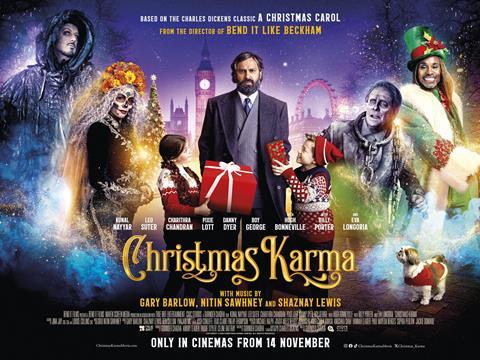
Christmas Karma is a reimaging of Dicken’s A Christmas Carol, written and directed by Bafta award winner Gurinder Chadha. The story is set in modern, multicultural London, through a British-Indian lens, with the lead, Mr Eshaan Sood played by Kunal Nayyar of Big Bang Theory fame. Like Scrooge, he is a hardnosed businessman, left miserly and bitter.
Over the course of Christmas Eve, Mr Sood is visited by three unforgettable ghosts, in the hope that he will turn his life around, these ghosts embody diverse belief systems. As the night progresses Mr Sood is reminded about karma and encouraged to embrace self-love.
READ MORE: Five Christmas films that have a surprising Christian message
Upon seeing the trailer for Christmas Karma I was intrigued, but as a Christian who values theological integrity, I found this interpretation problematic. Before theology entered the debate, critics were ruthless. One review on BritBrief described Christmas Karma as “among the worst things to happen to Christmas since King Herod.” While the Guardian’s Peter Bradshaw called the film “joyless and nausea inducing.”
In the cinema I tried to engage liberally but conceded, that where the film attempts emotional depth - especially in representing immigrant trauma or racial prejudice - those moments were undermined by tone-deaf musicality and the devaluing of the nativity.
It also struck me that the social commentary or archival footage would have felt more at home in a film that wasn’t seasonal.
It also struck me that the social commentary or archival footage would have felt more at home in a film that wasn’t seasonal. Making me question why Chadha felt the need to place her story at a time, where the focus should be on the birth of Christ and not the philosophical concept of karma.
READ MORE: What are you telling your children about Father Christmas?
Popularised by both Hinduism and Buddhism, karma is the idea that actions have consequences, not simply in the present but to future lives also. This idea frames redemption as purely transactional. The Christian gospel, however, teaches us that salvation or forgiveness are gifts of grace, not a result of moral accounting. Karma by contrast suggests a strict system of cause and effect, whereby “you reap what you sow.” Putting karma into a Christmas story then, risks undermining the very notion of Jesus’ birth. Seen & Unseen magazine said: “grace and karma can’t share the same stage.”
The redemption arc within the film also points to another key difference, the message of self-improvement or status, rather than pointing to spiritual brokenness and the need for divine forgiveness.
The redemption arc within the film also points to another key difference, the message of self-improvement or status, rather than pointing to spiritual brokenness and the need for divine forgiveness. Within modern society the concept of self-love is prevalent, but having seen audience members walk out of the cinema, I would argue that there is still a desire for Christmas tradition and this is where Chadha misstepped.
READ MORE: Book Club Our Sisters: the fight for justice for Christian women forced into marriage in Pakistan
Understanding different cultures and faith traditions is vital for moral or social development, this value is clear from a Christian viewpoint, as well as a human rights perspective. Nevertheless, I was uncomfortable hearing a reference to the Hindu deity Lord Ram, without the mention of Jesus and hearing “whichever God you worship” sung in a Church setting.
In an interview with The Upcoming, Kenyan born Chadha discussed the influences that helped shape Christmas Karma, and how her family celebrated Christmas. Chadha also expressed her excitement for writing a classic holiday film, that reflects the diversity of the UK today. To me Christmas Karma felt like an example of ‘over-inclusion’ whereby the Christian celebration became diluted. Not to put to finer point on it, but I would be glad to see this film get lost amongst the tinsel and foil garlands.
























No comments yet