







As communities across Japan begin the long road to recovery following last week’s devastating earthquake in Kumamoto Prefecture, many are asking where God can be found in the midst of such tragedy. Drawing on her experience serving in Japan after previous earthquakes, Rachel Mataraki reflects on how the Church can become a powerful sign of God’s presence long after the news cameras have gone.
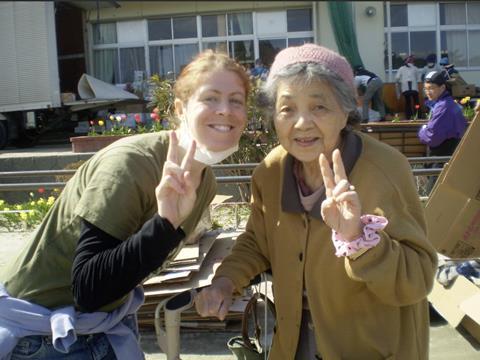 Rachel Mataraki in Tohoku, Japan, 2011. With volunteers she cooked and gave out food and talked with local people effected by the disaster.
Natural disasters remind us that the world is not as it was meant to be. Earthquakes, floods, wildfires and droughts all point to a creation that is groaning under the effects of a fallen world. Last week’s magnitude 7.1 earthquake in Kumamoto Prefecture, the second major quake to strike the region in the last decade, has left dozens dead, damaged homes and businesses, and tens of thousands without water or electricity during extreme summer heat. It is heartbreaking to witness. We see people suffering through repeated disasters and wonder: where is God in all this?
For me, it brought back memories of being there ten years ago and seeing first-hand the families who had lost pets, homes and loved ones.
READ MORE: Standing in faith: Making gender-based violence a national disaster in South Africa
As a first responder following the 2011 Tohoku earthquake and tsunami and again in 2016, and while working on a long-term art therapy project in Fukushima, I encountered communities that were deeply hurting. Homes had been destroyed, lives uprooted and futures left uncertain. While the immediate response focused on meeting physical needs, I came to realise that healing is about much more than simply rebuilding buildings. It is about how people feel when others show up for them.
In Fukushima, a potter’s family shared with me how they had covered the windows of their home in an attempt to shield themselves from radiation. During the art therapy project in another part of the prefecture, many children and adults struggled to express their grief. Yet through drawing and painting, they found a way to communicate their experiences.
READ MORE: ‘I found a Bible beneath the rubble’: Finding hope after Venezuela’s devastating earthquake
These stories speak of the hidden fears that remain long after the earthquake has passed and the headlines have faded.
These stories speak of the hidden fears that remain long after the earthquake has passed and the headlines have faded. They also revealed to me how the Church can become the heart of God in places of pain.
My experiences showed me the unique role the Church can play in disaster relief. Jonathan Wilson, founder of Crash Japan and Operation SAFE, recently wrote on social media: “Exposure to traumatic events only explains part of the story. What often makes the difference is vulnerability and our efforts to reduce susceptibility and increase coping and adaptation.”
The Church helps people cope through the ministry of presence. Rather than simply responding to the headlines and moving on, the Church listens. In a 2017 Lausanne Movement report, Shoichi Konda wrote: “As they asked themselves why such a disaster had fallen upon them, pastors and Christian volunteers found themselves engaged in ‘presence ministry’ as they tirelessly listened to victims repeat their stories of grief, anxiety and regret.”
Humanitarian organisations provide essential emergency assistance, but churches are often present for the long journey afterwards. They remain, rebuilding slowly—day by day and step by step. They offer companionship and create spaces where people can grieve, heal and find hope together. Disaster response is ultimately about people rather than projects. Recovery is not only physical but emotional and spiritual as well, and it takes time.
READ MORE: ‘Becky, are you OK?? Did you guys feel the earthquake?’
The Bible never promises that we will avoid hardship, but it does promise God’s presence.
The Bible never promises that we will avoid hardship, but it does promise God’s presence. Isaiah 43:2 says, “When you pass through the waters, I will be with you.” This is the heart of disaster relief: Immanuel—God with us. God does not promise that the flood will never come, but He does promise that we will not face it alone. In a world facing increasing uncertainty and ecological crisis, this is exactly the hope we need. Paul echoes this hope in 2 Corinthians 4:7–9, describing us as “jars of clay”—fragile vessels carrying God’s treasure. We may be “hard pressed on every side, but not crushed.”
John’s use of the term Logos also echoes the Hebrew concept of davar, which carries the sense of a word in action. When we show up for one another, we embody God’s Word through action.
The earth may groan, but it is not without hope. Every act of compassion, every restored relationship and every community that chooses to stand together bears witness to God’s restoring love. In a fractured world, the Church has the opportunity not only to respond to disaster but to become a living sign of the God who continues to be with us in every circumstance.
























No comments yet