








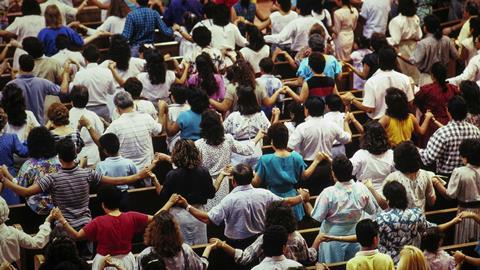
Elise Wilkes considers whether it is best for your local church to stay below 200 people
Have you ever been to a church service and wondered: “What am I here for?” What is the purpose of the church? Churches often talk of growth, but what kind of growth should take priority?
It is crucial to understand our purpose as God’s people (the worldwide Church, with a capital ‘C’) beyond simply filling a seat during the Sunday morning service. Erin Wheeler, author and podcast host on doctrine and discipleship, writes that the “most fundamental purpose of the church is the glorification of the Lord Jesus Christ” achieved through corporate worship, discipleship and evangelism (The Good Portion: The Church, Christian Focus Publications, p46). Nowhere in the Bible does it specify the ideal size of a church congregation, but the Bible is full of guidance for the Church regarding growth in righteousness. In fact, the New Testament is primarily comprised of letters to various churches for their correction and strengthening. According to Paul’s letter to the Ephesians, the local church exists “to equip” the people, the Church, teaching and discipling to ‘build up’ and ‘grow’ in Christ-likeness (see Ephesians 4:11-13). It is only once the Church has matured that it has the capacity to withstand false doctrine and can be ‘working properly’ in “unity in the faith and of the knowledge of the Son of God”, and so it “grows and builds itself up” (Ephesians 4:13,16). If there isn’t a strong foundation, a church won’t be secure. Without this unity of community and doctrine, the local church is liable to split over controversies. The apostle Paul was continually making disciples first and sending them out to make more once they were strong in the truth, in order to represent Jesus Christ to the world properly.
A disciple is a follower of God. To be discipled is to be equipped in faith and knowledge of God to maturity (Ephesians 4:13). Jesus commanded his disciples to “go and make disciples of all nations” (Matthew 28:19). When a church truly grows, it increases in the number of disciples, not just attendees. The discipled are to go and make more disciples. This is the growth we should pursue.
Growth without discipleship
Spiritual maturity, rather than numbers, reflects true growth.
I was part of a congregation of 1,500 for years. The teaching was sound and rooted in scripture. People knew who I was. I knew many people whose faith was genuine. Despite being involved, I nevertheless felt disconnected from many of my brothers and sisters in Christ. Many churches assume size equals health, but without personal discipleship, large churches can feel spiritually shallow. If the members of the local church are not growing in the truth and love of God alongside each other, any size of church can be led astray into weak faith, false teaching or missional stagnation (see 2 Timothy 2-3).
When the Church truly grows, it increases in the number of disciples, not just attendees
Rachel and her husband had been serving as elders at their church for over ten years. After moving, they began attending a new church. It was the same in denomination and service style. However, a handful of the women regularly met to read and dwell on a passage of scripture together, sharing their questions and observations. She was struck by the impact this quickly had on her understanding of the Bible. She shared that it was “like we’d been drinking milk for years”, despite having all the appearance of a mature Christian.
It is easy to get into Christian culture and toss around the words ‘growth in godliness’ and ‘disciple’ without the earnest weight of what these things mean. It is relatively easy to take a break from life for two hours on a Sunday morning to attend church. In a large church you may have varied options for events and people from which to choose and invest in, based on your age, interests and other factors. However, Bev Berrus, an author and experienced church planter, warns Christian women not to rely on programmes and events organised for them, but rather take initiative to participate in discipling relationships (‘Priscilla Talk’, Episode 33). Hand holding is not a problem in a season of needing more help, but she emphasises that it should not be a habitual need for Christians growing in maturity. You can be passive in both big and small churches, even if you care deeply about your church and the people within it. If you aren’t being discipled, ask your pastor to recommend someone, or directly ask a woman to disciple you.
A call to action
Discipleship is active. If we accept that the call to “Go and make disciples” was not to a select few men and pastors, but to the whole Church, what does that look like for you, whatever church you are in? All believers have a personal responsibility to pursue being discipled and to disciple others.
As roughly half the body of Christ, and equally bearers of his image, women considerably shape the Church’s doctrine and culture. Titus 2 commands women to disciple so “that no one will malign the word of God” (v5). That is no small issue, and we must all take it seriously by actively building each other up in love (Ephesians 4:16). Paul’s impact on Priscilla and her husband led to them both discipling the young preacher Apollos from incorrect doctrine before his ministry grew extraordinarily (see Acts 18:26, 1 Corinthians 3:6). The Church grew in size well because its members had first grown in spiritual maturity. Discipleship from the pastors must continue to be spread by the members of a church. Titus 2 states that older women must model and teach faithfulness to their younger sisters in the church. We don’t need the perfect, organised book study, regular dinner or event; it can happen in the ordinary and mundane. Just as God corrects us specifically because he knows and loves us, we are to encourage and correct each other in relationships. Jesus is the model we follow, as he has gone first and walks beside us in everything. Those who are further along in their understanding in the faith walk beside us too. Likewise, we have a duty to the younger women around us. As you look to be discipled, also consider: “Who am I discipling?”
All believers have a personal responsibility to pursue being discipled and to disciple others
Large churches require a more formal structure to achieve well-rounded discipleship. In large churches, small group Bible studies form micro-congregations where familiarity, accountability and sharpening relationships – essential to the Church – can be fostered. Since large churches require systematic business-like structures, rather than the relational informality of smaller churches, the congregation often has an organised focus led from the front; a powerhouse to “get mission done” (Timothy Keller in paper Leadership and Church Size Dynamics: How strategy changes with growth). They are a blessing for missional work, as they have more resources and people to send out and support multiple church plants and missionaries. It is worthwhile to consider whether more of these small groups from bigger churches, under pastoral leadership, can lead to the establishment of new churches. Large churches are not morally inferior to small churches, but they offer different opportunities and challenges for the Church.

The case for small churches
In Christ, all Christians, the whole Church, are family (see Ephesians 2:19, Mark 10:29-30). It’s a nice thought. Usually we leave the sentiment there, but we should take it seriously, allowing it to impact how we invest in our local church. This level of intentionality is more challenging across the corporate gathering of a large church than it is in a smaller church. When you are invested in a local church as a member of a family, you can serve and love as a daughter, a younger sister or an aunt to the children. This affects the whole culture of the church (‘Priscilla Talk’, Episode 37). Thinking back over her early 20s, Karen gratefully remembers the first church she truly invested in, saying: “those relationships were formed when things were good and they sustained me when things were really hard” (‘Priscilla Talk’, Episode 37).
After moving cities and finding myself in a very different (much smaller) church, I found I had no option but to love the few very different people in front of me. Church is where broken people gather. In a small church, they’ll likely not be the people you would have chosen socially. They may be in vastly different stages of life. They may get on your nerves. But they’re discipling you, revealing your brokenness. God taught me to obey first, to “be kind and compassionate”, showing “hospitality…without grumbling” because of Christ, which he grew into heartfelt affection (see 1 Peter 4:8-10, Ephesians 4:2,32).
God uses the friction of us coming alongside each other to sharpen us. It is a gift. He’s given it to us for a good reason. When I wasn’t able to regularly meet one-on-one with any one woman at church, many grasped the moments we’d bump into each other after the service to hear, exhort and encourage in what was really going on in our lives. Being in a small congregation aided our connection, since we frequently came across each other, even when busy. These relationships foster a culture of looking out for the spiritual growth of the whole church, teaching us to look to disciple newcomers, and those ‘younger’, naturally, as we come across them. In such a community, it is almost impossible to avoid being noticed and known.
Growth that goes: the role of church planting
In many cases, church growth combined with Church growth should lead to church planting. Large churches can become stuck in growing and not multiplying. Small churches and small group Bible studies within the larger church can become insular. Church planting allows churches to maintain a number of people who can know each other familiarly in community to grow while following the mandate to “go and make disciples”. The church that grows its members in Christlikeness will grow externally – through mission, evangelism and planting.
The number of people in our church building does not equate to a healthy church. When Jesus told us to “go out and make disciples of all nations”, the call was not to make large churches, but to make disciples. The local church should be growing spiritually, active and missionally minded. We are to desire to go out, as Jesus does. This should come from knowing him well. The local church, whatever the size, is where believers (the Church) are to be built up and equipped through Bible teaching and discipleship, in faith, unity and Christlikeness, to be able and willing to disciple others. We all need to be taught, encouraged and corrected so that we may grow, discipling the women around us in turn.
You can follow God and have a broad, well-meaning consideration for those around you in a large congregation, but you will not have the bandwidth to have a familiarity with most of the people there.
God designed us to be relational in our growth, equipping one another for glorifying God in everything we do. This is how God grows his Church.
References
Erin Wheeler (2022) The Good Portion: The Church (Focus Publications)
Keri Folmar, Jenny Manley, Erin Wheeler, Bev Berrus (2024) ‘Priscilla Talk’: a podcast by 9Marks, ‘Episode 33: Discipleship and Growth Among Women in the Local Church (with Bev Berrus)’
Keri Folmar, Jenny Manley, Erin Wheeler (2024) ‘Priscilla Talk’: a podcast by 9Marks, ‘Episode 36: Why Women Should Rightly Understand Missions’
Keri Folmar, Jenny Manley, Erin Wheeler (2024) ‘Priscilla Talk’: a podcast by 9Marks, ‘Episode 37: Learning to Love the Local Church: Comfort’
Keri Folmar, Jenny Manley, Erin Wheeler (2024) ‘Priscilla Talk’: a podcast by 9Marks, ‘Episode 42: Fertile Soil: One-on-One Discipling’
Timothy Keller (2006) redeemercitytocity.com/articles-stories/leadership-and-church-size-dynamics-how-strategy-changes-with-growth
Elise is the daughter of missionaries, cross-culturally raised and now serving in her local church.

















No comments yet