









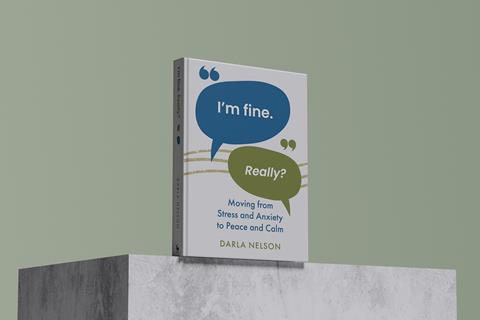
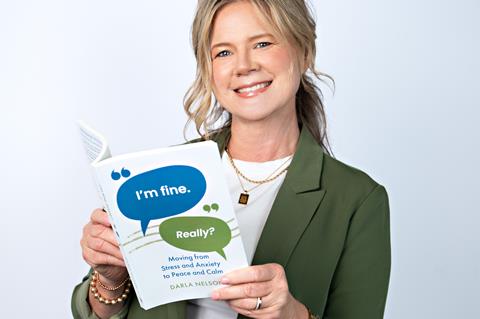
Based on an extract from her latest book, I’m Fine. Really?, life coach Darla Nelson looks at why we often hide our true emotions and how honesty sets us free
The day I finally let go wasn’t dramatic. There were no tears on the bathroom floor, no late-night breakdown, no moment where someone found me curled up, unable to breathe. It was quieter than that – and maybe that’s why it changed everything.
Years ago, our daughter was dating someone who was not good for her. As a mother, I knew the relationship was not going in the right direction. I was that mum – you know, the one saying all the wrong things: “Why are you with him? Why are you going out with him again? He is not good for you.” Each question came from a place of fear, but to her it sounded like judgment. And the more I tried to intervene, the more she pulled away.
Still, I kept insisting to everyone around me that I was fine. “She’ll figure it out.” “This is normal.” “I’m not worried.” “It’s just a phase.” But inside I was anything but fine. I was scared. My fear made me controlling, and my controlling made me disconnected – from my daughter, from peace and from myself.
Finally, when I reached the point where I had no energy left to pretend, God spoke gently to my heart: “Darla, when are you going to give your daughter to me?” And I said: “Right now.”
What lies beneath ‘fine’
Those two words became the beginning of my freedom. I wasn’t fine. I was terrified – and admitting that truth, both to myself and to God, opened a door to peace I had been chasing for years.
So many women live in that same space – the one between “I’m fine” on the outside and “I’m overwhelmed” on the inside. We shoulder responsibilities, absorb the emotions of those around us, and keep our fears tucked safely behind a smile. “Fine” becomes our default answer, not because it’s true, but because it feels easier than unpacking the truth. We say it because it feels safer than truth. We say it because we don’t want to burden anyone. We say it because slowing down long enough to feel our emotions feels dangerous. “Fine” becomes a mask we wear long after it stops fitting.
But the truth is that “fine” is often a cover for unspoken grief.
Grief doesn’t always come wrapped in dramatic loss. Sometimes it sneaks in quietly. It’s the loss of who we once were. The loss of a dream that shifted. The loss of relationships we thought would last forever. The loss of a season where life felt lighter. The loss of a version of ourselves we miss and don’t know how to return to.
Grief settles into the spaces where we stop tending to ourselves.
Grief shows up in the stories we don’t tell. It can feel like a heaviness in the chest that never fully lifts, or the weight of responsibilities that keeps growing or the feeling of being forgotten in your own home. It can be the moment you realise you’ve spent years taking care of everyone else while quietly falling apart. We often push grief down, thinking we need to be strong. We tell ourselves tears are weakness. We distract, deny and keep going. But grief is a sign of love. Grief is an invitation to healing. Grief is the pathway to honesty. And when we avoid it, it doesn’t disappear — it simply shows up somewhere else.
Our bodies reveal the truth
For many women, the first sign that we’re not fine comes from our bodies. Sometimes your body speaks the truth long before your mouth will. There’s the tightness in your chest. The lump in your throat. The quickened breath. The jaw clenched without realising it. The exhaustion that sleep doesn’t fix. The heaviness before your feet even hit the floor in the morning. The ache behind your eyes. The constant low-level anxiety you can’t quite name. Our bodies whisper the truth we refuse to say out loud.
I began to notice this in my own life. I had spent years pushing through everything – emotions, fatigue, worry, expectations – convincing myself that strong women don’t slow down, don’t break, don’t admit they’re overwhelmed. But my body wasn’t fooled by my “I’m fine” mask. It kept whispering, “Slow down. Listen. Something isn’t right.”
Sometimes your body speaks the truth long before your mouth will
One day, after ignoring my symptoms for far too long, I realised the truth: My body wasn’t betraying me — it was protecting me. It was sending messages I had been too busy, too afraid or too numb to acknowledge.
Your body remembers what your mind tries to forget.
When I finally honoured those signals – the tight chest, the rushing thoughts, the fatigue – I felt something shift. Those physical sensations weren’t weakness; they were invitations. Invitations to pause. Invitations to breathe. Invitations to reconnect with myself and with God. Listening to your body is a form of sacred honesty. It’s a way of saying: “I matter too.” Pretending comes with a cost – in our relationships, our health, our faith and our sense of connection.
Connection through honesty
When we hide how we truly feel, we create distance. We pull away from the people who love us, not because we want to, but because we don’t know how to let them in. We hope others will notice our pain without us having to say anything. But people can’t meet needs we never express. The longer we say “I’m fine”, the more misunderstood and alone we feel.
Sometimes the greatest intimacy comes from the smallest act of honesty: “I’m overwhelmed.” “I’m hurting.” “I didn’t want to say it, but I’m struggling.” “I feel alone.” “I need help.” We weren’t created to do life in silence or isolation.
People can’t meet needs we never express
One woman told me she could handle anything – work pressures, parenting, aging— as long as no one asked her how she was doing. Because if they did, she knew she would cry. And crying, to her, meant losing control.
But honesty doesn’t break connection – it builds it. Letting go isn’t failure; it isn’t giving up. It’s releasing the illusion that we can control everything: other people, outcomes, timelines, emotions, the future. Letting go is trusting that God meets us in the truth, not in the performance of being strong.
There is a shift that happens when we stop asking: “How do I fix this?” and start asking, “Who do I want to be in this?” When we release control, the weight we’ve been carrying begins to lift. Not because circumstances change, but because we change.
Peace grows not from perfection, but from presence. Little by little, we begin to feel grounded again. We speak more kindly to ourselves. We breathe deeper. We move slower. We notice moments of joy we used to rush past. We begin to trust that peace is possible – not when everything is perfect, but even in the middle of the uncertainty. We feel God’s presence again, not because he moved, but because we finally slowed down enough to experience him.
We were never meant to navigate life alone. Not our stress. Not our fears. Not our quiet heartbreaks. Not our exhaustion. Not our longing for rest. Not the transitions we didn’t ask for. Not the roles we’re trying to hold together. We don’t have to be fine. We don’t have to pretend. We don’t have to carry everything. We simply have to be willing to tell the truth – first to ourselves, then to the people who love us – and always to the God who already knows.
Honesty opens the door. Honesty reconnects us to ourselves. Honesty deepens our relationships. Honesty allows our bodies to rest. Honesty invites God into the places we’ve been hiding. Honesty is where healing begins. And honesty is how we move – slowly, bravely – from a life of stress to a life of calm, clarity
and connection.
Darla Nelson is a Christian life coach, author and speaker. Her latest book is I’m Fine. Really?: Moving from stress and anxiety to peace and calm (Zamiz Press).

















No comments yet