









When Emily Innes-Whitehouse married her Anglican fiancé as a Catholic, she expected their different traditions to present challenges. Instead, navigating their differences revealed just how much they shared – and strengthened her own faith in the process.
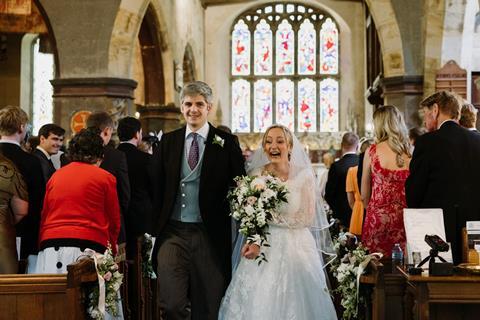
“There is one body and one Spirit… one Lord, one faith, one baptism, one God and Father of all.” — Ephesians 4:4-6
“That shouldn’t be a problem.”
Sitting across from the vicar who was to marry my fiancé and me, that wasn’t quite what I’d envisaged. A problem? A problem was something to overcome, not a joyous, lifelong commitment between two people who love each other. I was relieved that being Catholic wouldn’t stop me from marrying in the church, but “problem” felt like an odd word for it.
“Well, I wasn’t anticipating it being a problem,” I ventured. “I was thinking something to celebrate.”
Talking to a vicar wasn’t natural territory for me. I’d been raised Catholic, but I was marrying my fiancé in the Church of England church where he was christened – a beautiful building, built centuries before the Reformation and originally Catholic before becoming Anglican.
READ MORE: A French catholic nun is leading many to Jesus online
It was a fitting setting for a wedding where the bride and groom came from different branches of Christianity
It was a fitting setting for a wedding where the bride and groom came from different branches of Christianity; one where I would learn that the gap between Anglicanism and Catholicism isn’t as wide as it may seem.
Growing up with a Catholic mother and an Anglican father, I hadn’t thought much about what divided them; it never seemed to matter in our house. It was only in planning my own wedding that I started to look properly at what those differences were.
Catholics believe in transubstantiation – that during Communion, the bread and wine are transformed into Christ’s body and blood – whereas Anglicans hold a more symbolic view. Catholics answer to the Pope as the supreme head of the Church, whereas Anglicans have no equivalent. The monarch is Anglicanism’s titular head, and the Archbishop of Canterbury its spiritual leader.
READ MORE: Life Lessons: Faith can handle your questions – but sometimes people can’t
Ahead of a Catholic Mass (still said in Latin in some churches), worshippers enter a church filled with the scent of incense, genuflect towards the tabernacle and make the sign of the cross. An Anglican service is built around the Book of Common Prayer, with a tradition of choral singing and hymnody. The clergy differ too: Anglican priests, both men and women, can marry and have children, which isn’t possible for Catholic priests.
But underneath the surface, I believe far more joins Catholics and Anglicans than divides them: the same Nicene Creed, the same Scripture, and the same belief that Christ died for our sins and rose again.
But underneath the surface, I believe far more joins Catholics and Anglicans than divides them: the same Nicene Creed, the same Scripture, and the same belief that Christ died for our sins and rose again. Throughout our wedding planning, my fiancé and I looked for ways to reflect that shared ground in the ceremony. We applied for a Catholic dispensation, so the Church would recognise our marriage even though it wasn’t being performed in a Catholic church. This was granted by the Bishop of Arundel and Brighton.
We chose prayers and classic hymns that would be familiar to both the Anglicans and Catholics in attendance, and we invited our local Catholic priest to say prayers alongside the vicar, in front of a congregation that was itself a mix of both traditions. We attended the Catholic Marriage Preparation course, where we met several other couples navigating their own interchurch marriages.
READ MORE: Ten things I wish I’d known in my first year of marriage
Our wedding day itself felt like proof of everything we’d believed in the months before. The congregation of our loved ones, drawn from two Christian traditions but united by one shared faith, was filled with happiness at our union. A Catholic and an Anglican marrying shouldn’t be seen as two worlds colliding, but as two branches of the same faith coming together in joy – a union worthy of celebration, not in need of management. If anything, discovering how much unites us only deepened my own faith.
My advice to any couple facing an interchurch marriage would be to look for what you share before you brace yourself for what divides you. You may be surprised by how little separates you at all!





















2 Readers' comments