
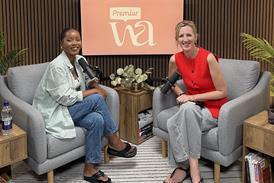



Jane Knoop spoke to Becky Murray, founder of the global anti-exploitation charity One By One, about how a single, shocking encounter with a vulnerable child on the streets of Sierra Leone ignited a lifelong mission to fight human trafficking and injustice.
Starting an international charity that has reached over 50,000 people affected by, or at risk of, exploitation doesn’t happen overnight. It requires commitment, investment and resilience. It demands a steady belief in a vision, one that often takes years to fully form. But sometimes, that vision begins in a single, defining moment, when everything comes into focus.
“I remember looking at her bare feet,” Becky Murray, founder of One By One, recalls. “I didn’t know then that this is commonplace for many children, bare feet on dusty ground.”
It was during a mission trip to Sierra Leone in 2006 that Becky, a teenager at the time, met Felicity, a nine-year-old girl living on the streets. Her instinct was to buy this little girl shoes; 50p for a pair of sturdy flip-flops. Later that day, Felicity came looking for her, not to thank her, but to repay her. “Shall we go to your room?” she said. Becky didn’t understand at first. She invited her instead to an event the team was hosting. But again, Felicity repeated the question. And then came the horrifying realisation. “She thought I’d spent the 50 pence so I could have her body… For a nine-year-old to think that… it really affected me.” What had this child already experienced in her little life, to believe that even the smallest act of kindness came at such a cost?
“I remember looking this little girl in the eyes, but having a conversation in my heart with God: ‘Okay, I am all in.’” In this moment, something shifted. “Even if it’s only ever for one life, I’ll give my whole life to this… No human should ever be bought or sold.”
Early devotion
Becky grew up in a home where faith in Jesus was modelled authentically and consistently. “I joke that I pretty much grew up in church,” she says, describing a childhood shaped by community, prayer and service. Her dad’s well-worn Bible became a symbol of that faith. “We used to say he had a ‘soggy Bible’. He’d cry into the pages as God revealed something new to him, even from verses he’d read thousands of times before.”
That environment left a profound impression. “My mum says I wanted to be a missionary from the age of four or five. It came out of nowhere!” she laughs. There were glimpses, even then, of something deeper forming. She remembers watching an advert about hunger as a child, quietly offering up the chocolate bar she was eating, an instinctive response to seeing another child’s need. It was a small, innocent gesture, but it hinted at a compassion that would come to define her life. By the age of nine, that compassion had found its anchor, as Becky made the decision to dedicate her life to Jesus.
As she grew older, that same heart translated into a strong sense of justice. She dreamed of becoming a lawyer, convinced that was how she would confront injustice head-on. She would go on to do just that, but not in the way she had imagined.
Learning to wait
Through a series of mission trips, Becky began to sense something shifting, her own dreams slowly aligning with God’s purpose. There was something about these spaces; perhaps the proximity to poverty, the rawness of human need, the unmistakable nearness of God. Or perhaps it was simply that, in these moments, she was more open. More attentive. She began to recognise the way God was speaking to her, not audibly, not dramatically, but through a quiet, steady clarity. A deep knowing. As if something that had always been there was suddenly coming into focus, making sense of everything else.
The first of these spiritual experiences was in Romania. “God spoke to me about working with vulnerable children,” Becky shares. “Not specific words, but I knew it was God. There was no doubt in my mind.” At the time, it felt like a broad, undefined calling. But years later, standing in Sierra Leone with Felicity, that call found its shape. What had once been abstract became deeply personal. God was directing all of her, her energy, her compassion and her plans, towards one clear purpose: to fight exploitation, one child at a time.
But clarity didn’t mean immediacy. “Sometimes the waiting takes the most faith,” Becky reflects. “I had to hold on to God’s promise.” In reality, it would be thirteen years between that early sense of calling and the launch of One By One. Thirteen years of preparation. Of faithfulness in the unseen.
She trained as a nurse, sensing it would equip her to serve vulnerable children in practical ways. She travelled widely, joining mission trips across the world, deepening her understanding of humanitarian need and effective responses, all the while constantly praying and seeking God’s guidance on how to live out the calling he had given her. Inevitably, doubts crept in. “Is this something I’ve just made up?!” she’d wonder, while friends challenged her sense of direction. “There are needs everywhere,” they’d say. “Why this specific focus on exploitation?”
“But I was so determined to wait for Isaac,” Becky says, referencing the story of Abraham and Sarah. A promise given, but fulfilled only in God’s timing, not through human striving. “I found the waiting frustrating,” she admits. “I’m the kind of person who thinks, ‘Tomorrow’s too late, let’s do it today!’ But I knew the time wasn’t wasted. I think God will spend years working on our character before we can ever be entrusted with the promise he has for us.” And so Becky waited, holding hope and doubt in tension, for God’s promise to be fulfilled.
Now’s the time
“Now’s the time. Look for land.” These words fell into Becky’s consciousness on a mission trip to Kenya in 2009. “The words were very direct,” she recalls. “It was crystal clear that it was God.” There was both excitement and uncertainty. Clarity about what, but no idea how.
But she didn’t have to look far. Early in her trip, she mentioned these words to a pastor they were partnering with. “He looked at me with tears in his eyes,” she shares, explaining how this pastor expressed a similar vision of providing refuge for vulnerable children. And then he said, “I’ve just been given some land.”
That land would become the foundation for One By One. Even then, it wasn’t immediate. It took another three years of fundraising, planning and prayer. But on 12 December 2012, the first children’s home opened its doors.
At first, it operated much like a traditional orphanage, welcoming children who were orphaned, abandoned or at risk, always with a view to resettling them with families in their home communities where possible and safe. The focus was one child at a time. One name, one face, one story. But as the work grew, Becky began to notice patterns. Individual stories pointed to wider issues, systems and structures that left children vulnerable in the first place. And she couldn’t ignore them.
“‘Pray for me,’ a mother asked me one day. ‘My daughter has gone missing.’” At first, Becky didn’t think much of it. “I prayed for her, but assumed it was a one-off.” But days later, another mother came. Same request. This time, her daughter had been missing for five months. “That’s when it really struck me.”
Becky began asking questions, speaking to local schools and looking for patterns. Was it seasonal? Age-related? Gendered? “There were lots of different factors at play,” she explains. “But the common denominator that would rise again and again was period poverty.” Girls were missing school because they didn’t have access to basic sanitary products. Falling behind, many eventually dropped out altogether. And in that vulnerability, traffickers found opportunity, offering false promises of work and drawing them away from their homes.
“We launched the Dignity Project that same year,” Becky explains. It quickly became something both practical, providing reusable period pads to girls, and more holistic, working with local authorities to educate girls about trafficking, helping them recognise warning signs and understand their rights.
The Dignity Project soon opened doors beyond Kenya, including into Pakistan in 2018. But there, Becky encountered another layer of harrowing injustice, one she hadn’t seen before. “I was seeing a form of slavery that was so blatant… it’s not hidden,” she says, describing her visit to brick factories where families were trapped in bonded labour. She met one family who had taken out a small loan of around £120 for a medical emergency. Thirteen years later, they were still working to repay it. “They’ve paid off that debt ten times over and more,” Becky explains. “They are literally owned by the brick masters.” In these environments, exploitation runs deep, with children growing up believing that even their bodies are not their own.
Again, it was impossible for Becky to walk away. In 2019, a safe house was established, offering children education, safety and a long-term pathway out of slavery, not just for themselves, but for their families.
Today, the Dignity Project has reached over 50,000 children in 13 countries, with safe houses in Kenya, Pakistan and Uganda. One By One has grown into an organisation that is persistent in its pursuit of systemic change, constantly morphing, expanding and adapting to meet real, prevalent needs.
But for Becky, the heart of it has never changed. It is still about the individual. And each child, each story, reminds her of Felicity.
“It started with one little child… I still think of her to this day. Back then I didn’t know what to do. I couldn’t help her. But now, with every child we reach, it’s like I’m taking Felicity home to safety, again and again.”
















No comments yet