







SPCK’s Head of Marketing and Publicity, Rio Summers, spent sixteen months working behind the scenes to bring author and apologist John Lennox to one of the world’s biggest podcasts. This is the remarkable story of persistence, prayer, algorithms and what happened when Lennox finally sat down with Steven Bartlett.
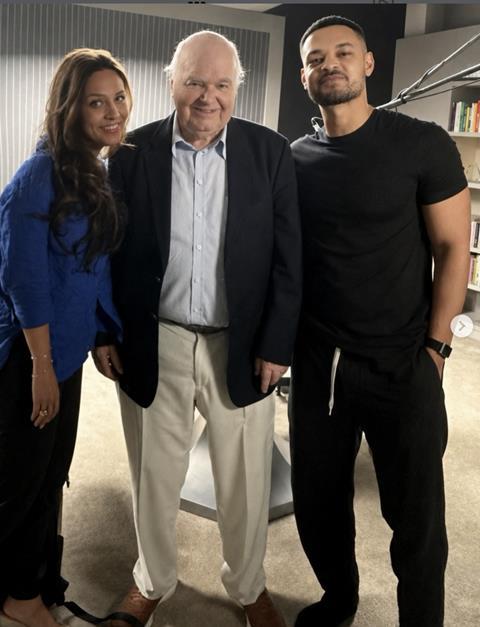
By the time I arrived at the studio of the Diary of a CEO podcast, clutching a prawn mayo sandwich and running on four hours’ sleep, it had already been a sixteen-month journey. To get SPCK author John Lennox and his books God, AI and the End of History and the newly released memoir My Story onto the second most-listened-to podcast in the world, 17.2 million followers, episodes regularly hitting millions of views, had taken a grassroots strategy: writing to the show directly, pitching to adjacent podcasts to build John’s profile and grow into their sightlines, working the algorithm, making sure that when someone typed into Google, or increasingly into ChatGPT, “can you be a scientist and a Christian?” or “what does AI mean for human identity?” or, more simply, “God and AI”, John Lennox was the name that came up.
As Head of Marketing and Publicity at SPCK Group, the UK’s oldest Christian publisher, and a podcast producer on the Unbelievable? and Ask NT Wright Anything podcasts, I spend my days thinking about how books find their readers: the strategy, the positioning, the long game, and increasingly, that means thinking about algorithms as much as audiences. Sixteen months of work, and the timed release of My Story, was, in part, an answer to that question.
READ MORE: What Brené Brown gets right about belonging and what faith says we’re missing
For anyone unfamiliar, Steven Bartlett is one of the most-listened-to podcast hosts on the planet: a global audience that is vast, largely secular, and asking the biggest questions of modern life.
For anyone unfamiliar, Steven Bartlett is one of the most-listened-to podcast hosts on the planet: a global audience that is vast, largely secular, and asking the biggest questions of modern life. Steven grew up in a Christian family but lost his faith at eighteen. He told John as much early in the interview, with the kind of honesty that makes you really lean forward.
I’ll be honest: the journey to that green room was not straightforward. Underneath it all ran a constant refrain, not that it would definitely happen, but that it should. That John’s voice belonged in that conversation. That his books carried something our global cultural moment needs. And yet there were moments along the way, not just with the gatekeepers of the show, but closer to home, when I wasn’t sure we’d make it at all.
Much of the work was quiet, unannounced, not celebrated, just consistent. And it’s worth saying: getting a Christian voice, an unashamedly, intellectually rigorous Christian voice, onto a mainstream platform is often harder than it should be. Which makes DOAC’s openness to this conversation all the more significant. An email here, a relationship tended there, a pitch refined and sent again, another blog, another review. No fanfare, no guarantee. Just that knowing, and the conviction that if we kept placing these books faithfully in the right sightlines, something would eventually shift.
READ MORE: Wendy Grisham’s books that kick up the dirt
Walking into those studios on Sunday, I found myself reminded of a meeting this past February with author and bishop Jill Duff, who had kindly prayed over me and described two images: water droplets cascading faster than I could catch them, and a horizon almost too far to grasp. Standing in that building, months of work arriving at this moment, I felt I understood something of what she had seen for me, and I want to encourage anyone reading this with the same hope for your own God-given horizons.
And yet there is always a flicker of self-doubt, isn’t there? Meeting the crew, watching the cameras, the machinery of one of the most professionally slick operations in podcasting, I felt it: what exactly is my role here? These people are exceptional at what they do. John Lennox is one of the great apologists of our generation. I’m the woman with John’s favourite sandwich. But then I thought about what had actually got us into that room, and the team behind it.
And that is what it means to be part of something larger than ourselves. Not everyone holds the microphone. Some of us hold the space, the logistics, the strategy, the prayer in the green room while the cameras roll, the ability to see the horizon, and that work is no less load-bearing than what happens on screen. I love what I do precisely because of this: not the limelight, but the privilege of helping others be heard. If that’s you, the one in the background, the one without the microphone, the one whose name won’t appear in the credits, I want you to know: the horizon-holding matters. Your faithfulness is part of how the gospel travels.
And Steven is extraordinary at what he does: utterly in command of his craft, bringing his vast audience with him every step of the way, making the complex feel urgent and alive. But underneath all of that, what you sense is a man genuinely stuck on truth. How can I really know?
John’s answer, warm and unequivocal: you have to check. You have to try for yourself.
John’s answer, warm and unequivocal: you have to check. You have to try for yourself. Go and see if there really is a red Ferrari parked in the street outside. You can’t assume it isn’t there based on arguments alone; you have to step into the answer itself. Steven leaned in. He was, above everything, open.
At the end of the interview, Steven made an observation that stopped me: of all the guests he had interviewed on DOAC, it was the Christians who carried a particular peace and contentment. When John spoke of Christianity as a home that can’t fall down, and a peace that doesn’t fade, I watched, even from where I was sitting, something in the atmosphere of that conversation shift. John’s personal response, over seventy years of self-interrogation, questioning and testing to be sure of the Christian truth, landed unmistakably: “It won’t come about by pressing a button,” he laughed. “It will come about if you’re open enough to say, ‘God, I’m open. Reveal yourself to me, and I’m prepared to take the steps.’”
How many of us are searching for exactly that, a home we can’t quite name, a peace we’re terrified of losing, a certainty that guides us forward?
Producers remarked afterwards that listening to John had felt like sitting with a wise grandfather: someone who speaks with both authority and care. Steven’s team reached out personally after the recording, thanking me, asking to stay in touch, keen to hear future recommendations. This was not a transaction. The connection continues.
I’ve worked with John for just over ten years and, in my experience, it’s rare for him to confuse names. At eighty-two, he’s no less sharp. And yet, on this occasion, he kept calling Steven “James”. I corrected him a couple of times, but afterwards something about it stayed with me. My mind went to the James of the Bible: the half-brother of Jesus, raised in a religious household, sceptical in his youth, searching for truth, then transformed beyond recognition after a private encounter with the risen Christ. Whatever passed between James and his resurrected half-brother changed everything he knew of hope, truth and the future. In this conversation, John articulated the resurrection not as doctrine but as lived reality, and I hope and pray that Steven-James might one day say the same of his own story.
READ MORE: Deconstructing faith is trending – but hold on to your Bibles
After two hours of conversation, John was exhausted and Steven closed graciously. We said our goodbyes, Steven had candidates to interview, and John joked about whether he could apply. Turning to John for the first private moment after the cameras stopped, his eyes were glinting despite his tiredness. He said simply, “wow.” That was everything, and I treasure the thrill of seeing two genuinely curious minds, across generations and beliefs, meet with instant camaraderie in the pursuit of truth. That’s who Steven Bartlett is, and that is who John Lennox is.
What happened next was its own kind of story. Within days, the episode was spreading, Christians around the world sharing, commenting and celebrating. Not just the arguments, but the encounter. Viewers coming together across time zones and traditions, recognising something they’d longed to see: the gospel, spoken clearly, on one of the world’s biggest stages. That collective exhale. That shared yes. And the books are selling worldwide, just as we hoped, but it’s the comments I can’t stop reading, because the conversation supersedes the sales. As one viewer put it: “This man has put into words exactly what’s been going through my mind. I’m turning to God.”
A week later, here’s what still strikes me about the timing. The request came on a Thursday. Confirmed on Saturday. Recorded on Sunday. Live by the following Thursday. And you cannot imagine the sleepless nights behind that. In under a week, our team rebuilt pages, created publicity tracks and tackled a campaign that would normally take months. And yet it only happened because of what came before: those sixteen months. Sometimes God opens a door and all you can do is walk through it. You do the work, you hold the space, and then you trust the rest to someone else.
But the horizon you can see, yet almost can’t grasp, is often the one that matters most. Keep trusting, keep reaching. I know I’m already praying for the next one.




















No comments yet